
Behind the Scenes of the Less Stressed Life with Christa & Podcast Manager Lori
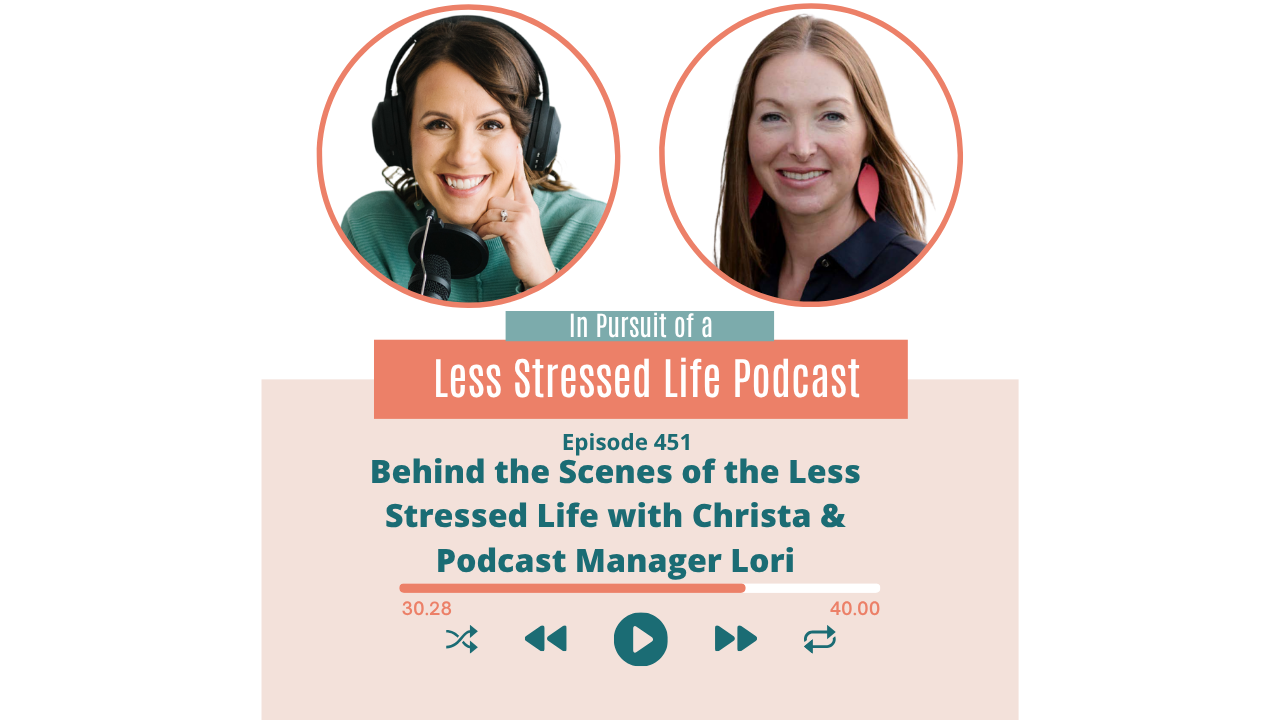
This week’s episode is a behind-the-scenes conversation with my podcast manager, Lori, where we look back on the first quarter of episodes and talk honestly about what stood out, what we liked, what didn’t land as well, and what actually felt useful. We get into some of the bigger topics from the quarter like radon, water filtration, fascia, and detox, share a bit about how we think through guests and episode quality, and wrap up with what’s coming next, including new protocols and where I want to take the podcast this year.
- #439 Stealth Toxins: Testing Radon and Indoor Air Contaminants
- #438 The Link Between Minerals, Emotions & Fatigue
- #445 Fascia, Stress, Trauma and a 50 lb Weight Loss
- #440 You Don’t Know What You Don’t Know: A Guide to Getting Started
- #443 Healing Crisis Part 2: How I Trashed My Hormones
- #446 What My DUTCH Test Revealed (and What I’m Doing About It)
- #448 Everything Water Filtration
- #449 Metal Circulation, Sensitivities, Binder Types, and Histamine
Resources Mentioned:
- Water Testing & Filtration Guide
- Targeted protocols (sinus congestion, blood sugar, and more)
- Collagen Challenge
- Inflammation Guide & Score
- The Clean Water Store is also offering listeners 15% off water testing or whole house systems. Use code LESSSTRESSED15 at checkout and you’ll be automatically entered to win a Portable Stainless Steel Gravity Water Filter with UV Purification (a $230 value).
- Questions or comments for Christa? Submit them here: https://www.christabiegler.com/questions
WHERE TO FIND CHRISTA:
Website: https://www.christabiegler.com/
Instagram: @anti.inflammatory.nutritionist
Podcast Instagram: @lessstressedlife
YouTube: https://www.youtube.com/@lessstressedlife
More Links + Quizzes: https://www.christabiegler.com/links
Protocols: https://www.christabiegler.com/protocolshop
NUTRITION PHILOSOPHY OF LESS STRESSED LIFE:
🍽️ Over restriction is dead
🥑 Whole food is soul food and fed is best
🔄 Sustainable, synergistic nutrition is in (the opposite of whack-a-mole supplementation & supplement graveyards)
🤝 You don’t have to figure it out alone
❤️ Do your best and leave the rest
SPONSOR:
Thank you to Jigsaw Health for being such a great sponsor. 😎 Use code LESSSTRESSED10 anytime for 10% off!
TRANSCRIPT:
[00:00:00] Christa Biegler, RD: I'm your host Krista Bigler, and I'm going to guess we have at least one thing in common that we're both in pursuit of a less stress life. On the show, I'll be interviewing experts and sharing clinical pearls from my years of practice to support high performing health savvy women in pursuit of abundance and a less stressed life.
One of my beliefs is that we always have options for getting the results we want. So let's see what's out there together.
Okay. Today on the Less Stressed Life, we're doing something we have never done before. But I thought it would be fun because this is what it's like when I have friends listening to the show. Usually we don't get to talk about the show, like in retrospect, very often. If I'm ever talking about the show, in retrospect, it's usually with Lori, the other person on this, meeting, and Lori is a little uncertain about this idea because she likes to hang out behind the scenes. And so I'm gonna introduce Lori first, but we're gonna do a little bit of a review on the first quarter, which I think is, it's something we're actually called to do all the time, right? As humans we're called to reflect, what was good and we do this.
And I think probably subconsciously one of the motivations for doing this was. We do this in our quarterly team meeting, we follow a process from Traction. It was funny 'cause I was at a business meeting last week and the guy leading it said, this is not like a fun book. It's like a dry, boring, not let's go to the beach and retraction.
It's like dry and boring and systematized and essentially it's like a process for. Running a business kind of right, where it's what's the plan, what's the mission, what's the values? And when we started implementing pieces of that, I feel like it really changed everything. Like it really improved the overall culture made us enjoy our work more, et cetera.
So every month, one of the things we do with this quarterly meeting is we back up and review the previous quarter before we go forward. And we look at that past month and we ask, we say, what did, what are we grateful for? What are we personally excited about? All those things.
And it just keeps us in better touch. So maybe subconsciously that was part of the instigation for this episode, which is a review of the last quarter. And I guess as we come into this information age, or even as we continue to interview, like recently we had Chris shat on, and it's probably his third time being on the show.
It's there's some good stuff in the past and. What would be a quick summary, like what are actually the favorite episodes and why? And so that's what we wanted to like crack open a little bit. So Lori is our podcast manager here at The Less Dress Life. I think she's been here for three years, but I have no idea.
So I can't wait for Lori to tell us how long she's been here and how she got here. And my goodness, she has grown so much. It's been really fun to see her grow and just to like, for her to take take ownership of everything. Lori. How long have you been here? How did you get here? Just tell us a little bit about you.
[00:03:05] Lori Loomis: Yeah, I think it is going on three years now and it's all a blur, which is hard to believe. And I actually started working for you because I was a previous client many years ago. I think it was like 2018 ish or something like that. So
[00:03:21] Christa Biegler, RD: it's a long time ago.
[00:03:21] Lori Loomis: It is a long time ago.
[00:03:24] Christa Biegler, RD: Yeah. So very funny. And then I don't really remember how it happened,
but I may have referred you to a colleague of mine and then you ended up working. We did a little test trial, but I was not organized enough for whatever I needed you to do whenever that was a million years ago. And so I referred you to a colleague of mine who loved having you work for her forever.
And then a few years ago I was like, I need someone to do this exact thing. And, I think it's been good 'cause we went on a team retreat to Zion a few years ago, like the four of us, and I think everyone learned, like Lori loves doing the repeat tasks every week maybe. I'm not sure if that's right or not.
It's predictable, right? There's some predictability about, I
[00:04:04] Lori Loomis: don't even think I hear that about myself,
[00:04:06] Christa Biegler, RD: Yeah. Yeah. We learn a lot, right? We learn what we don't like. For me. I'm gonna share something that I don't know if everyone knows about me. I don't like being asked the same question over and over.
And maybe that's a flaw, but it's also is what it is. And so I like rearrange my life in order to stop being asked the same, I like a new question or a new conversation, or a different way to look at things. Just how my brain works. So we wanna talk a little bit about some of the highlights of this last quarter.
I want. Q1 to go through April 15th. So that's I just pretended it did when we're going over this highlight reel. And so you and I just went through the episodes, but I'm gonna let you ask me the questions that we need to answer to be in best service to the people listening today and give them the highlights of Q ones episodes.
[00:04:51] Lori Loomis: Yeah. We have a lot of great ones on deck tell me what stood out to you for, there's quite a few episodes, so which ones stood out the best?
[00:05:00] Christa Biegler, RD: Okay, I have a short list. I don't know how many are in a quarter. Pretty easily It's probably 12, right?
Like four ish. Yeah. Usually there's not gonna be five because we usually, we publish on Wednesdays or Thursdays. Yes. And then it takes probably a good 24 or 48 hours for all of that to populate to people's players. So we started doing this a few years ago. I'm just gonna go through the list that I made for myself.
And so we start the year with doing some encore. We started doing that a couple of years ago to lighten the load over the holidays. It's like a busy time for everybody. And so what we do is typically look at the last year, the most popular episodes for the last year, and replay those for three to four weeks.
I think that's good. No one's complained. I think it's nice. It's good. It's let's ref feature this thing that you guys really loved. So one of the ones from that in that first quarter in January was from Don Wood. I saw Don Wood speak a year ago at a conference. So it's actually funny.
It was, must have been pretty darn quick. It was in December of 24 that I saw him speak. And in December or in January of 20. Anyway, am I getting that wrong, Lori? Anyway, I must have spoke. That's what happened. I interviewed him sometime that year and then we replayed it. Anyway. He talked a lot about, his daughter's autoimmune condition and his desires to like really help her. I think she ended up with a couple autoimmune conditions. I don't know that his wife was involved, but essentially he was a therapist that developed a protocol or a process for releasing trauma from the body. Now he does a really good job describing the how this happens and creating some intrigue. The only thing for me is I didn't really leave fully understanding like what some of the process and protocol is, which is okay. Sometimes it's that's your secret sauce or whatever. But , I always wanna know more and I actually, there's a different episode, a long ago episode.
And it was the guy, the emotion code practitioner and so many people, I've never had so many local people be like, oh, I got that book. I got that book, I got that book. It's actually used to be alarming to me when people from my local town say, oh, I listened to this episode. I'm like, oh, I didn't know anyone was listening.
It's funny 'cause it's such a one way street really. And so it's actually fun when someone reaches out just to talk shop about an episode like a old friend or something. But anyway, about that episode, that emotion code one, I was glad that so many people told me they liked it because I remember thinking like, yeah, but I always feel like nothing in the world is new.
It's like some combination or accumulation of someone else's stuff. So for example, it's okay. Anger is stored in the liver, or if you have acne on your chin, like where does that stuff come from? That comes from like ancient Eastern Asian medicine. Your traditional Chinese medicine.
So I sometimes, like when we I guess I like to give credit where credit is due and I was digging for like, where does this come from? Like, where do you learn this stuff? And and I get it, I totally understand that, but. In general, I think he's like a lovely human and a lovely man. And I've had some clients go and do his thing and I had considered buying his program for my dad as well.
But in general, like how do we release traumatic emotions? Is still to be the answer. And sometimes I question like, is there more simplicity to be continued? I'm like, I've been digging into somatics. Quite a bit the last few years. Somatics mean like therapies that are in the body, been doing like this types of coaching with clients for a long time, which I think has been incredible for my stress response.
But anyway, I'll shut up about that. Then there's hope Praza. That one was, she and I did a swap and we ended up being, now this doesn't always happen very often, but. Sometimes we're kindred spirits, like we have, we're very aligned in how we look at things and look at life and support people. And so I think I went on her show first and then I invited her on my show.
But Hope is FDN. It's like a function. It's like a certification. And so we talked about minerals and emotions and fatigue, which I think is good. Anyone, you can get into kind of a nerdy conversation about minerals. It's usually great but pretty nuanced as well. So I just remember she and I just really enjoyed each other overall, so I appreciated her.
Some of my favorites are these next four. We did a radon testing episode. That one was hard to schedule. That one was rescheduled three or four times. By our guest, it was hard to, we didn't know who we wanted to interview around radon. I think I put Lori on the task go find us a radon expert.
And then I can't remember what came of that. Essentially, why were we interested in this? Sometimes it's your personal interest. In fact, you're gonna see two major personal interests. Something I'm trying to circle back to is. How do we account for our environmental toxin load?
And every, I still don't have a perfect water situation, which is, one of the conversations I had with Jerry fin of clean water store everything, water filtration. That was a great episode. We should really rank like whatever the top three.
[00:09:40] Lori Loomis: Yeah,
[00:09:40] Christa Biegler, RD: I think so. They are to come what I'm discussing right now I think the other clinician in the practice and I, Jenna and I we were talking about radon poisoning. 'cause we were wondering if she had gotten radon poisoned. 'cause she had a big health crisis last year and we were trying to detective like what was all happening and where she was living.
60% of the homes there need radon mitigation. And it's a bigger thing if there is a crawl space or a basement, sometimes it's not getting outright, but it's a colorless, odorless gas that's associated with lung cancer years later. But the thing is like if it's causing toxicity now, it's probably causing other, like low grade things.
Now, overall, and I've had over the years, like different things pop up , I've had a couple of people that have, had issues with gas leaks as well. I know that's different, like radon gas and propane gas are very different, but just in general issues with gas leaks and the gas company is supposed to come out and check those things, whatnot.
So it took us a while to find this radon expert, but when you do this mineral test, there is a, in the toxic metals, and again, all of this is part of the earth's crust, so we don't freak out about it. But one of the things that we can see is uranium amounts in the body. And something I've seen historically is if we have a whole family or more than one person in a family doing a test, and one person has high uranium, usually other people do, and typically one thing we say is like Google, whether you have uranium stuff near you, et cetera.
And usually it'll be like really in the soil where they are. But I wish I'd had known years ago that probably means they need to get the radon, like at minimum they probably also need the radon tested in their home. And what else is that creating for them? And here's the thing is like.
I was, when I went, did that episode, I was like, oh, check, check, check. At our short term rental or little cabin. I was like, oh, we are like, five or five on this self scoring system. Like it's in a place where there's mining, it's up against a hill, it's down in a crevice, like all these things.
So I did, I was able to find, I feel like radon testing. Like for all the things that you could have tested. Way more straightforward. You're looking for one thing over samples. I was having a conversation with a construction guy recently and anyway I think mold is tricky. I think water is a little tricky, but radon is like, seems more straightforward.
Maybe I don't know enough, but basically I was checking out like self-testing options. 'cause I talked to Justin and he thought maybe it would be about 500 bucks. To have someone test. So I was checking out self-testing options, but I called someone locally, it was like a hundred dollars and he came and, oh, that's not at all I know.
And he said, if you know you need a mitigation system, we will just put it toward the mitigation system. I was like. Gr you're hi. Like you're hired yesterday, right? It was, I couldn't even buy a device for that. And here's the thing that really surprised. So it was great. It was good overall episode and the bottom line, I was like, on the edge of my seat.
I was pretty prepared for doing this. It's just they, I think they the simplified versions put, some kind of pipe into the ground that allows that gas to essentially evaporate and disperse. So it's not getting in your indoor air quality. But shockingly I didn't need a radon mitigation system.
I was literally dumbfounded, he said, because it was slab concrete, just like a slab. It didn't have crawlspace or basement, so it probably would've been, it was like usually under two, I think it was five days of samples. So I was able to look through all the reports, essentially if it's over four, the EPA, here's the too long didn't listen version right now.
But I did think this was really fun and I did get a couple texts from friends that were thankful for this episode. So anyway, once it's over four, the EPA is like game over. You really need rate on mitigation. If it's between two to four and you're there all the time, you should get it. So I definitely had some that were over too, like quite a few readings over too, but not.
It wasn't, they weren't even high twos. They were mostly under two, so I was shocked, to be honest. Very shocked. But, whatever, I'll just move that money toward water filtration, which was probably, to be honest, that was probably, there was like between Jerry Fin's water filtration episode, the radon testing episode, and ADE's episodes.
Those are probably my favorite, but I don't know. I really liked the Fascia episode as well. Okay. So I'll talk about that one since it's in order. We never know we're getting better, we get a lot of pitches for the podcast and we could teach a class on how to pitch.
I'm sure actually was actually, it's on my list for my business group is don't send pitches like this, but they're ultimately overall getting. Better. Anyway I'll leave it at that. But we never know sometimes if a pitch is gonna be good. One thing, Lori because we've had some not amazing experiences, they sound better on paper than in real life.
We had some of those this quarter as well. One thing Lori does now is she goes and tries to listen to them on another podcast or something to try to make sure that they're good. You don't know how promotional sometimes people are gonna be about certain things. But anyway, that was not really the case with Deanna Hansen.
I enjoyed her. She was from Canada and her story is interesting. I'm sure there's more to it, but basically she was like, I intuitively felt like I should start massaging this area and this is all the things that happened. But essentially she like shined a light on fascia. I do think fascia is gonna be one of those things of the future, meaning like it's always been there.
It's always fascia's one. Leading fascia educator online describes fascia as, it's like you have a pile of straws all taped together and those are the muscle fibers and then the like plastic wrapper around the straw is the fascia. And the conversation is you have to get in there, you have to get in between those fibers 'cause they'll you'll have tension there, et cetera.
So especially if you have like ongoing pain or inflammation issues. And I think this goes back to this premise, I always think of. All symptoms through the health triad as much as possible. But people come to us and they want us to solve, the nutritional chemical or functional medicine, like how we perceive.
It's oh, I have this food problem. It must be related to this gut health or food restriction, whatever. They come thinking. It's just that. But often there's other parts of the health triad, like what's the emotional energetics that at play, as well as what's the structural, physical, and with fascia it's like what is being held in that structural physical.
Part of the body overall. So it's been around, we're humans, right? It's always been there, but, and maybe it's where my attention is a little bit, but I do think that it's an area that we're gonna talk more and more about. I think lymphatics in general have gotten more forefront.
I'd be curious if you have a different opinion about this,
I feel like in general, Q1 was like I was holding on tight 'cause it was a lot of new things personally this year as well. Okay. Fascia. Fascia. I really enjoyed that episode, but it left me like, ultimately I was like, wow, I really need to get into fascia work.
[00:16:07] Lori Loomis: That's
[00:16:07] Christa Biegler, RD: Why,
[00:16:08] Lori Loomis: that's what I felt.
That's what I was left with too.
[00:16:10] Christa Biegler, RD: I was like, this is interesting. You lost 15 pounds. The story's really good. I feel like I still have a lot of opportunity there and in general. I mentioned this earlier, I'm like trying to make the space. I've been working to make the space for this for a long time.
'cause there's a lot of things like I wanna grow in and learn in and that is the beauty of life. I'm excited about them, right? I'm like, I wanna dig into somatics because what happens when you're in this area is you realize wow, we still have so many, like you do these mineral tests and it's like people are depleted because stress.
Is anything that costs nutrients, right? And so it's like you deplete all these nutrients and you need to put 'em back. But then the bottom line is like, Hey, guess what? It's all just stress and like how we're operating in our lives, et cetera. And so I'm pretty interested just in general of like how the body holds tension, et cetera.
And I do think especially fascia work. Is good for anyone who's got refractory bloating, meaning like they really have done effective things for bloating, but it comes back again and again. I think there's multiple things. 'cause I think thyroid can be sluggish as well, but that's not gonna show up on blood work, et cetera.
That shows up on mineral tests. So yeah, tangent about the fascia one. I did generally love that one. I almost forgot about this one. I don't know if someone asked us to do hydrogen water for sure. Like it's a, it's a trendy topic.
I am still interested in hydrogen water. It reminds me it's similar, but not similar kind of. We did a sponsored episode on structured water like a couple of years ago and, the people who were being interviewed, and I totally get this. I can absolutely be this person too. They were having a hard time.
They were so smart. They were having a hard time articulating and relating to the audience. I was more confused at the end of that episode about structured water and somewhat similarly is a little bit how I felt about the hydrogen water. I think that there's a lot of opportunity for even, I wonder if I should just dig into the research around it, right around that.
That one was like left me. Uncertain and curious. Yeah. For more, overall, so that one was unusual, but on the water thing in general, I. I think it took us a while to get to this interview too, so like probably again, my favorite interviews, the radon and the water one, but I think so valid.
So to be honest, I think those are very helpful episodes and the episode we had last month with Jerry from Clean Water Store was something I'd wanted. I've wanted someone to talk about water filtration for a long time. And didn't really feel, and I don't know if we've really done one much with that.
Didn't really feel like we had like good people to do that. And we get asked about it enough from our clients. So eventually we did write up a pretty good, a pretty okay handout, which then I included as part of the show notes for that episode, like our water filtration handout. 'cause it's not straightforward, right?
It's not oh, do you have radon or not radon? It's not like one thing. It's do you have pathogens in the water? Do you have. Too much mineral in the water, right? Where it's causing issues or do you have chemicals overall, right? Those are the big categories. And so you're looking at all of those things and not surprisingly, I think there's like some similar industries like this.
It's interesting, the initial takeaway I got from Jerry was that people didn't necessarily pursue water filtration for health. They were pursuing it for cosmetic reasons or preserving appliances or whatnot overall. And I thought that was just, it is so interesting to talk to someone who's like outside of your industry.
There was some other guy we had similar it was a similar scenario where we like got an guy who worked in industry, I'm trying to remember what it was in very similar type thing. It was like, oh yeah, people aren't even. They're into this for the utility of it or something not related to health, because I look through my like, blinders of health all the time.
Like, why wouldn't we wanna, improve the water because it's 60% of our body. But this in general, I loved this one. I thought what I am, as I'm a big fan of. What do the symptoms tell us about the system? And with water, there's a lot of clues. Water leaves a ton of clues and it's like, what does it mean if it's like rusty looking, what's it mean if it's like blue or black or whatever.
If it's like leaving spots on the door and you might know parts of that or you might know all of it. That's amazing if you do. But there's several things in our lives that we don't really know until we. Choose to learn or are forced to learn about them. I think that with mold stuff all the time, it's like that's just a skill, unfortunately.
And we're not all universally in agreement about it. And it's like with our bodies too. We're not all in universal agreement about it, even though, there is some basic physiology we could just be supporting. But water filtration is something. When you're trying to do everything.
I think so often, like we try to, we look at our health as check check, check. And it's sometimes it's gonna be layers. You're gonna do what you have capacity for at the time and then you're gonna need a break and you're gonna come back to it. And I, I. Only got so far with water personally because, it can be a project, right?
I live in my home. I'll probably live here for a very long time. My husband bought some filtration systems without consulting me once, and then they were not working right, and then we turned them off. And so it's been a whole thing. But it's been really interesting because the last couple of years I've arrived at oh, this hard water, my hair is breaking off from, this hard water.
How much is it relating to hard being like it's full of calcium? How much is it impacting my cellular function and impairing potentially my thyroid? I talk about this a little bit on the episode. I go up on my little poor tangent. How much is that potentially, and that can cause a lot of. Refractory gut stuff, refractory, fungal stuff, et cetera.
It's there's always something there. So that was probably my favorite episode of the quarter was the water filtration one, just because I felt like it was in. And that was my goal. It was in very good service to the listener. It was like, here, can you tell a lot? Can you learn a lot without testing?
And just look at it, which is my thing. And then we also talked about testing as well, so I love that one.
[00:21:44] Lori Loomis: Actually, the testing was really reasonable too.
[00:21:46] Christa Biegler, RD: So reasonable. I haven't done, I gave
[00:21:48] Lori Loomis: you a discount code too. For,
[00:21:50] Christa Biegler, RD: oh, he did? I didn't remember that.
[00:21:51] Lori Loomis: I think it was Lustrous 15 or something.
I'd have to look.
[00:21:54] Christa Biegler, RD: Oh, nice
[00:21:55] Lori Loomis: to put that,
[00:21:55] Christa Biegler, RD: I should totally use that myself. I should totally use that myself. So this is the be beauty of this episode is oh yeah, I didn't even think about that one.
[00:22:03] Lori Loomis: Because then we have to shout out your guide for that one too. Your water filter.
[00:22:07] Christa Biegler, RD: Oh yeah.
I was,
[00:22:08] Lori Loomis: it's also all this stuff will be linked in the show notes for, so
[00:22:12] Christa Biegler, RD: Over half of us are not getting enough magnesium, which is responsible for thousands of processes in the body. But how do you know if you'd benefit from magnesium? What visible signs could you see? Here are some cases where I'd want you to start thinking maybe I should try magnesium for that. Now, let's say you wanna get in some good deep sleep.
Try a high quality magnesium 30 to 60 minutes before bed. If you have any inkling of a headache or even just to relax, any of those premenstrual cramps or muscle tension, especially post-workout, magnesium would be a superstar for filling in those gaps. Now up to 600 milligrams for that headache. If you're finding your heart racing with caffeine or with stress, then for sure magnesium's calming effect could be helpful.
But if you're dealing with eye twitches or restless legs, you're past the point of as needed. These are major red flags that you're probably depleted in magnesium. The good news is you could absolutely fix it, but it might take a few years to really fully replete those magnesium stores. But here's the deal.
Don't stop when the symptoms stop. Just keep going to replete it even further in any of these cases. I love jigsaw's mag, SRT because it allows you to take a higher, more effective dose without any laxative effects because it's got an eight hour time release. That's what the SRT stands for. It stands for sustained release technology.
It's the only time release magnesium with a human trial on the market that we know of. This is helpful to get all the benefits of magnesium throughout the day or throughout the night depending on your need. You could take it at both times if you want. And it's Meg Sr T's 20th birthday this year. So you can celebrate by getting yourself some Meg, SRT with the discount code, less stressed, [email protected].
You can use less stress 10 to get a discount on anything you want, as many orders as you [email protected], including my favorite potassium cocktail and cod liver oil. So go check them out and we just appreciate them sponsoring the podcast so much. So when you support them, it supports us.
[00:24:19] Christa Biegler, RD: I appreciate when Lori remembers things that I don't remember. And when he was talking I was like I have a lot of some of this in a guide or a lot of it in a guide. And so I hope that is helpful to people. It was the one we made, we drafted for clients to help them.
And again, we're all looking for the easy button. I know like it's complicated, but what's the one filter I should use? And I feel like Jerry and I did an okay job of going over that. It's how long are you gonna live there? The shower filter is probably not gonna do as much as we want it to.
If nothing else, probably do an under sink filter at minimum. And I know where we all are, but the thing the good news is like the under sink filters for drinking water are very reasonable. They're a couple hundred bucks, so that's a really good thing. And that's something.
And then there's just some things that are hard to filter. And that was what part of what I wanted to interview Jerry, because, we got a lot of iron. Iron and calcium are really hard things to filter. And so those were my concerns or issues overall. And so leaves me, a little bit with a husband discussion regardless of
We might have to do this thing.
So yeah, I loved that episode, but it's a good, like when you feel like you have the right capacity and the beautiful thing is like that will always be there for you if you're like, I cannot do one more thing or maybe. I just need to do the $200 thing and I can take it with me when I move to the next place or whatever like.
Whatever you need to do. Hopefully that episode is really helpful to you. And then the last one, this one was not technically in Q1, but we had crochet come back and crochet. I think he started Quicksilver Scientific. They're, I have a handful of supplement companies that do novel things that kind of they were doing something really creative, interesting novel in the industry.
Very small handful of them. And I think Quicksilver was one of those. We've had him on twice. I think we talked about liposomal or nano particulate delivery systems, which is extremely nerdy. And I can't remember the other topic, which is pretty much where I arrived when I was talking to him before.
I should have had you grab that one. But it was good because I was able to talk to him. That was a lot of what we were discussing was like binders and the importance of binders and the difference of binders. And if you don't know, you don't know how valuable the conversation is, but at the same time, like if you've ever had toxic burden of any type, which makes you feel like.
Crap or is the source of a lot of symptoms in general. And the other thing we did talk about was like there's just not great testing again, there's not an easy pill for the type of testing for toxin testing, right? It's not oh, let me go test my toxins, or Lemme go test my liver or something.
It's like there's not really good testing for this, right? Like you can go get a liver enzyme for a few bucks, right? But it's like really usually only gonna be off when things are messy. It's just, it is another, I thought I wanted to include it in this roundup. 'cause who knows when we do the roundup again.
But that one, especially since it was pretty recent, that one was pretty, pretty solid. And I had to chase him around. He didn't show up the first time either. And I like to tease his assistant about it. He's pretty easy to cheese. Yeah. So that's Q1. That's Q1. Overall, those are my favorite ones.
And why? Why they were my favorites.
[00:27:12] Lori Loomis: And you're a little reluctant to talk about, you had three solo episodes that I thought were fantastic.
[00:27:20] Christa Biegler, RD: Oh, I'm glad you saw that.
[00:27:22] Lori Loomis: What, you don't know what you don't know. That seems like a mouthful, but it's true. So can you kind tell us about that episode a
[00:27:30] Christa Biegler, RD: little?
I don't really remember what all was in that episode, but the main point of it was that. No matter what your question is, you have to start with assessment. And so I can't remember what stories I used or what I talked about for sure, because it was a while ago
[00:27:45] Lori Loomis: about your son and physical therapy.
[00:27:47] Christa Biegler, RD: Oh, thanks for the reminder. I remember that now. Okay. That's what it was. Yeah. It was like , my friend who's a physical therapist, saw my son's back and I had thought eh. Looks something and she sat and she's he needs six weeks of physical therapy immediately. Like he has kyphosis and it's worsened because of injury.
Like he had an accident and it can be worsened. And she had a whole reason of like, why that happens, but you don't know what you don't like. I didn't know what I was looking for. And so sometimes we can be blind by, of course. We are completely blind by the filters over the masks of our eyes, the bales of our eyes, of course, or whatever lens we're looking through.
And so what happened is like she looked at him and knew what was wrong, right? And so we can do that with other people and we can do that on our own. And so the bottom line the answer to where do you start for everything is assessment. It's assessment for sure. And i'd been talking about this for years.
Whenever I'd go on other podcasts, people say what's one thing you can do today? I'm like you can download this thing you can find on the internet. But what we did was we took our version of that it's basically like a comprehensive symptom scoring guide and where it like allows you to calculate inflammation score.
And the fun part about that is that it is very. Normal and typical to be able to reduce that. Like it doesn't matter what the score is. On average, our clients score anywhere from 30 to 180, the score is neutral. It doesn't really matter. Just hey, you can cut that in half in a few months if you start supporting your body in the right order for you, in the right systems, which is the bottom line of like our current work, like how we're working with people, because I don't wanna play whack-a-mole with things, right?
And so how you avoid playing whack-a-mole is why don't we just restore function to the body? That'll resolve a lot of symptoms and that's what happens. And then from there, why don't you resolve a hundred percent? 'cause we're layered, and sometimes we need to go about it from one of the other angles of the triad.
There's more to it. Like maybe we have something, maybe we were dealing with some tension in an area, right? And so to get to where we need to go, we get to dig in a little bit deeper. It's you don't learn all your lessons in a few months. You learn them over time. So I thanks for that.
But yeah, that actually is probably hopefully someone got some support outta that one too. And then healing crisis, how I trash my own one. So I dunno when the first healing crisis one was. We should do a roundup. We have one cool tip is that at krista bigler.com/podcast.
There is, if you just scroll down a little bit. There's links to specialty playlists like skin health for parents like a nerd playlist. And those have to be manual updated. So I'm not sure the last time Jenna updated them overall, but in general, there's a lot, there's gonna be some good stuff there. If you need a specific topic, if you need to know about like certain kinds of toxins, like we got the list where they're all categorized all for you already. And so we should probably make one on healing crisis stories or something. 'Cause the first healing crisis was skin stuff and gut stuff. And this one was how I trash my hormones through intermittent fasting accidentally, as we do when we are skipping meals. I don't know if you ever had any experience with it. I don't remember that. You came
[00:30:42] Lori Loomis: on. I think that's when I actually became your client.
Because you were working with a bunch of nutritionists.
[00:30:48] Christa Biegler, RD: Oh, that was the time
[00:30:55] Lori Loomis: the famous in,
[00:30:57] Christa Biegler, RD: yeah. I didn't, yeah, I didn't realize that was the same time. You're totally right. It was exactly the same time. Wta, it's a blur.
[00:31:04] Lori Loomis: I know.
[00:31:10] Christa Biegler, RD: Blur, but also fine. It's a beautiful life. It's oh, that was cool.
Lots of lessons there, and that's all good as well. And on that note, the last one was what my Dutch test revealed, which is like a one way to look at hormone function, a good way to look at hormone function. And I know it was a little meandering, so I apologize. It's hard to, it's like how do you frame this in a way that is supportive to the person listening to it?
So I did a screen share. I put my results in a document so you could access them. And I was telling Lori before we hit record, I was like, it might have been a little meandering. I hope it was helpful and. How am I gonna get better at doing solo episodes if I don't just do 'em? Sometimes I just hit record and I hope for the best and I hope that they are received okay.
For the person who needs to get them.
[00:31:52] Lori Loomis: It's nice about that one is if you have had a Dutch test link that in the show notes so you can go in and follow along with Krista as she's going through that episode. Yeah. And actually look at the result, her results.
[00:32:04] Christa Biegler, RD: Yeah. And I think.
I guess worst case scenario is if you wanted to do that kind of test or if you ever thought you wanted to do it, you can understand, you get like a real picture of what that looks like. Like I'm not holding anything back there. I'm trying to be as transparent and as clear as I can be, but it's pretty meaty.
There's a lot to it. So like I usually say you can't really get through that test in one appointment and there's multiple tests like that, but you could go through it a few times and get different input. That said. Literally what's going on that month and the day you took the test could skew it as well.
So we always have to take it like over a coin flip. It's not end all, be all. I always say we wanna line up a test with our symptoms. And there's a lot to say about that because you, was talking about this morning and I was interviewed on a different show and.
One of the reasons I didn't do Dutch tests as much anymore, is like they take a long time to collect. Like you have to do time, your menstrual cycle, unless you're post-menopausal, which at that point you're really only looking for estrogen metabolism. 'Cause you expect the other hormones to be down to what you're looking for is like how you can detox and drainage, which you can still learn a lot of that from just symptoms.
And it's a great test, but you have to time it if you don't time it, and I said this in the episode, mine sat on the shelf forever and then I didn't get it sent in time and then I got rejected and I got to do it all over again. And then the other thing is, if you have any for example, any belly fat or sluggish liver or whatever, it'll like, it'll skew the way we look at the cortisol or the metabolize or long-term cortisol.
And so I don't think there's anything worse. Then having someone who's clearly depleted in front of you and then their cortisol stuff looks okay, that's not helpful, let's go ahead and treat those symptoms instead. So again, no shade. Dutches is one of the best companies testing companies out there. They truly are.
They do great work and there's lots of great indications on why you'd wanna do that. But with everything, there's some pros and cons, and I think one of the fallacies in our industry is like, people believe that tests are the answer to all of their problems. And it's yes. The answer to your problems is understanding your body better and exactly the messages it's trying to tell you.
That I have arrived at through the school of hard knocks and working with people for a long time and not wanting to whack-a-mole. And it's and so that's like the whole crux of our work now is let's restore function and then we'll resolve symptoms. And
[00:34:12] Lori Loomis: save a little money just by going on symptoms
[00:34:15] Christa Biegler, RD: and stuff.
It been fun. It's like our appliance have appreciated it, right? Yes. It's yeah, totally. We can order whatever you want. It just comes at an expense, so it's and if you'd like to just jump in and get results, like the track record is great. So this is like very, against the grain. This is very against the grain for the industry. It's, to be honest, it is a little crazy. And I'm here for being the rebel. It's totally fine with me to be the rebel. Very normal for me to be the rebel. I like to question things, but the reality is like when we started doing this about a year and a half ago we're like this work, I think it could work.
And like we track the results really diligently and it works great. The average is, the same. It's like you get the same results. With that. And again, there's times and places for tests. And so we try to, I always tell people I do informed consent. I wanna help you steward your resources well, your time and your money and energy.
And so I don't wanna just go blindly order stuff because it's not that exciting unless the results are really dramatic. Yeah. Good. Laurie, man, we talked about a ton. But there's a lot there. So we should start to wrap it, let's talk about what's coming up and what's in the future for us , I
[00:35:20] Lori Loomis: think the only thing we missed that we should shout out is you released a bunch of protocols.
[00:35:27] Christa Biegler, RD: Oh,
[00:35:27] Lori Loomis: one or two.
[00:35:28] Christa Biegler, RD: Yeah something. What I'm working on, what's going on in my life right now is I'm attempting to give myself permission to do the things that I've wanted to do for a long time, but haven't had any time and space to do. And so the goal with the protocols, and I was working on them in Q1 and I got four or five out.
I think four. Now one of 'em I haven't promoted at all. Just 'cause I sometimes it's like you can't be focused on too many things at once, otherwise other things are breaking down. So I got about four done and I was like thrilled to have something like that you could buy for $7 to solve a problem.
Like the goal was like a micro solution. So there's all kinds of little things that show up all the time. It's okay, we could share what we've learned for that or that. Now will AI overtake us at some point? Maybe. But maybe not. I don't really worry. About that.
When I consider anything with ai it's a how can we, is there any opportunity to help someone get a result faster? We don't use AI with any of our clinical stuff. We don't use it to replace any brain. I feel very lucky that, like my clinical brain was very, developed before the time of ai.
So I don't ever think oh, wow, AI's gonna do a better job than me interpreting tests. And that thought never crosses my mind. But I'm sure it can do an okay job with lots of things. So whatever. Anyway, but with the advent of it, and it's not going away, the goal would be like, how do we use it to help us help people?
But anyway, it may overtake me at some point with this, but for now I think it'd be really. I have a long list of micro solutions or micro protocols that I wanna put out that are just meant to be helpful. It's I have this problem, here is the solution and here's what to do if that doesn't work.
And if someone buys one of those for five bucks, seven bucks, 17 bucks, then you know. I can go back through and update those as I'm prioritizing those and you get lifetime access to those. And so I'm excited to develop those more. And if you have specific requests or you have and so just think about something that annoys you.
So if you have something that annoys you, I'd love for you to submit it to us. 'Cause I don't really know how others are gonna land until I launch them. And it was funny, like the sinus congestion one, went way crazier than, how to not be sick, or how to like, and maybe it was our name, right?
It's 'cause it's like, how do people perceive that name? I was like, Hey, do you wanna not get sick as much? People are like, no, I just want, don't wanna have sinus congestion. That's what they voted for with their $5, with their $7. And then we did a blood sugar one. That one I don't even, that one was from stuff that came from client work.
I actually pulled back on. A lot of my clients and past clients don't even know some of the stuff that's in that because I was always so afraid that clients would lose their, not be hungry. 'cause we have so many people that like undereat. Anyway,
[00:37:58] Lori Loomis: yes,
[00:37:58] Christa Biegler, RD: this is very relevant conversation with the advent of certain medications.
But I need to revise, I'm revising the name of that one too. It's stop sugar cravings in under 30 days for under $30. So that end part, the 30 days, $30 is an addendum. And then the one that I haven't promoted at all is the dry scalp protocol. And then I'm gonna do one on dry skin. Very next and then we'll see what you guys want.
Maybe fertility. I think there's a lot of opportunities there. It's like sometimes it's like I got all this stuff in here that we've learned and could I share it with somebody and could it make their life better? That is the phase, that's the decade I'm moving into, right? That's the decade I'm moving into in life.
So that is. Past, present, and future, right? Those are the protocols. Last week I announced collagen challenge. I haven't done any kind of challenge group accountability group in 10 plus years. So we shall see if anyone joins. I would like to do, about 20 grams of collagen per day for a month.
And just see what happens and run this experiment. And I've been meaning to do it on my own and I'm not getting it done. So I thought maybe if I invited people to do it with me, we would get it done together and maybe it would be more fun. So we'll see if anyone does anything. I know that like when you're listening to podcasts, you're not really in a place where you're like, I'm gonna type that into my phone and fill out a form real quick.
And we learned that when we did the St. Patrick's Day giveaway, we gave away lots of good stuff. And I thought we would have more entrance. We had enough like we doubled our entrance in a few days by just. Posting a few times. And so it was like, oh, where are all the people? Where are all these people listening, not entering for free things.
So we'll see if people like the collagen challenge. I'm just here to have a good time. And then we're looking back and looking forward a lot. I think we have a lot of we're 400 some episodes in. Which is amazing, and as we hit this information age, I wanna make sure, I wanna be as intentional as possible around this space.
I see a lot of people, this is not really affecting me. I'm just like, oh, interesting. There are some podcasters that I have loved that I've gone on their shows, that have been on my shows, and they are. Quitting or they're taking a break. Yes. And we're not planning to do that at all. In fact, if anything I just feel like I'm bringing more intentionality for the future.
That's my goal is to bring more intentionality, which I can do as I create some space. So we'll see how we do. But we are looking at with this great repository of what we have over these 400 episodes, are, is it time for some of those people to come back? What landed well, like what would be really supportive going forward?
That's not, it was like, there was good stuff there. Could we talk? And that was part of even just having this conversation first. It's what would the CliffNotes look like? I dunno if it was really CliffNotes, but hopefully, and hopefully it helped you understand. I love behind the scenes stuff, so I hope that you getting to see behind the scenes or hearing from Lori who is like the girl behind the show notes.
Every week she makes everything happen. Because no one is doing anything by themselves, just to be clear. So when you're trying to do everything to this listener we cannot, it is impossible to do everything by ourselves. And I was just having that conversation in our team meeting today. I was like, I am past the point of wanting to take care of everyone by myself.
Please help me. Thank you very much.
[00:41:01] Lori Loomis: Yeah, that's,
[00:41:02] Christa Biegler, RD: And it makes it more fun all the way around. So yeah, that's part of it. And then, like I said. This semester I was homeschooling, which is hilarious because in 2020 I was like begging to hire a tutor. And this semester I like wanted to take this intentional time.
It was expectedly hard. It was expectedly very crazy. I felt like I was like holding on for dear life sometimes, but on the same note, I feel amazing this week 'cause I was at a business conference retreat last week and I got my recalibrated and so I'm just like very excited about.
Everything we're doing next so you can let us know if you liked this. So we actually have a form. We used to have a little voice memo button on the website, but I don't know if it still is there, if it works anymore,
[00:41:43] Lori Loomis: I think it's still there.
[00:41:44] Christa Biegler, RD: Oh, okay. Cool. So if you go to krista bigler.com/podcast, there's like a voice memo widget, but people don't really think of that one.
Every once in a while, if we promote it, people will go in and fill out the questions thing. So you're so welcome to do that. Let us know. Or like worst case scenario, when you get the podcast roundup for the week, like every Sunday or Monday, Lori sends out the weekly newsletter with what's going on in the podcast.
You can always reply to that and let us know. I think we don't have to be complicated. Feel free to reply to that and let us know what you want for protocols or future topics, et cetera. So that's what's going on here,
[00:42:14] Lori Loomis: listeners.
[00:42:15] Christa Biegler, RD: Yeah. Do
[00:42:15] Lori Loomis: you wanna see anybody come back?
[00:42:18] Christa Biegler, RD: For sure. So we'll be planning that out.
Okay. Thank you so much for kind of sorta interviewing me, rounding this up, Lori. I appreciate it and I hope that the listener appreciated seeing the behind the scenes.
[00:42:29] Lori Loomis: Yeah, for sure.
Do you need a detox?
Getting "too old" to handle alcohol?
Sensitive to smells or metals?
Skin issues?
Detox isn't just juice cleanses & snake oils. It's a process that our body is trying to do all day long.
Take the quiz to find out if it's time for a detox.


