
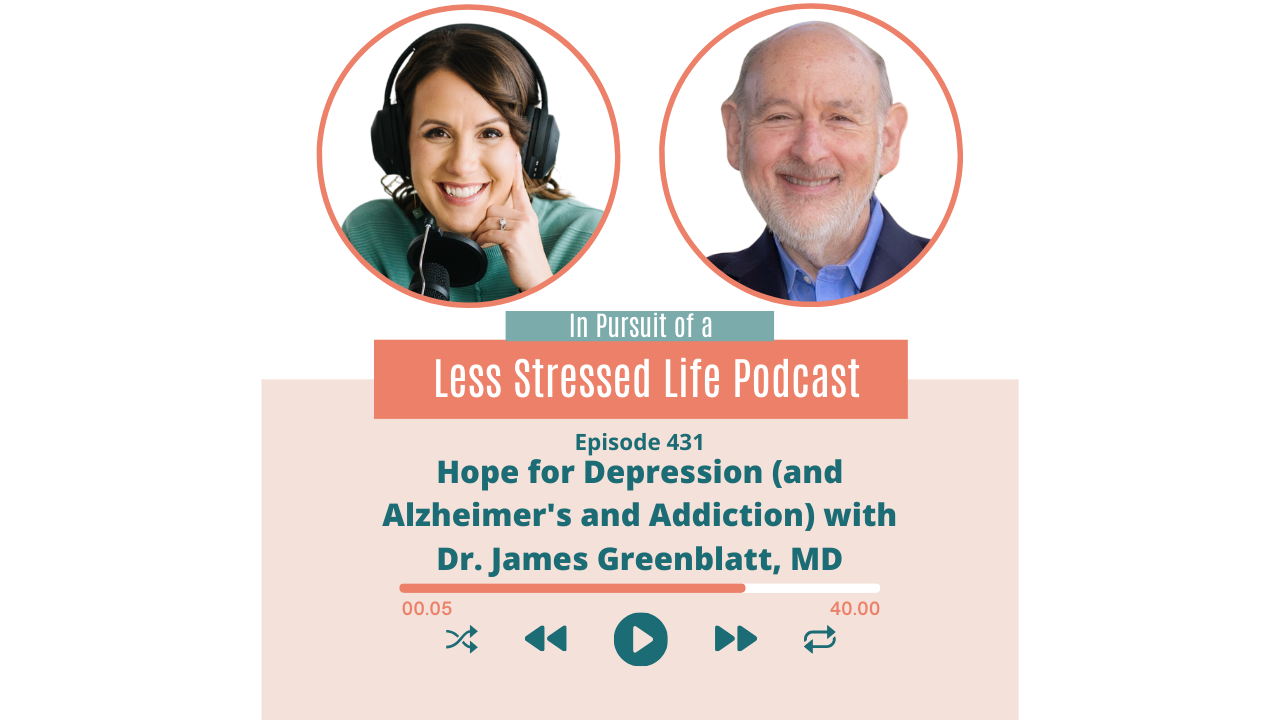
Hope for Depression (and Alzheimer's and Addiction) with Dr. James Greenblatt, MD
🚨🚨🚨Watch Christa's free training here: christabiegler.com/blueprint
This week, Dr. James Greenblatt returns to talk about the root causes of depression that often get missed. We dig into why many people still struggle despite medication and therapy, the surprising importance of amino acids for neurotransmitters, and how stress and low stomach acid quietly disrupt protein and nutrient absorption.
We also cover key deficiencies linked to depression, including zinc, B12, folate, magnesium, vitamin D, and omega threes, and why “normal” lab ranges are not always helpful. Dr. Greenblatt explains why very low cholesterol can increase depression risk, and we explore new research on nutritional lithium and its potential for mood, cognition, and long-term brain health.
You can now preorder Dr. Greenblatt’s upcoming book, Finally Hopeful, which releases January 13, 2026. It offers a whole-body, personalized roadmap for understanding and treating depression.
Check out Dr. Greenblatt's other episode on the LSL: #400 Malnourished Mind: Nutrient Deficiencies In Mental Health & Anorexia
KEY TAKEAWAYS:
• Amino acids are foundational for neurotransmitters
• Zinc, B12, folate, magnesium and vitamin D strongly influence mood
• Stress and low stomach acid impair nutrient absorption
• Very low cholesterol increases depression risk
• Nutritional lithium shows promise for mood and brain health
Find Dr. Greenblatt’s free webinars here: https://www.psychiatryredefined.org/webinars-in-functional-medicine/
ABOUT GUEST:
James M. Greenblatt, MD, is a board-certified child and adult psychiatrist and a leading voice in functional and integrative psychiatry. In practice since 1988, he has authored seven books, including Finally Focused and the upcoming Finally Hopeful, and lectures internationally on nutritional approaches to mental health. He is the founder of Psychiatry Redefined and a member of the Orthomolecular Hall of Fame.
WHERE TO FIND:
Websites: https://www.jamesgreenblattmd.com/ & https://www.psychiatryredefined.org/
Instagram: https://www.instagram.com/psychiatry_redefined
WHERE TO FIND CHRISTA:
Website: https://www.christabiegler.com/
Instagram: @anti.inflammatory.nutritionist
Podcast Instagram: @lessstressedlife
YouTube: https://www.youtube.com/@lessstressedlife
More Links + Quizzes: https://www.christabiegler.com/links
SPONSOR:
Thank you to Jigsaw Health for being such a great sponsor. 😎 Use code LESSSTRESSED10 anytime for 10% off!
📢📢📢I released a free training that shares the 4 steps I use to help clients reduce eczema, inflammation, and food-reaction symptoms by 50%+ in a few months — without restriction or overwhelm. The feedback has been incredible, and I answer every question inside the training.🙌🏻 Watch here: christabiegler.com/blueprint
TRANSCRIPT:
[00:00:00] Dr. James Greenblatt: too much zinc and people trying to treat their prostate or treat their kid with autism and they come in with copper deficiency.
So high dose zinc over a period of time will deplete copper. Copper deficiency, results in depression, fatigue, lack of motivation, and it's not uncommon.
[00:00:19] Christa Biegler, RD: I'm your host Christa Biegler, and I'm going to guess we have at least one thing in common that we're both in pursuit of a less stressed life. On the show, I'll be interviewing experts and sharing clinical pearls from my years of practice to support high performing health savvy women in pursuit of abundance and a less stressed life.
One of my beliefs is that we always have options for getting the results we want. So let's see what's out there together.
Today on the Less Stressed life I have back Dr. James Greenblatt, who has treated patients since 1988 and is a pioneer in the field of functional and integrative medicine and is board certified as a child and adult psychiatrist. After receiving his medical degree and completing his psychiatry residency at George Washington University, Dr.
Green Black completed a fellowship in Child and Adolescent psychiatry at John Hopkins Medical School. He's lectured internationally on the scientific evidence for nutritional interventions in psychiatry and mental illness, and is the author of seven books, including Answers to Anorexia, finally focused the Breakthrough Natural Treatment Plan for A DHD.
The functional and integrative medicine for antidepressant withdrawal. And he's also the author of the upcoming book, which we'll talk about today. Finally, hopeful, the personalized Whole Body Plan to Find and Fix the Root Causes of Your Depression. He was inducted into the Orthomolecular Hall of Fame in 2017 and is the founder of Psychiatry redefined and education platform dedicated to the transformation of psychiatry, which offers online courses, educational lab, webinars and fellowships for professionals.
He was on the podcast back in April on episode 400 Nutrients and Mental Health, and we had such a great conversation. I said, how are we going to preserve your legacy Dr. Greenblatt? So I appreciate at the end of the bio there, there's lots of options. So welcome back to talk about depression today.
[00:02:38] Dr. James Greenblatt: Thank you Christa. It's always good to be with you.
[00:02:41] Christa Biegler, RD: Yeah. Okay. So let's talk about, I wanna just set the stage on depression. I wanna understand why this was the next book that was needed. What patterns were you seeing in practice? How prevalent is depression, if you need to comment on the severity of depression and how it's maybe different than a low day, things like that.
I'm just curious about the overall profile of depression, because when I think of depression, I think of other comorbidities or other diagnoses that go with it, like fibromyalgia, et cetera. And so I think about when I hear the word depression, sometimes it like creates this whole balloon in my brain.
So I wanna hear a little bit from your perspective, why this was the seventh book that you wrote.
[00:03:22] Dr. James Greenblatt: I think if we just take a step back and take a global perspective for a minute, depression. Is in a couple years we'll be the number one global disability of all health conditions, close to, I think it's 300 million individuals, but there's actually rating scales for disability.
So when I say the number one global disability, they're including cancer, arthritis, kidney disease, diabetes, every other disorder. And the functional impairment in one's life, depression wins.
It is just a malignant illness that is, is growing and the why now is there's research to support everything that I've been trying to save for 30 plus years.
Looking at a nutritional, biochemical approach, whether we call it root cause or just understanding why people don't get better with traditional models. So with the current epidemic, the limited treatment options that we have, just meds and therapy, I just felt it was really important that we offered patients an alternative.
But more importantly, I love my title, hope.
[00:04:46] Christa Biegler, RD: Yeah, for sure. I wanna hear about you wanted to share a little bit about the functional model versus the model that you have, but can you first talk about what are some of the dietary or the metabolic, or the genetic or the environmental risk factors for depression?
Like, why are people essentially getting depression in the first place?
[00:05:08] Dr. James Greenblatt: I wish there was a simple answer. And the answer would be, a six hour discussion on so many aspects of our environment and diet just encompasses a huge range of. Whether it's ultra processed foods we know now, when I first started talking about this, I didn't have research to say ultra processed foods contribute to depression and suicide.
But now we have stunning global research supporting it. So diet, we have lifestyle, sleep deprivation contributes to depression, multiple mechanisms. We have sedentary life. We have infections, we have nutritional deficiencies, we have stress and trauma. The list is really endless. And I think that's the reason we wanted to write the book, is to least provide a framework of knowing where to begin.
Because too often in our psychiatric world, we just say you're depressed and you'll get a medicine for depression. With no concept of looking at underlying causes.
[00:06:13] Christa Biegler, RD: Yeah. All right. So let's talk about the model that you have. So let's talk about how your model differs from our traditional functional medicine model for depression.
[00:06:24] Dr. James Greenblatt: Sure. It's essentially a functional medicine model, would can call it functional psychiatry and rather than treating symptoms. So you're sad. And in my traditional psychiatry community, we give you an antis sad pill, an antidepressant, nobody looks at underlying cause. So the model just says, why might somebody be sad or depressed?
And that's where objective testing. And it's the same model that we use in every other aspect of medication. If you walk into the emergency room with a severe headache, they don't just give you a headache. Pill, they're gonna make sure they're gonna tell you the difference. Is it a brain tumor? Is it an aneurysm?
Is it a stress headache? Is it an infection? So after objective testing, our medical model is treating what you find in psychiatry. There's no objective testing. It is just, this symptomatic based care. So it's a long list of looking at hormones and nutrients and what's happening in the gut and what's happening in your life to say these are factors that might be contributing or preventing you from recovering quickly from your depression.
[00:07:47] Christa Biegler, RD: Yeah. Okay. So let's talk about the nutrients and then some of the testing and maybe we'll dance a little bit between them. So one of the first chapters in your book I noticed is about amino acids. And I absolutely agree this is important. Amino acids are phase two detox.
They help with repairing cells, right? But there are these spark plugs of neurotransmitters, but testing amino acids is a little bit uncommon, which is why, and this is like the question I may ask you with every nutrient, is that if you go to any practitioner and ask about testing amino acids, I would argue that most people don't digest protein very well in the first place.
And can you talk to us about the importance of amino acids and then can you talk to us about the accessibility of testing around them for depression?
[00:08:35] Dr. James Greenblatt: Sure. I remember exactly. And where I was, it was 1994. I remember the office, 'cause I checked the wrong box in the testing and I got an amino acid profile, plasma amino acid.
And at the time it didn't make any sense 'cause I just thought if you ate steak, for dinner you were gonna have high levels and if you ate salad you would've low levels. And so it, since 94 I started doing amino acid testing, was part of a bundle of tests that I did on every patient. And it was truly amazing to me that a fasting amino acid test.
Was not predictive of what you ate the day before or the night before. It was predictive, as you just said, how you digest and absorb protein. So a lot of my career has been with eating disorder patients, anorexia patients. So I know people that restrict their diets for months, if not years, can have normal levels of amino acids.
And I have carnivores who have low levels. But so testing just offered me this very significant tool to share with someone that dietary intake is not always sufficient and you're spending all this money on organic meats and fish flown in from Alaska, but you have low levels of essential amino acids so you're not digesting and breaking down this protein.
So we would offer them digestive enzymes, hydrochloric acid. Amino acids, freeform amino acids. And that is the one of the most effective tools I use in the treatment of depression. Unheard of in the traditional psychiatry world and not as well known in our integrative and functional world.
[00:10:32] Christa Biegler, RD: Yeah. I would love to know if you had to dose amino acids individually or if you did them comprehensively and saw changes.
[00:10:43] Dr. James Greenblatt: Great question. So I use a free form amino acid powder that has all the essential amino acids. There were periods where a lot of 'em took out trytophan. You wanna make sure trytophan.
So these are low doses and ratios of, like eggs. And it's a powder. There's no digestion. It's easily absorbed. And that's the foundation. And that's usually twice a day before meals. And then I might use isolated amino acids as precursor to some of the neurotransmitters. And that might be pheno, alanine, tyrosine or tryptophan.
But the core foundation is to make sure all the essential amino acids are normalized. And that would be with a free form amino acid supplement.
[00:11:31] Christa Biegler, RD: Yeah. I just wanna share, you're talking about treating depression. I work with a lot of skin and other types of issues and food sensitivities. And I also find, starting with amino acids gives great results for different reasons.
They are building blocks of so much. So I think that success always leaves clues. And so I wanted to share that is, it's funny and coincident. It's not really coincidental, it's just physiology, right? That we both find amino acid's incredibly helpful and. I wanted to mention or see if you have feelings about this.
Something I have noticed in many anecdotal stories, we've had people come on the show and talk about this. People will go on a low, essentially they'll go on a vegan diet or low protein diet, and it'll be fine for a while and three years later they will end up in a mental health spiral. And I always think it's related to amino acids.
Have you seen this as well?
[00:12:29] Dr. James Greenblatt: Yeah, sadly too often in the eating sort of world that I spent most of my career in. And then as I started looking at the research I know it's hard for a lot of vegans and vegetarians to hear, but we have documented research from many different countries that a vegan vegetarian diet is a high risk for depression.
And I've just seen it. And it's not just the amino acids. I think that's part of it. But it's also zinc and B12 deficiency that often tags along with a vegan diet. And I've done enough testing over many years and thousands of patients that not every vegetarian is deficient in zinc or B12 or amino acids, but some are and you don't know unless you test.
And as you said, it's too common that people feel great simplifying their diet, eating healthier food, but at some point those vulnerable can end up with mental health challenges like depression and anxiety.
[00:13:33] Christa Biegler, RD: When you are finding these deficiencies related to amino acids or low zinc or B12, I always think that like you already said, that these are really issues around digestion.
So do you ever do anything or encourage clients to support digestion at that point as well? So that they're actually gonna benefit from their meats and their fish from Alaska.
[00:13:54] Dr. James Greenblatt: Absolutely. Part of that intervention with low levels is digestive enzymes with hydrochloric acid. So I just gave a two hour presentation on geriatric depression and the entire two hours was based on low zinc, low hydrochloric acid interfering with amino acid absorption.
Yeah. So yes digestive enzymes decrease as we age. Acid decreases as we age or other conditions. So it's very important part of the puzzle
[00:14:25] Christa Biegler, RD: and every time you're stressed. So I think it's gonna be an ongoing thing for people to reassess and to support no matter what. So I'm just popping that in there because we talk about this with older people, is that B12 deficiencies increase as we age, but I don't know if they increase or if we just never replete or I think you said.
Some, acid levels decline. Maybe you know more about the science behind it.
[00:14:50] Dr. James Greenblatt: They simply decline. We know that it's pretty dramatic and it's not the elderly, the numbers are staggering. They start decreasing at around age 40 and they just keep going down. I think some of that is a zinc deficiency.
You mentioned stress. Can I just go back to that for please? Anytime. 'cause we think of stress and we get in this sympathetic overdrive and we turn off our digestive system so we can run away from the danger. What I have found, many of the patients similar to what we're talking about, low levels of amino acids, their stress or even trauma were years before their presenting for treatment. They're actually doing quite well now. And so I'm quite convinced that chronic stress. And even trauma years before an episode kind of turns out the digestive system in a way that never gets turned on in the same path. So we see a lot of individuals where they're not currently under stress, but they had stress in the past.
And it's the same thing. Poor digestion, low levels of amino acids.
[00:16:00] Christa Biegler, RD: Yeah, no, I would agree with you completely. We know that's the case in autoimmunity as well, but I think the farther, I think many of us are landing at that exact same thing. And when I started working on gut health work, 10 years ago I was unprepared with the level of mental health challenges that came along with it.
Whereas, I don't know if you had your own revelations similar to that, but I thought I was just helping people with gut issues. In fact, there was tons of other issues as well. Lots of anxiety, lots of depression, et cetera. Just, I'm picking up this book because I saw something online yesterday talking about animals releasing trauma with all these somatic movements except for zoo animals and humans.
And so it made me pick up Peter Levine's book about waking the tiger off of my shelf to browse through it, because I love to collect books, but not to fully read them all the time. So as you bring that up, yes, I absolutely agree. Let's talk a little bit more about some of these other deficiencies.
Zinc, B12 B vitamins, magnesium. How are all of these nutrients intertwined with depression?
[00:17:07] Dr. James Greenblatt: They all have a life of their own and related to depression, and again, 20, 30 years ago when I started. It was just a group of clinicians seeing low levels of zinc and magnesium associated with depression.
But there are articles that have come out in the last couple months, academic research articles demonstrating this clear relationship between nutritional deficiencies and depression. So we know zinc deficiency associated with depression, poor response to medications, and higher relapse rate. We know magnesium associated with depression, vitamin D, low levels associated with depression and suicide risk. Quite dramatic. And then folate, again, not only low levels associated with depression, but low levels associated with increasing suicide risk. So I could keep going, but what has been, some kind of solidifying for us as a community of clinicians.
Is now we can't our colleagues can't say we don't have the research. 'Cause the argument years ago is absolutely research looking at nutritional deficiencies associated with depression.
[00:18:26] Christa Biegler, RD: You said something I wanna grab onto. You said poor response to medications was seen with, I think you said zinc deficiency.
And I am, in general, this is a topic of interest to me. When we become. Reactive to taking medications. It's a conversation with like peptides and things and what I think about is that we really don't have nutrient co-actors to do some of the processes in the body. And so I think that sometimes people, I see that people come in on thyroid medication and struggle with their thyroid medication without nutrient co-factors.
And that makes more sense to me because that's something I understand better than some of these other, I certainly do not understand the medications in your profession, but I'm curious if you have a similar, maybe you do, regardless you are naming specific nutrients, but to me I've gotten to a really a place of trying to help these nutrients.
I know that you probably have to hyper dose an individual nutrients sometimes, and I'd like to talk about that, but I've tried to get to a place where we have synergy of an entire nutrient profile because I find people in general are depleted. But I don't have the same patients as you either.
[00:19:33] Dr. James Greenblatt: Yeah, no, but you're absolutely correct.
Both in, if we take antidepressants, we're talking about depression. Some of the most commonly prescribed meds, and I think it's like one in seven, adults. There's a subset where it doesn't work and a sub, like almost a third and a subset where they have side effects. And what we've been able to demonstrate those individuals where the medicines don't work, we call them treatment refractory, we blame them.
Or those are the ones that have horrible time coming off the medications. So the withdrawal syndrome those ones exactly as you described, are usually missing the co-factors in the synthesis and breakdown of these neurotransmitters. And you need vitamin D and you need magnesium and zinc and folate and B12 to synthesize these neurotransmitters.
If they're deficient. The meds just don't work as well. We have a whole presentation on nutritional augmentation for antidepressants based on current research, how to add nutrients to medicines that not, it's not working effectively.
[00:20:40] Christa Biegler, RD: Yeah. Are there specific nutrient deficiencies caused by some of the antidepressant medications or the common ones?
[00:20:48] Dr. James Greenblatt: The short answer is yes. The complicated answer is not really well-defined and clear. Micronutrient deficiencies that we see repeatedly from the different antidepressants.
[00:21:01] Christa Biegler, RD: SSRIs specifically, don't they slow down serotonin production and so there's a gut impact?
[00:21:10] Dr. James Greenblatt: Absolutely. A lot of the serotonin is in the gut and some of the side effects are related. To serotonin changes in the gut, the the micronutrient deficiencies that result from the medication I've just seen vary from individual to individual.
[00:21:25] Christa Biegler, RD: Okay. So I wanna ask you a little bit about some of these nutrient deficiencies more specifically.
So we're seeing, we can test vitamin D pretty easily. We can test BB 12 very simply and very easily. Magnesium varies. Zinc they don't necessarily vary, but if you go to the provider and you ask for these tests, you may run into some challenges. Is that correct?
[00:21:52] Dr. James Greenblatt: Absolutely. A traditional doc probably wouldn't do any of 'em, except for now I think of vitamin D.
Is probably okay. So many doctors are not gonna order some of these other tests.
[00:22:05] Christa Biegler, RD: So how, what would you say to someone who says, I have depression. I would like to find out if I have some of these specific deficiencies that we're talking about right now, d, B12, et cetera. And some of these, to me, some of these are more straightforward than others because I've looked at some of these nutrients and comprehensive nutrient panels.
I've looked at some of them in serum panels. I've looked at some of them in tissue panels, specifically the zinc, magnesium, et cetera. But if you were talking, if someone was listening and they were thinking a. I can't even necessarily get those labs. What would you say, and maybe the answer is partially in your book, because I think about this and I think I love what you're saying, but I just wanna connect the dots between the challenge.
'cause I think we often think the test is gonna solve the problem, but the test is the beginning to me personally, where it's if you go get a B12 deficiency, I'm or a B12 test. I'm so happy for you if it shows up deficient and you're able to get some major relief. The other situation is that those reference ranges are based on the most recent patient population.
So since I've been practicing, and I'm curious what your opinion is on this since you've been practicing as well. I've seen that reference range decline dramatically over the years, meaning that people who used to. Flag as deficient would not flag as deficient anymore. So they would, be walking around quite tired, exhausted, maybe, tingling in the fingers, in the toes, even, which is, are all signs of B12 deficiency.
And maybe it wouldn't even show deficient. Maybe they would be told that their labs are normal. And I just wanted to give a little lip service to that part of the conversation for a moment around some of the one, the challenges. And so what would you say to the listener and then as far as interpretation, do you go over that in the book as well?
Functional ranges?
[00:23:53] Dr. James Greenblatt: You brought up B12 and I've used the term repeat over the years. One of the single greatest tragedies in all of modern medicine is those normal values for B12. Can't tell you how many hundreds of individuals walked to my office where. Their PCP or doctor said, your B12 is fine.
That's not the problem. And we treat everyone under 500 and the lab slip might say normal is 200 and above. So these individuals think they have normal B12, they get a B12 shot and their life changed. So absolutely the values are skewed, particularly for B12, which is a great example. I think that, yeah the book goes through the tests and what to order and how to order it.
And I wish it was a simpler path into finding doctors and clinicians who can help you interpret the test. They're more and more, this would've been a very challenging conversation five or 10 years ago. 'cause I think anyone listening would have nowhere to go. We have the list of our tests listed on, d HHA labs, so there's a a Greenblatt panel there so people can see all the tests we look at. And then there are doctors that are willing to do those tests and there are just much, much easier to find clinicians and dieticians and nurse practitioners and naturopath who can help you identify not only what is the test, but as you described, how to proceed with treatment.
[00:25:27] Christa Biegler, RD: I agree. I do think that we've come a long way in a handful of years, and I do think that there's some, it's wonderful if you can find someone to help you. And if you don't feel like that's very accessible, I also want you to know that you can take a lot of action or. Into your own hands and so you can start to be your own provider if you sometimes can, run up against a wall where your provider will not order.
So you brought up DHA labs. I was checking requested tests before we got on to see, what was available for amino acid pad or, amino acid testing, et cetera. Because I don't run amino acid testing personally, but not that it wouldn't be very valuable, but just get a lot of benefit from adding it and then rotating through it.
But I think that it's a con, it's a starting conversation, right? It's like the test is the beginning to understanding what that can look like. And I don't mean it in some complicated way. I mean that, hey, when you go ask for a B12 test, or even you go ask for a vitamin D test that different people may interpret it differently and that's okay, right?
Everyone's just working with the tools that they have. And some people may just give you B12 and then some people may encourage you to look at your digestion as well. And so it's just peeling back those overall layers. When you're seeing deficient zinc, will you talk about some, will you gimme a story of some zinc labs that you've seen on a depression patient and how you introduced zinc and what was the change or the difference?
And when I think of zinc, I think about this. Ratio that zinc and copper have. I wonder about that. And if you would just do zinc long term, because in 2020 we saw a lot of people just going on high doses of zinc. High is subjective, right? They would go on at least maybe 38 milligrams of zinc for a long time without ever coming off because they were trying to boost their immune system in these high virus times.
I wasn't a big fan of that. It didn't feel very synergistic. I thought that was concerning for other mineral issues. So can you talk about testing, zinc, what you've seen, patient story, et cetera?
[00:27:33] Dr. James Greenblatt: Sure. Zinc deficiency is been a major part of my career because I think A DHD has been shown to be zinc deficient.
We have research going back 30 years. What they didn't look at 30 years ago was why. Which I'm quite convinced now is because of high copper in the environment. A DHD and then my work with anorexia nervosa and I think those are zinc deficiency disorders where people lose their sense of taste, digestion, depression, and then the work with depression and zinc deficiency.
So it's been a major part of my practice and I certainly share your concern about indiscriminately taking zinc or indiscriminately taking any supplements because life minerals, everything's in balance with everything else. And I've certainly seen over the years, even before COVID, too much zinc and people trying to treat their prostate or treat their kid with autism and they come in with copper deficiency.
So high dose zinc over a period of time will deplete copper. Copper deficiency, results in depression, fatigue, lack of motivation, and it's not uncommon. And gray hair, little patches of gray hair we see. So if I have a zinc deficiency patient, whether it's an 11-year-old with a DHD, 16-year-old with anorexia, a 3-year-old with depression, I might use 15 to 16 milligrams of zinc depending on the age.
It's usually best twice a day. It's usually best after meals. But after three months of repletion, I would wanna check all the parameters and usually have a multivitamin that has both zinc and copper or kind of just add copper to it. So you don't want to give long-term zinc. By itself.
[00:29:28] Christa Biegler, RD: Okay.
Let's talk about, I have a story about someone who was taking zinc to dry up sinus dripping from a side effect of another medication. And she was telling me about having loose stool, and I was asking her when that started, and it was about the time she started all the zinc. And I said if we do not get minerals inside the cell, then often we will have loose stool.
But that takes me to the importance of fatty acids which make up that lipid membrane. Can you talk about how, mechanisms of low cholesterol and fatty acid and their impact on depression
So a while back, my college age daughter shared with me that she was tossing and turning and waking up several times per night after a period of stress. We started her on magnesium and her sleep immediately improved. I personally think magnesium should be your first thing to try if you're having trouble sleeping or staying asleep, especially tossing and turning, and it's a no brainer if you have any restless leg issues.
The thing about magnesium at that is that there's a lot of types of magnesium that will give you symptomatic relief, but I like to steer my clients and loved ones to a more absorbable form of magnesium because most big box magnesium is mag citrate, and that will push bowels, but it can be damaging to your teeth if it's used daily and it's not the most absorbable.
Rather, jigsaw Health makes one of my favorite great tasting magnesium powders called Mag. So that has magnesium glycinate, my favorite calming and absorbable type of magnesium. It's available in both a great tasting powder and to-go packets. And they also make a product, that's great for slow release, especially if you have restless legs called Meg, SRT.
So if you are not falling asleep easily, or if you have disrupted sleep, you can try at least 200 milligrams of. Great magnesium like Mag Soothe or mag, SRT, especially if you have restless likes, it works better to take this at least 20 minutes before you go to bed to allow it to kick in. And you can get a discount on all of jigsaw's amazing products, including Mag Soothe at Jigsaw Health with a code less stress, 10.
Now you can use. Less stressed, 10 as many times as you want with every order at Jigsaw Health, which is honestly pretty unheard of with coupon codes. So enjoy the magnesium from jigsaw with my code less stressed, 10.
[00:31:47] Dr. James Greenblatt: sure. No, really important. So the brain is 60% fat. So think about it for a minute.
It's critically important for every aspect of brain function and I believe critically important if you go through evolution for the evolution of the human species as they move to the shores and start eating fish. So we have these big brains made up of fat. And fat deficiency, is a cause of major mental illness.
So there's been enough grass over the years on omega threes, right? Fish oil and eat fish for brain function. So that research has been established. It's dramatic. Low levels of intake, in different cultures and regions, low levels, higher rates of depression, low levels, higher rates of suicide.
And then we could do blood tests. Same thing, looking at omega threes in the blood, low levels, higher rates of depression and suicide. It got to the point where the military actually added Omega-3 fast to some of their rations, their food rations. 'cause they knew Wow. That it was preventative for depression and suicide.
They did some of the studies.
[00:33:03] Christa Biegler, RD: When was this?
[00:33:05] Dr. James Greenblatt: It was added probably about eight or 10 years ago. The, the not too far where I live is where they develop a lot of the food supply for the military.
[00:33:13] Christa Biegler, RD: And
[00:33:13] Dr. James Greenblatt: they actually injected omega threes. I don't know if they still do it, but they did it at the time into their, these, canned foods that they would serve.
Active duty military.
[00:33:23] Christa Biegler, RD: I'm surprised it wouldn't get rancid. Thinking about how it can oxidize easily. I know it wouldn't in a canon theory, I just am thinking through it. That's like kind of the poo of omega threes is like buying cheap, crappy omega threes and then buying oxidized rancid fish oils and for, and it being worse, right?
That's like kind of the negative press around omega threes. So that's where my brain goes. Yeah, no
[00:33:45] Dr. James Greenblatt: great point. And so I'm not sure how they did it. I know it was in a cake and a pound cake and whether it was fresh, frozen, dehydrated, I don't know.
[00:33:54] Christa Biegler, RD: Maybe they could wrap it in some antioxidants.
[00:33:57] Dr. James Greenblatt: But the point was they were so concerned with getting enough omega threes Yeah. In our active duty. So that's been out there. People appreciate it. As you said, the quality of the supplements are important, but what is not appreciated and sorely missed in our mental health community is low levels of saturated fat cholesterol.
Now as a culture, we flipped out cholesterol is evil and bad. It's gonna kill you. Even though most of the cholesterol from our bodies are made in the liver not obtained in our diet, maybe 15% is dietary intake. But there is a subset that we don't completely understand, but very easy to assess of individuals that have what I call very low total cholesterol, unrelated to diet.
Most of these are young adults who are eating standard American diet hamburgers, french fries, and shakes, and they're total cholesterol, sometimes are under a hundred. I've seen 60, 70, a hundred, 120. And again, 30 years of research demonstrating if you have these low levels, much higher risk of depression and suicide.
[00:35:16] Christa Biegler, RD: The important part to say here that I'm gonna jump up and down and scream is that some providers are gonna give them a gold star for that. They're going to see that total cholesterol of 120 or a hundred or hopefully not less, but it does happen. And like you said, you've probably seen it much more, but I think that when people go in with and get a, have a total cholesterol of one 20, that they're getting padded on the back and they're being told everything is fine and that's an issue.
[00:35:42] Dr. James Greenblatt: Absolutely right. It's it's challenging on the front end. Or if you're a mental health provider and that a hundred and you see that patient across from you struggles with a depression addiction and it's usually violent, the violent suicide attempts, and you try to treat it, the primary care doc or the cardiologist is gonna really put the patient in the middle and tell 'em it's completely normal.
[00:36:06] Christa Biegler, RD: Yeah when we talk about this sort of epidemic of low cholesterol, and I always thought it was more prevalent in people who go on statins and then their cholesterol becomes dangerously low, in my opinion. When I used to work in more of a setting where I was seeing that type of stuff all the time, I was working with pretty chronically ill people for about almost a decade before I went into private practice.
And a different kind of chronically ill I mean like dialysis, diabetes, where you're actually checking that stuff. So most of your patients are on statins, and so you see these stupid low cholesterols quite often and I think this is not ideal, but there's a lot to that anyway. But when we talk about this epidemic of kind of issue around fatty acids, et cetera, I also think that this still.
Goes back to partially a digestion and absorption conversation always right, because it's, we have to have good functioning bile to, we have to have the intake of the fatty acids. And then we have to have good bile to be able to break that down to absorbent, to move it around in the body. But when you're in crisis of course you should always start at the top.
And this is like you, I think this is an area of opportunity that we have not leveraged high enough. I think that this testing feels a little more straightforward to me. It feels like we could probably standardize it. It feels like we're all more on the same. There's a few nutrients.
I think we could all be more on the same page about specifically, who do you like for Omega-3 testing? How do you like to do Omega-3 testing?
[00:37:34] Dr. James Greenblatt: Well over the years I've used many different labs. I started with looking at we sent it to Johns Hopkins, Kennedy Krieger, looking at RBC fatty acids and then Genova Plasma fatty acids.
And now, I still use Genova, but if I was starting a private practice now, busy practice, I might just use the Omega quant. Yeah. As the simplest and easiest path to looking at Omega-3 levels.
[00:38:00] Christa Biegler, RD: That was who I was introduced to Omega testing through there. Not that far from me actually, and I've interviewed.
Bill's daughter, Dr. Christina Harris Jackson a few times. And I wanted to mention, I always think these are such old episodes and I wanted to mention she's really passionate about omega threes in, I know this isn't exactly our topic, but hey, depression rates increase after pregnancy. So I think it's relevant.
Her thing is that if your DHA levels are low while you are growing a baby you have a much higher risk for preterm birth. And I just think what an incredible opportunity. Look at all the doctoring we're doing while we're pregnant and how simple it would be to finger prick someone or send them home with a $50 test to finger prick.
And if you aren't deficient, there's no benefit in supplementing, but if you are deficient, you could reduce your preterm labor births and save exponential dollars in nicu anyway. , It's a tiny side passion I have that We could bring this into public health a little easier.
[00:39:01] Dr. James Greenblatt: Yeah. We've been talking about omega threes and postpartum for many years, so I'm glad that they're looking at it.
And and you're absolutely correct. There's this concept of prevention, doesn't exist in psychiatry and our mental health world.
[00:39:18] Christa Biegler, RD: Yeah.
[00:39:19] Dr. James Greenblatt: Think about it. We can think about cardiology and we're gonna prevent A, B, and c. By doing X, but there's no model of prevention in the mental health world.
And just what you described, looking at omega threes in pregnancy is a model of prevention.
[00:39:34] Christa Biegler, RD: Yeah. And I feel like pregnancy is one of the most accessible healthcare models where we're trying to prevent issues and we're trying to be proactive and we're trying to check for everything. We're trying to be on top of it.
So it just seems like a natural thing. So if you're listening and you're a provider of pregnant women, it's such a simple thing. You don't even have to, it's $50, it's almost easier to just say, you should go order this from this company. And I've, to be honest, I've never seen one That's amazing.
For anyone that's ever done, one, unless they've been supplementing, I dunno whether that's good or bad. There are certain tests I've seen a lot and I know you probably have a lot of experience like that as well with different tests that it's oh, these are all deficient. But it makes some sense because we convert plant-based fatty acids into animal-based fatty acids through the liver.
But if we do it slowly, like this is a near and dear topic to my heart. 'cause I don't do it very well, which means I'm gonna have more dry skin if I'm not taking an omegas in the winter. But not all of us convert that. And so the only option is to eat. Salmon or black cot or other sources of animal-based omega threes.
And the reality is, I do import fish from Alaska and I still don't eat it every single week. And so the reality is I've, I gotta look at my symptoms. I do choose to look at my symptoms. If my skin looks dry, I'm like, my omegas are low, I'm gonna go ahead and love on those. I get great results.
I'm okay with that. But my point is that testing is really reasonable and. Inaccessible. Okay. Let's talk about some other things I know you're very excited about. It's really nice when the research catches up to things you've been doing for 20, 30, 40 years.
Can you talk about this paper that came out from Harvard in August about nutritional lithium? So tell us about the paper and then you're gonna have to explain the difference between drug lithium and nutritional lithium because, we need, life isn't in a soundbite. And sometimes when we say lithium, all these things come up for us.
So tell us about the paper that you're really excited about.
[00:41:32] Dr. James Greenblatt: Yeah, no really important. So when we think of lithium, yeah. We jumped to this medication that's toxic, that, somebody in a hospital took for bipolar illness and had all these side effects. Yes, lithium carbonate is a medication and it does have side effects.
Lithium is also a nutrient. Lithium, orate is a nutrient, and lithium is also an element. It's in the periodic table, it's in the earth's crossed, and our brain doesn't function without a little lithium just like it doesn't function without a little iron and zinc and copper. So it is an essential element and the aside, which I guess is where everyone's hearing about lithium, this mineral is essential for technology, right?
Lithium batteries, I think it's airplanes, cell phones, computers. And that's why we're trying to mine lithium all over the world to get this precious metal. It's in the Earth's crust and it's been in the earth's crust since the moment the earth was formed 3.8 billion years ago. So it's got a cosmic story for me.
So lithium's in the earth, it's leached into the water supply. And I learned even before I was a physician about lithium orate from Jonathan Wright, one of the founders of integrative medicine. He was a Harvard trained family practice doctor. And so I just knew about lithium orate, this low dose lithium.
And as a psychiatrist, I've been using lithium orate as a treatment for irritability, impulse control, anger management and mood liability at dosages between one and 10 milligrams. And I've also been giving lectures for 20 years on some of the research about this mineral being helpful for the prevention of Alzheimer's because you have research that the amount of lithium in the drinking water where you live.
If it's high, less Alzheimer's, and there's been some studies of lithium preventing Alzheimer's. Anyways, a long-winded workup to this study that was published in August of 2025 in one of the most reputable science journals around nature, where a Harvard group spent a number of years looking at mice models of Alzheimer's, and they did dissections of human brains from a brain bank comparing those with Alzheimer's, with those normals.
And briefly, those with Alzheimer's had low levels of lithium in the brain. The only metal that was low, I think they looked at 30 or 40 different metals. So lithium was low in Alzheimer's brains. Number two, they found that a lithium deficient diet in mice. That were prone to Alzheimer's, developed Alzheimer's more quickly, and then they demonstrated that they could prevent Alzheimer's with lithium orate.
And then they showed they could reverse the neuropathology of Alzheimer's with lithium orate. It actually untangled the plaques and tangles it broke down the plaques and tangles in the brains of these mice. So it was just stunning research took many years and again, it's a nutritional supplement that we've been using for 30 years and really can appreciate the safety and the efficacy.
But what was just stunning about the paper is when all the colleagues around the globe commented what a brilliant paper was, how interesting it was, how it's gonna fuel more research. Everyone ended their commentary saying, but we need more research.
[00:45:41] Christa Biegler, RD: Oh God, that's everyone's commentary for every research that has ever been published since the beginning time.
It's like the escape door. Like we will always need more research. We will never be good enough. I know life, like we will never have enough. But what you're describing that was in this paper, I'm sorry, I'm over here still rolling over about you saying that it was reversing Alzheimer's plaques in the brain.
I'm still just wanting to chew on that one a little bit. Has there ever been anything that has ever been shown to reverse Alzheimer's and how far advanced was it? This is one of the most horrifying diseases, by the way, right?
[00:46:22] Dr. James Greenblatt: In these animal studies, it was quite reversed. We have some human studies where things were broken down after three or four years.
But here it was just dramatic and everyone commented on the drama of what it looked like and how other forms of lithium could not reverse it. Like lithium carbonate couldn't get into the plex and tangles, but lithium orang could. To me, the punchline of the research is one, prevention is the best model.
And then two, there, there's a model of treatment that we don't have to wait for more research since many of us have been using this supplement at micro doses for 40 years without any side effects. And the costs are pennies. There are pharmaceuticals now developing drugs. Where they can patent lithium to charge a lot more.
[00:47:12] Christa Biegler, RD: Yeah. I mean they should be with these kind of, I research sometime every once in a while. This doesn't happen very often. I can't remember the last time that I heard something like this. There isn't scenario like this there, the podcast where I was like at least if the pharmaceutical company patents it, at least people can get the help that they need by having the drug.
I can't remember what it was, but it was one of those things where it's oh, this is ridiculous. And also, am I catching is because I don't know, I used to like to think about nutrient forms a lot and now I'm realizing it's been a while. So the lithium orate is what's found in the earth, right?
So it works really well. And the lithium carbonate is completely synthetic. Is that what I'm understanding?
[00:47:56] Dr. James Greenblatt: No, actually the orate is made in the lab as well. So the lithium in the it's in the rocks. It's bound to lots of different molecules. In the Earth's crust, and then it leches into the water and the food supply.
But no lithium bound to orate is also made in the lab. I don't know, I don't think it's a natural form, but it's just easily crosses a these blood brain barriers and membranes. And a German scientist did some of this research in the seventies. People dismissed it. But now once you get the Harvard label published in nature, it's harder to dismiss that.
Lithium orate seems to be a better, and, maybe, I had a physician, well-known physician giving an hour discussion dissecting this research paper for our educational platform, psychiatry to find, and he ended the presentation. I thought with a brilliant line, maybe we've been looking at the wrong form of lithium all these years because carbonate was just made up in the, it was in the fifties just because it was a delivery form for lithium.
And not really thought are there other forms that would be better?
[00:49:12] Christa Biegler, RD: Whoops. The daisies, and we can actually translate that to a lot of what we've said so far, is that there is actually. More optimal forms of pretty much all the nutrients we've talked about today. I would say that's generally true across the board.
There's more optimal and less optimal. And when I say optimal, probably more absorbable and less absorbable forms of nutrients. When we're talking about even the bees, magnesium, zinc, et cetera, I would assume you might agree with that as well.
[00:49:44] Dr. James Greenblatt: Yes, absolutely. Yeah.
[00:49:45] Christa Biegler, RD: Can't leave lithium quite yet.
Want to double check a few things. So you brought up the concept of you've been microdosing for irritability, impulse control, what else?
[00:49:59] Dr. James Greenblatt: A aggression and mood swings would be the four that as a psychiatrist I use every day in a clinical practice.
[00:50:06] Christa Biegler, RD: I would assume that it might be supportive for something as.
Minor is brain fog as well, potentially.
[00:50:16] Dr. James Greenblatt: Oh, absolutely. Lithium, when you dive into the research, that's why it has this kind of too good to be true. It affects, every aspect of brain function. Not only genes, but stimulates a lot of these neuropeptides that, that like brain derived neurotrophic factors.
That cause the neurons regenerating and grow. So it, it is just essential for normal and healthy brain function.
[00:50:42] Christa Biegler, RD: I would say what you just said about lithium and like diving in the research and it being a miracle nutrient tends to be true for a lot of nutrients. As we take into them, we're like, oh, they're all miracles.
Who would've thought that our brain, our body needed all of these nutrients? Okay, so I was actually in a deep dive. I remember you brought this up on the last podcast. Episode 400. Who knows what episode this is? I don't even know what number we're on, but testing and water. I was recently working on some water testing and lithium wasn't even right on my radar.
I forgot all about it. It wasn't even in my options for test kit. So is that very easily, can you offer any insight on testing lithium in the water? And then can you also tell us about testing lithium in the blood? Because I don't know anyone who tests lithium in the blood, so I'm not used to that.
[00:51:31] Dr. James Greenblatt: Yeah, there's no way of testing lithium in the blood. Sweet. The way we look at lithium in blood would be just monitoring drug levels. So if we're not taking lithium carbonate as a medication, we shouldn't have undetectable lithium in the blood. The water supplies there's national geological maps that have the amount of lithium in certain counties and there are lab companies that look at lithium.
I have not really. Put a lot of energy into that because I've just been comfortable supplementing, so the test that I do use sometimes is our hair test. So trace mine hair test does look at levels of lithium. And since I've been doing it for 30 plus years I'm just making up these numbers, but maybe around, 60% of the patients that I saw had normal lithium in the hair a number of years ago, or now I'm seeing like 30%.
So I'm just seeing much less. What do you think about that?
[00:52:35] Christa Biegler, RD: just basic because like, where are we getting lithium, besides the earth and the water, where else would we be getting lithium from?
[00:52:42] Dr. James Greenblatt: I make fun of bottled water.
[00:52:44] Christa Biegler, RD: Yeah. A
[00:52:44] Dr. James Greenblatt: lot of times it's filtered out. So since nobody drinks tap water anymore, that's where.
A lot of lithium came from. And then my concern is that there are toxins that are interfering with the absorption of lithium. And a study just came out that an ultra processed food diet interferes with lithium absorption. I think there are a number of factors all contributing to just lower lithium levels in the hair.
No, no research just been my observations.
[00:53:14] Christa Biegler, RD: Yeah, I mean I think what you just said right there is something we could plaster across. The reason that we struggle with lots of nutrients between digestion and ab and absorption. I'm really cur, I need to remember to look into this 'cause I'm curious about the mechanisms of toxins interfering with l lithium absorption.
I wonder if it's I. I wonder, I'm just thinking out loud right now, which may not be the smartest thing. I'm just thinking about how it moves around the body in general, what else is needed, et cetera. So anyway, something I can dive into on my own, but just thinking about lithium and one of these nutrients that you have loved for a long time, but generally goes under the radar.
There's several nutrients like that but really dramatic changes, I'm guessing that you've seen.
[00:54:00] Dr. James Greenblatt: Yeah. I used to, have a slide with a thank you note, just saying that I've gotten the most thank yous from spouses and teachers and patients and parents by utilizing lithium. Think of it the irritable impulsive A DHD kid.
[00:54:15] Christa Biegler, RD: The
[00:54:15] Dr. James Greenblatt: road rage spouse that just can't control it. Lithium has just such profound effects on brain function. I think one thing I didn't mention, but a particular area of interest of mine now. For longer discussion is lithium's control in addiction. Because if we just add up what I just mentioned, irritability, impulse control, mood swings that's all there.
Lithium just has that profound effect. And there's a few research studies, but clinically it's been some of the most gratifying work that I've done.
[00:54:49] Christa Biegler, RD: I know your work really has been in those clients. This reminds me, I saw a little news feature the other night about a man who started a charity when he was 82.
I think maybe his son, maybe a son passed of addiction. I missed the beginning of it, but this man started a charity at the age of 82 trying to increase funding for addiction research because. It's basically null overall. And I got to thinking about what, I don't know the numbers of who's affected by addiction, but I have this little text chain, there's four or five of us girls in it.
And someone was going through something and I like, had forgotten. Every single one of us has someone in our nuclear family that we've lost mentally to addiction already. Or actually like physically in the flesh. And it's like I don't know how common that is, like how it's one of those weird things where it's like you're mourning someone alive.
And it makes me wonder about with these nutritional deficiencies, is there a road back from addiction? Depending on the severity. 'cause I think about like my own brother who was doing drugs for most of his life. And so there's like such a, there's such a, I have mourned that or grieved that overall.
But it's just interesting to think about oh, that's the profile that you are used to seeing with all of these extreme deficiencies overall and what would happen if we bathe someone in nutrients. Overall.
[00:56:09] Dr. James Greenblatt: Yeah. I mean I think that we're talking about depression and in the psychiatry world or functional psychiatry, if we do this testing, we're gonna find maybe two or three things to work on with our addiction patients.
It is just so heartbreaking. If you do all the testing, we're gonna find seven or eight. Major metabolic genetic or nutritional things. So you just look at their tests in front of you. You have so much empathy for why it's so hard for them to control this addiction. But for those families or patients that can, take the supplements and follow the plan, you can completely support and reverse and, help someone through recovery.
It is challenging.
[00:56:59] Christa Biegler, RD: But
[00:56:59] Dr. James Greenblatt: it's absolutely a biochemically based, illness of the brain, mostly around micronutrients.
[00:57:08] Christa Biegler, RD: Yeah. One more thing about lithium and then we'll start to wrap here. My question is, in this study when they were reversing Alzheimer's in mice or wrap models. I'm wondering, you had said in human studies it took three to four years to see these Alzheimer's plaques break down from lithium.
What was the dosing like and for how long to see those changes occur normally, and I'll preface this by saying the more severe something is usually the more aggressive and longer it would take for something to be reversed. But I'm just curious what that looked like.
[00:57:43] Dr. James Greenblatt: Yeah. We have no concept and that's why everyone's saying more research of what the dose might be or how to extrapolate the mice studies to humans In the in the human studies, it was a two year double line study where they noticed improvement and it was lithium carbonate, it was low dose lithium carbonate and they just monitored blood levels, so they had low blood levels and it was between the second and fourth year.
Where they started noticing some of the breakdown products of the plaques and tangles in the, in, in the urine and CSF. The dosages were low for pharmaceuticals because they kept the blood levels these studies that were considered low, under 0.5
[00:58:28] Christa Biegler, RD: Interesting. Yeah. This is pretty incredible news for, there is a genetic predisposition for Alzheimer's.
So people who have Alzheimer's in their family know this. They can get some genetic testing done, they can find out where they land on the spectrum of a POE gene. And I'm not saying that, I don't know, I think Alzheimer's in general has boomed regardless of genetic predisposition. But I've worked with a number of people who have Alzheimer's in their family and.
They're very interested in prevention overall. So I think this is exciting stuff. And I would ask, I know you're seeing in the hair test the lithium decline by half over the years. And I would ask you, because the testing is not, and maybe you're doing that hair testing on everybody, but have you ever just trialed lithium for people to see how they respond to it?
[00:59:16] Dr. James Greenblatt: Yeah. Most of the time I do not use the hair testing as a guide because there are times we're treating a deficiency and we see that, but oftentimes when we think of lithium I call it, it's a nutraceutical. We're doing somewhat higher dosages. So someone could have normal levels in the hair, but still might be irritable and angry.
Struggling with addiction, we would use lithium orate. I start everyone off at two milligrams, a physiological dose, the amount we might get in our food and then titrate up. Might be 10 or 20 milligrams of lithium orate, but usually two to 10 milligrams.
[00:59:54] Christa Biegler, RD: Yeah, I think that's important to mention that sometimes things don't always show up on labs completely, but there may not be a risk to trialing something.
I always think if we're trialing something, it's good for us to have kind of a boundary in place where it's I'm gonna trial this and adjust it. Maybe rely on some expert opinions around it. I'm not saying we should trial willy-nilly everything, but when we are trialing things, and I think this goes for everything because I have people walk in and they've been trialing diets, and I'd like to give the same disclaimer when you're trialing that it's good to have a boundary on those.
Like, how long do I wanna trial this for? Three weeks? Because I see people slip into different things where they just forget why they're doing something in the first place. Things fall apart. So it's good to put, be intentional about your experiments, put it on the calendar, remind yourself to assess, at the beginning and then, after a few weeks of something as well.
Just wanna mention that as we're navigating sometimes our own bodies overall. So today we didn't even get to, hormones affecting depression and your anti-depression getting off antidepressant drugs, but people can learn about that in your book, which is coming out in January, and you have several other books.
I've got one on one of the top of the piles over here, the finally focus for a DHD. Such a pleasure to talk to you. If you could leave people with kind of one thought, if they found this episode encouraging, what would you wanna leave them with and where would you wanna send people online?
[01:01:18] Dr. James Greenblatt: Sure.
I'll end with the title. Hopeful. Finally. Hopeful. And I do think. We can treat depression. It doesn't mean medications might not be part of the solution, but micronutrient deficiencies have to be addressed. And I think the most important thing that I've learned in my career, and that I can say is that everyone's different.
We've talked about lots of things. You might have a B12 deficiency in depressed, your neighbor might have low thyroid and be depressed. Both are treatable if you look at the underlying cause and that's the goal. Everyone's different. And that personalized approach is the only path to really improving our current outcomes for depression.
[01:02:03] Christa Biegler, RD: I always think that our background, our history creates who we are. And I remember being so intrigued the first time I talked to you about Dr. Greenblatt. How did you get access to those tests at those times? And you said. I was just in shock. I was the medical director, so I just did whatever I wanted.
Thank God for that. Thank you so much for giving it a try for checking beyond what was really conventional and honestly pretty crazy when you started this work in whatever, whenever it was 30 plus years ago, 1988, I guess almost 40 years ago. So we're very appreciative of this work. I'm so glad that you are continuing to do interviews, that you are continuing to share this legacy because we have our work cut out for us and we have, I think, so many opportunities that sometimes we're throwing drugs at, but we could really support nutrients for.
So thanks so much for being a voice on the show today.
[01:02:57] Dr. James Greenblatt: My pleasure. It's always good to be with you and hear your insights. Thanks again.
Do you need a detox?
Getting "too old" to handle alcohol?
Sensitive to smells or metals?
Skin issues?
Detox isn't just juice cleanses & snake oils. It's a process that our body is trying to do all day long.
Take the quiz to find out if it's time for a detox.


