
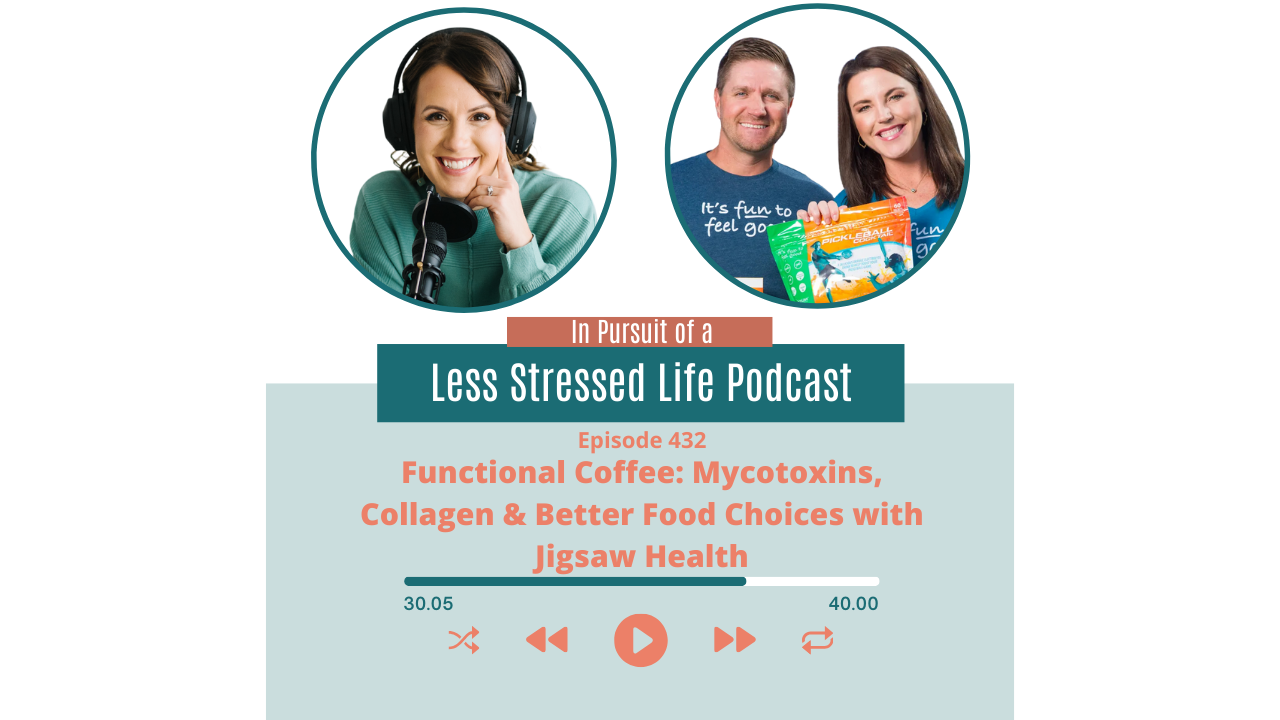
Functional Coffee: Mycotoxins, Collagen & Better Food Choices with Jigsaw Health
🚨🚨🚨Watch Christa's free training here: christabiegler.com/blueprint
This week on the Less Stressed Life, I’m welcoming back two of my favorite humans, Patrick Sullivan Jr. and Ashley Leroux Sullivan, the married duo behind our amazing podcast sponsor, Jigsaw Health. If you’ve been around here for a while, you already know I love partnering with brands that truly care and Jigsaw walks the walk while making it fun to feel good!
We go behind the scenes on supplement quality, why third party testing matters, and why supplements should supplement real food, not replace it. We also nerd out on clean, mycotoxin tested coffee, functional lattes with collagen, and their new documentary Breaking Big Food, which explores how local food systems and informed consumer choices can help fix what’s broken in our food supply.
Check out Patrick's previous episode: #347 5 Types of Magnesium and 2 types of Muscle Cramps
KEY TAKEAWAYS:
• Supplements work best on a strong whole food foundation
• Third party testing is non negotiable
• Mold and mycotoxins in coffee matter more than you think
• Pairing coffee with protein supports energy and blood sugar
• Small consistent upgrades can create meaningful change
Jigsaw Health Links:
Website: https://www.jigsawhealth.com/
Instagram: https://www.instagram.com/jigsaw_health/
YouTube: https://www.youtube.com/JigsawHealthTV
Documentary: https://www.jigsawhealth.com/pages/breaking-big-food
Firefly Coffee: https://www.jigsawhealth.com/pages/firefly
ABOUT GUESTS:
Patrick Sullivan Jr. and Ashley Leroux Sullivan are the married CEO and CMO of Jigsaw Health, a family owned supplement company founded in 2005 by Patrick and his father, Pat Sullivan Sr., built on the belief that life is too short to feel crappy and it’s fun to feel good. Jigsaw is known for magnesium and potassium focused supplements like the fan favorite Potassium Cocktail, plus weekly fun edu-taining videos. They are also the producers of Breaking Big Food and the founders of Firefly Organic Coffee and Market in Scottsdale, Arizona, home of Ashley’s collagen boost latte, Firefly Glow.
WHERE TO FIND CHRISTA:
Website: https://www.christabiegler.com/
Instagram: @anti.inflammatory.nutritionist
Podcast Instagram: @lessstressedlife
YouTube: https://www.youtube.com/@lessstressedlife
More Links + Quizzes: https://www.christabiegler.com/links
SPONSOR:
Thank you to Jigsaw Health for being such a great sponsor. 😎 Use code LESSSTRESSED10 anytime for 10% off!
I released a free training that shares the 4 steps I use to help clients reduce eczema, inflammation, and food-reaction symptoms by 50%+ in a few months — without restriction or overwhelm. The feedback has been incredible, and I answer every question inside the training. Watch here: christabiegler.com/blueprint
TRANSCRIPT:
[00:00:00] Ashley Sullivan: as owners of a nutritional supplement company, we're super passionate about helping people feel better, but the key word is supplement.
And we cannot get everything we need just from pills and supplements like we need to have. Good food to start with.
[00:00:15] Christa Biegler, RD: I'm your host Christa Biegler, and I'm going to guess we have at least one thing in common that we're both in pursuit of a less stressed life. On the show, I'll be interviewing experts and sharing clinical pearls from my years of practice to support high performing health savvy women in pursuit of abundance and a less stressed life.
One of my beliefs is that we always have options for getting the results we want. So let's see what's out there together.
All right. Today on the Less Stressed Life I have back the duo, the Paley, Patrick Sullivan Jr. And Ashley LaRue Sullivan, husband and wife, business partners who are the CEO and Chief Marketing Officer of Jigsaw Health, a family owned supplement company with a belief that life is too short to feel crappy, which I would agree with.
They're also known for their. Wonderful tasting sugar free electrolyte powders with a special emphasis on magnesium and potassium, which is how they caught my attention because they make my favorite potassium rich electrolyte called potassium cocktail, but it used to be called pickleball cocktail, and all these stories will probably work together today.
So Jigsaw Health was started by. Patrick's father-in-law, Patrick Sullivan, Sr. And Ashley and Patrick run it, but both she and Patrick have a musical entertainment background. So they love to bridge the gap between health and entertainment. So they make educating fun. Every Friday they publish a fun and edutaining video to help customers learn something new.
And so on that vein, they're also the producers of a new. Feature documentary titled Breaking Big Food, how the American Food System Went Rotten, and How It's Being Revived, which is coming out on Apple TV and Amazon Prime Video. By the time this publishes, they also just opened an amazing new coffee shop in Scottsdale called Firefly Organic Coffee and Market making Ashley's famous collagen Boost latte.
Firefly Glow. So they've been here before and today we're back to talk about talk shop, about a little bit of behind the scenes. I love a good behind the scenes. I'm always talking to clients about, yeah. Behind the scenes of this, I just think it's one of the ways, you're getting high quality products and supplements is the only way to know is to meet the people behind it.
And every once in a while you get the joy of finding a wonderful family owned company that really cares about the integrity. And that's really what it boils down to. So that's why. Ashley and Patrick, affectionately known as the Paly, are back today to talk about this. So welcome back guys.
[00:03:03] Ashley Sullivan: Thank you.
And we may or may not have a tattoo with our team name. I, we may or may not. You like to have a lot of fun? Yeah.
[00:03:11] Christa Biegler, RD: It's one of the business values. Fun.
[00:03:14] Ashley Sullivan: Yes. As a matter of fact, our tagline, if you can see Patrick's shirt, is it's fun to feel good. Yep. Yeah. So yes, fun is definitely the umbrella in which we try to put everything else underneath.
[00:03:26] Patrick Sullivan, Jr.: And speaking of fun, Christa, thank you for welcoming us back to your show. Yours is definitely one of the most fun shows that we get to do 'cause we get to nerd out. And just talk all sorts of wonderful things. So thank you for having us back. Oh, yeah, thank you.
[00:03:38] Christa Biegler, RD: I'm delighted to nerd out.
I'm glad to have people who want to listen to nerdy conversations and to nerd out, so let's for sure. Let's go with that. Okay, so let's talk about. What's happening behind the scenes at Jigsaw right now? There is a lot. You guys got a few things going on. Aside from making everyday Friday videos, we're making a documentary, but first we've got this coffee shop that I'm hoping to visit in a couple of weeks.
But once upon a time we did a collaborate collaboration online. Ashley started putting, she has like a special. Maybe I was thinking about the morning drink, but she makes a lovely latte with collagen and I'm just curious about the whole coffee origin story. We started as a supplement company and now we've got coffee as well.
But Ashley, a lot of people have a soft spot for coffee. You a soft spot for coffee. You worked as a barista at one point, right?
[00:04:27] Ashley Sullivan: Yes. As a matter of fact, that was my very first job was being a barista and I have so many fond memories. From that.
And I've just always loved coffee and I probably started drinking it way too young. But essentially Patrick and I we had this afternoon latte habit, and when it comes to buying food and feeding ourselves, like we try to find the highest quality stuff we can. We buy organic when we can and just, we really focus on that.
However, we weren't really paying attention to. What quality coffee we were drinking because I didn't really know. And then I started to hear more about coffee can contain mold and it's highly sprayed with pesticides and started to get the wheels turning. And then all of a sudden this afternoon latte habit where we would go visit different coffee shops in our area got a little less fun just because I was like, I wonder.
What I'm really putting in my body every afternoon. You're stressing out about it? A little bit. A little bit. I mean
[00:05:24] Christa Biegler, RD: it's not really unreasonable and I will back up Ashley, with my own story that I have a mold history and so those of us with mold history, but there's a lot of us, you're gonna a little more of a canary in a coal mine and about half of us only like we just don't metabolize mold well.
So my experience with coffee was actually pretty. Jekyll and Hyde, like I would have coffee and I would crash and feel terrible, like I would have a high and then crash. And I eventually learned it was really related to poor quality coffee and my, so I actually joke, I'm a little bit of a bloodhound.
I can tell if coffee is poor quality because after I drink it for a while, my body odor starts to stink. It'll make my heart raise. I'll have kind of a high and a crash. But it was such a weird thing to learn. I have memories about this in college and whatnot, so I'm backing you up.
It is actually like, when it has actually affected you, it's a little bit eyeopening as most things are Right. Until you have it happened to your body. And I remember, it's been a long time since we talked about coffee quality here, but I will tell you, it's incredible to me for clients, people always say.
Oh, do I need to change this, and this in my diet or around mold? And I say, you should really just start with the lowest hanging fruit. Like an easy swap is to get mycotoxin free coffee, but you really have to have it certified as such. So tell me about your journey of so you started to realize maybe not all coffee was awesome.
I don't know if you saw anything for yourself or if you were just learning about it. That's.
[00:06:48] Ashley Sullivan: How I ended up finding out that I actually have some mold things that I was working on detoxing as well, and I did a mycotoxin test and it showed that it was coming from food and I started to think coffee is one of the highest things.
I'm drinking it multiple times every single day. I better pay attention to this. So I was like. What really started to get the wheels turning. And then at Jigsaw Health, we're always looking for ways that we can provide solutions and options for better options for people, right? So we figure this could fit fine underneath that umbrella, but like everything that we do, we need to do third party testing.
So not only did we find an organic bean that is USDA certified organic. We have to trust but verify. So we decided we're gonna put it through the same ringer that we put all of our supplements through and send it in for third party testing. Patrick can go into a little bit more detail on that.
[00:07:40] Patrick Sullivan, Jr.: Yeah.
So behind the
[00:07:41] Ashley Sullivan: scenes of third party testing,
[00:07:43] Christa Biegler, RD: this is not always, not everyone does this on every batch, right?
[00:07:47] Patrick Sullivan, Jr.: Even a spoiler alert, really. 'Cause part of this journey was to find a clean, organic coffee was captured in the Breaking Big Food documentary. And the part of the reason for that doing some research on Okra toxin or OTA the EU found that it was this mycotoxin, this mold was effectively in about 50%.
Of all the samples that they tasted or that they tested.
[00:08:16] Ashley Sullivan: Maybe they tasted 'em too, so they might have tasted '
[00:08:18] Patrick Sullivan, Jr.: em too. So yeah we finally found a roaster that we really liked. They had a registered organic bean. The roaster that we work with for the firefly coffee beans had been working with this family farm in Honduras for over three decades.
And they're like, it's, high elevation and shade grown, and it has a lot less humidity than most coffee regions. So that is a big part of helping to limit the mold. But as Ronald Reagan once said, trust but verify. So we tasted the coffee, we were like, this tastes amazing. I hope it passes the test.
I'm holding in my hand for those that you that are watching here. The lab results over three pages of data on all the things that we tested from heavy metals to glyphosate, pesticides. Pfas more Texans, toxins, pfas, and this coffee came back, squeak and clean, and we just started selling it on jigsaw health.com.
It's the Firefly Small Batch organic Coffee, and it. Tastes amazing. I have definitely become a coffee snob. I didn't grow up drinking coffee but I have become a coffee snob. And you really taste the difference with this medium roast. It has flavor, notes of chocolate and honey and stone fruit and doesn't taste like mold.
'cause there's
[00:09:42] Christa Biegler, RD: nothing in there. You know the way I understand it, how a lot of coffee gets moldy is that the coffee beans are drying out. They're like. Picked or something, they're drying out and then because often they are paid, like whoever is paid based on weight, they will literally soak the beans after they've dried because then they'll be heavier in shipping.
I don't know if you're seeing it or understanding it from a different perspective. That's how I understand how often gets moldy overall, so it's based on weight, they're spraying it down, it's getting heavy now, and then you're packing it up and sending it off. So it makes sense. 'cause anything that's wet more than, a day is typically gonna grow mold.
So I haven't
[00:10:21] Patrick Sullivan, Jr.: heard that, but that does make sense. And yes, our roaster import. Based on weight, they pay based, on a and that pound basis. That's probably
[00:10:29] Christa Biegler, RD: industry standard. And so that's part of that. It would be interesting to ask them, I wonder, do you know much about the relevance of shade grown in high elevation when you see terms like that listed on a label?
Usually it's a good sign. So it's always nice to have an organic label, but there are high quality brands that are not always labeled organic because it is such a regulatory. Sure. Hoop to jump through. But when you start to see these other terms, usually it's ooh, these people are really interested in some detail here.
I don't know what the relevance is of high alation. You mentioned lower humidity. So there's something to that, but in general with coffee, it's dried. So I don't know what the significance is of shade grown, but I bring it up because when I've seen shade grown on a label, usually it's pretty dang good tasting coffee.
Yeah.
[00:11:14] Patrick Sullivan, Jr.: One of the things that you mentioned, let's start with organic. We were bound and determined to deliver a, registered organic coffee bean to our customers. But really zero coffee is grown in the United States, and organic is a term that is regulated by the SDA. So there's only about 2% of the coffee.
The world is registered, USDA organic. So that's one thing. Not many farms are willing to spend the money to do that. Willing or able, I should say.
Number two just because you're registered organic doesn't mean that farm is necessarily always following their protocols. It's one of the downsides that Joel Ton, the renegade farmer would talk about in terms of just because you are registered organic doesn't mean that you're even necessarily following appropriate standards.
And one of the things that happens to coffee, in fact, I think the biggest problem with dark roast coffee is that's the sign that they're trying to burn off the mold. So at the largest. I don't wanna name drop them names them who they, who won't be named, but think of it as the McDonald's of coffee.
All of their coffee tastes so burnt and they then layer on sugar and cream and whatever to it. I believe it's 'cause they are buying the cheapest possible coffee. And then just trying to burn the mold off of it.
[00:12:42] Ashley Sullivan: And it's consistency of flavor too. If you just burn it all, it always tastes the same and people, want consistency.
[00:12:50] Christa Biegler, RD: I mean it all, it is annoying in a good, annoying way to become a coffee snob at the end, is what I was saying. I agree. And I used to think, oh, I liked dark roast, but I really just liked. Concentrated coffee, espresso. And this actually happens accidentally during travel because the way Europeans and South Americans consume coffee is much more concentrated, right?
You get a little shot of espresso, maybe a little bit of milk. And so I always thought for a long time I like dark roast. So I'm intrigued by what you're saying here, because I found that this was actually not true. Like very often the dark roast was like, gross didn't taste good.
You actually made a medium roast in your espresso. So yes. Notes, side notes. But yeah, I wonder about. With USDA you would know a lot about this, about with it's such a good point when you're importing something, how do we verify that it's actually organic and you. It would be, it's hard.
You have to trust that third generation farmer you're working with. Yes, you do your testing, but you gotta do
[00:13:45] Patrick Sullivan, Jr.: the testing. Do the testing.
Because we are so used to doing testing on our own supplements, it was just natural for us to send in, the first bag that we got from the roaster to a lab and gave them a whole battery, three pages worth of test results for them to say yay or neon.
And we were. Because we loved the flavor. We were crossing our fingers, like hoping this coffee came back clean, and thankfully it did.
[00:14:13] Christa Biegler, RD: Yeah. So will you test every batch? Because when you order it, you're ordering the beans and then as it roasted, it's roasted, local to you, right? Because after roasting Yes.
It's roasted in
[00:14:24] Patrick Sullivan, Jr.: Chandler and we've decided that we won't need to test for. Everything that we tested for, but we will test for mold and mycotoxins every single time. Heavy metals. Yeah. We don't really need to test for heavy metals in each batch. It's the mold in the mycotoxins. Yeah. So the very first batch was essentially to verify the supply, that the supply is clean.
Then we will test each future batch for mycotoxins and mold, because that's the thing that could creep up if it is, humid, if it's stored in a human environment.
[00:14:56] Christa Biegler, RD: Yeah. And if it's organic, it would never have pesticides in general. Whereas I feel like being organic doesn't mean that it's mycotoxin free for most people.
Which is why you would be testing to delineate the difference. Correct. And for Correct. Those of us that struggle with this, it, it makes a big difference 'cause coffee when I have drank decent good local grown coffee that may have some mycotoxins, it usually accumulates. I can usually tell, usually little things start to bug me.
So yeah, I am your little blood hound about this. The overall so you had this afternoon coffee habit. You decided we're gonna open a little coffee shop right next to our headquarters. And so you opened that, but you do some things and I. Do this. If I'm drinking too much coffee, I start to add protein to it.
Will you tell us a little bit about how you like to upgrade your coffee to get more benefits?
[00:15:46] Ashley Sullivan: I really can't sleep. Maybe just try. Max. Can't sleep away, baby. Just try. I've tried everything. I know you ain't tried this yet, but this use. Is good Magnesium? Well, maybe it's Nutri Tri if it's D Taste good, refreshing and a life of for sure. Try. Beautiful. Told you, you A, you'll be begging for more.
What's in the street baby? That is Mag Sue. Oh, this is Magoo baby. It's called Mag. I wish I knew it about to find. Right. I'll take your hand, help you bed. Maybe you should listen. I, what's the sense in why I really can't? Maybe just try this baby. Just try.
[00:17:10] Patrick Sullivan, Jr.: You're very pushy. You know? I like to think I'm just helpful.
[00:17:18] Ashley Sullivan: Baby. Just try. Try
[00:17:28] Patrick Sullivan, Jr.: just a little sip. Then that took a lot of convincing.
Merry Christmas and happy Holidays for me, Ash and everyone at Jigsaw Health. That's right. And you may know how much we love doing musical parodies. So we hope you've enjoyed our rendition of Baby. It's Cold Outside. And just remember if you need help relaxing over the holidays, baby, just try Max. Merry Christmas.
[00:17:57] Ashley Sullivan: Merry Christmas.
Yes. So actually our number one seller by a landslide has become the Firefly Glow latte. And that is essentially your regular latte with, of course, organic espresso. And organic milk, but we add a scoop of the jigsaw collagen boost.
This is our grass fed collagen protein clinically tested. This is really high in collagen. And so we add a scoop of that along with a little raw honey, some cinnamon and some vanilla, and that makes up the firefly glow. Oh, also a little bit of sea salt too. Yes. I just gave away my whole secret recipe, but you don't know the exact measurements.
And it tastes better when you're sitting in Firefly. If you wanna copy that at home, please do. Because it's just so delicious and it really upgrades your coffee.
[00:18:50] Patrick Sullivan, Jr.: It goes to another, there were multiple reasons that we started Firefly and that is another layer of Ashley having these protein goals that she was wanting to hit.
And it's we have this afternoon latte habit, but nobody. Has any like protein, obviously there's protein in the milk, but like why doesn't anybody put collagen or even have it as an
[00:19:11] Ashley Sullivan: option
[00:19:11] Patrick Sullivan, Jr.: or, yeah. In the latte. So yeah, it has definitely the Firefly Glow latte has become the number one bestseller at the shop.
[00:19:19] Christa Biegler, RD: We call this Functional Foods. When you're. Enjoying something, but then you get a benefit from it, right? Where it's it's food, but it's a treat. But actually I am getting almost 20 grams of protein. I don't know how much of a scoop you put in the latte. I feel like you could probably get away with a decent amount.
Usually a scoop of collagen is like 18 to 20. I think yours is right. Consistent with that.
[00:19:37] Ashley Sullivan: One scoop is eight grams. Two scoops is 16 or 17. Got it. So yeah, we usually do the, depends on scoops. Yeah. And then whatever kind of milk you're getting. So if you're doing regular milk, you're getting a decent amount of protein in that as well.
[00:19:48] Christa Biegler, RD: Yeah, for sure. And the tricky thing about coffee is we all metabolites caffeine a little bit differently. So for lots of us, especially on an empty stomach, that caffeine spike will spike our blood sugar a little bit. And so that spike in and that decline can leave us feeling.
Not exactly hangover, but like it leads to a little bit of instability with blood sugar. So when we pair that with a little bit of protein, the effects are not so significant. Or anytime we're eating with it, it tends to land better. And so essentially and we've all done it where we have coffee middle of the day.
We have coffee the beginning of the day and we don't eat. And sometimes for some of us that can create little bit of symptoms a little bit later. I know if I forget to eat breakfast with my coffee, it's not ideal. But when you pair it with. Protein. It is really ideal and. Collagen more on that in a different episode.
We all know that collagen declines with age and all three of us sitting here and every one of you listening, we are all aging whether we or not. Our collagen Wait right now? Yeah. Right now. So our collagen is starting to dissipate and that's why we sometimes have hair loss or different things, but what was mind blowing to me, why I bring this up.
So it's we know that, but I was on a long drive with my optometrist friend recently and I was trying, and she's so smart, right? You talk to those people, they're like, I'm trying to understand how to fix my eyes here that are declining with age when I'm looking at my computer.
And she's oh, it's just 'cause the collagen is essentially like falling, like the structures are falling in your eye. That's why I don't lie. She was like talking about it. So nonchalantly duh, of course this is what's happening as you age. And I thought, all right, I gotta make sure.
So I have now a phone alarm in my phone in the morning, take my scoop of collagen, go take my jigsaw. Yes, take collagen. All is well. So far. I'm
[00:21:26] Ashley Sullivan: continuing
[00:21:27] Christa Biegler, RD: and it's a great thing because
[00:21:29] Ashley Sullivan: it is totally tasteless. It mixes in. Yes. You can't even tell it's there.
[00:21:34] Christa Biegler, RD: I forget, people don't know this and you can, you throw it in baking.
It is like the nicest protein booze that doesn't actually taste like something. Yep. So it's very nice. And it's heat, like it's resilient to heat as well. So obviously if you can bake it, but people forget that. It's like the easiest, simplest thing you can throw into any kind of baked goods or anything to increase the protein.
We're all on protein goals over here, Patrick? Yes,
[00:21:57] Ashley Sullivan: we are.
[00:21:59] Christa Biegler, RD: Okay, so we've got this coffee, so yay, squeaky clean coffee. And I have so many thoughts about, getting into different things. You guys, this happens a lot in entrepreneurship. Entrepreneur, you brought this up earlier, that you always look for problems to solve.
And I was talking to one of my. Friends that we both know earlier, and she said she had a statement. She said, problems are forever. And so in entrepreneurship, we're often trying to solve problems, but you guys take it, sometimes you take it that step further where you're like, I'm gonna have fun solving these problems.
And so last year you came out maybe two years ago, maybe three years ago, I don't know, the years all blend together. You came out with your first documentary after a couple years of doing videos at the company where you're like educating, I think there's a video I'm trying to remember of Patrick dressed as a fish for cod liver oil or something.
I don't know. It really made me laugh. Oh, that's a classic. That one really got me. And then there was right before not too long before you guys changed the name from Pickleball. I actually love the story of this. I think it was did potassium cocktail or pickleball cocktail come to fruition because you were doing magnesium research in the magnesium researcher said, oh, if you're having a cramp during exercise, it's potassium.
And you were always playing pickleball for two hours a day and you were getting cramps. So that's how That's right. That's how Pickleball Cocktail came to be. But there is a spoof video where Patrick is like, Hey, if I, I'm a wrestler, can I take this? And so it just cracked me up because I knew this was based on real events.
[00:23:27] Ashley Sullivan: Yes. You actually helped influence the name change quite a bit because you were telling me how many of your clients that you recommend Pickleball cocktail to, and you're like having to give this a little quick explanation of It's okay if you don't play pickleball. Still need this drink. And and we had people calling in, Hey, I play volleyball.
Can I take this? And so we decided to yes, make a funny video out of it. Yeah. Because of what? Cramps
[00:23:49] Christa Biegler, RD: ball, exercise, cocktail. And then some. And then some. Also great for helping your. Blood sugar stabilize helping your body use insulin and improve insulin sensitivity and allows for thyroid function better helps your thyroid function in general.
So I'm like a giant fan of potassium. I think it's a huge issue. We're dumping potassium all the time. I'll shut up about that. But you guys had to bridge all of these things that kind of come together. You guys decided to do a documentary. About pickleball at one point, right?
[00:24:19] Ashley Sullivan: We did,
[00:24:20] Patrick Sullivan, Jr.: yeah. Two years ago.
I I would change that phrase to problems or opportunities.
[00:24:24] Christa Biegler, RD: Yeah.
[00:24:25] Ashley Sullivan: Yes, true.
[00:24:25] Christa Biegler, RD: Yeah.
[00:24:25] Patrick Sullivan, Jr.: And we, in 2022, so three years ago, opened the orchard at Jigsaw Health, which is two indoor pickleball courts. But it's really we designed it to be like a. Studio or a boutique stadium. So we would host these events and we started something called the Arizona Pro Pickleball League.
And I said on camera, you can see this in the trailer for breaking pickleball. I said to the camera, look, I hired you guys talking to the documentary crew. I hired you guys because even if we crash and burn with the Arizona pickleball. We should at least get it on tape. And the series Breaking Pickleball, which you can find on Amazon Prime video goes through season one, the 13 week season of the Arizona Pickleball League.
And it was really this amazing process where, okay, I don't know that, I didn't see that coming, but wow. It was great. And that led to us like, okay, I think we're gonna make Breaking Pickleball part two. But we felt is a sequel really the problem? It just
[00:25:28] Ashley Sullivan: feel right for some reason. And our intuition was like, do we really wanna do like a sequel?
And then it came and it was like, oh, here's why we're not doing that because we're pivoting and we're gonna do Breaking Big Food instead. Because this is the moment. This is what we can do to help really educate and help move the needle and help. People decide how they're gonna make different choices.
So it's like we cut our teeth on our Breaking Pickleball documentary and had the same exact crew, which they're so incredibly talented. Work with us on Breaking Big food which we're super passionate about the subject obviously. So
[00:26:03] Patrick Sullivan, Jr.: we started breaking big food because we had a pickleball court.
Yeah. Now that seems like a far cry, but because we had a pickleball court next door to our pickleball court through the demising wall was an office and in that office. At Tuesday on a 2:00 PM on a Tuesday, there was like the sound bleeding through. So that office was like, we can't take it anymore.
There's too much fun happening over at Pickleball and we're trying to have a meeting in here. So that, no, that's how it
[00:26:37] Christa Biegler, RD: actually started.
[00:26:38] Patrick Sullivan, Jr.: And we were like, and our landlord was essentially like, Patrick Ashley, why don't you guys become your new neighbors? And we were like okay, what would we do with that space?
And that was where Ashley was like. There's no organic coffee shops in Scottsdale, and nobody puts collagen in coffee, and everybody's using milk, loaded with hormones and crappy alternatives. And why don't we do our own coffee shop? And then we turned it into, why don't we film a documentary about building the firefly and about really what I think is a very healthy food revolution happening at a local level here in Phoenix.
And so breaking big food is almost this whole like, I can't believe how that all came together, but it's designed to be very inspirational to the rest of America. 'cause I think. Fixing the food is such an important topic that needs to happen.
[00:27:33] Christa Biegler, RD: Yeah. Okay. We'll get into that, but I kind of love origin stories.
Yeah. And I didn't really realize that your meeting place, your business your headquarters was next to a pickleball court. Yeah. It was driving you crazy before you joined them. And you were like, maybe we should play pickleball actually all the time as well. And I brought up some of that because life is a bunch of skills and usually it's this sort of like bizarre mix of things happening behind the scenes of your interests and whatnot.
And then sometimes they all collate or converge at the end. And that's what I view is like somehow we ended up making documentary about pickleball. 'cause we had this pickleball court, we like it and we like. Entertainment and we like to educate that way. And then that skill that sharpened our teeth, right?
That skill converted over to maybe we should make this about health, since that's actually like our flagship company overall. Yeah. Yeah. And the convenient part about that is, is sometimes that helps with good connections. And and I'm intrigued why it was called Breaking Pickleball, right?
Breaking Big Food kind of makes sense, but I'm intrigued where that name came from. But what was the sort of vision. What were you hoping would be some of the outcomes? What were you hoping to highlight in breaking big food that hadn't been done specifically? I know you just said it was how you were hoping to bridge a gap, solve a problem, help inform, help make a difference.
Help make an impact, which are all things that really keep us all going in business. Having a purpose and a vision and all those pieces. But when you were storyboarding this or playing it out, what were you hoping to include? What were you hoping to hit on?
What were some of the high points?
[00:29:12] Patrick Sullivan, Jr.: A big part of the inspiration was in the spring of 2024. Hearing Callie means speak for the first time, Callie means, and his sister Casey means wrote a book called Good Energy and Ashley, and I felt like they. Really laid out chapter and verse how things got so messed up.
And we really wanted to help bring an amplifier, a megaphone to their message. But we didn't just want it to be like investigative journalism. And this is right before the rise of the term Maha make America healthy again. But we had met. At consumer Health Summit in I guess May of 2024, and just started talking to him about the process.
So the full title of the documentary is Breaking Big Food, how the American Food System Went Rotten, and How It's being Revived. So we wanted to tell this story about local farmers that we had gotten to meet a local market in our hometown. Where we live now fountain Hills, Arizona called Good Living Greens inspire Farms in Mesa, Arizona.
And we felt like there could be some, a good way to tell the story and inspire others would be, put Cali in front of a camera and let him talk about what is in their book, good energy, and then cut to different vignettes of, arizona Grass raised beef,
[00:30:39] Ashley Sullivan: or Wendell the goat farmer or like all these different awesome little local companies that, or people that are doing things right that we can highlight and show that really it's more about what changes can be made on the local level.
What can you do right now, not waiting for government to solve our problems for us? We need to do it ourselves.
[00:31:03] Christa Biegler, RD: I'm smiling because this is quite kind of the premise of what I've done in my business, but completely different than what you're doing, right? Is that I notice that we often have this disempowered state where we wanna outsource things to other people or expect that some, and it all happens honestly, like anytime we have a problem, we're like, we hope someone would fix it or we would.
Yeah. If I have an issue, I go to try to find an expert to fix it for me. And sometimes that doesn't always work. I can't necessarily outsource my health completely to somebody else. I have to take autonomy or ownership over my health. And so this was a big thing for me over the last year where I was like, this is an issue.
These are problems we want to solve. We don't want people to. Be dependent on us or really anyone for a long time. I think how we change healthcare is we start at this grassroots level of what can I do? And I think that entrepreneurship has that grittiness installed in us to an extent.
'cause we think you can fix that, right? Like we tend to be, we gotta find a solution for it overall. So I think it overlaps and so it makes a bit of sense. Essentially there wasn't a win when people left feeling disempowered. And I was gonna say this earlier, talking about supplements and your overall mission of if it's fun to feel good and life's too short to feel crappy.
I tell people on this same vein that I think that we've really made it when we can use supplements. To feel how we wanna feel. 'cause we understand them, we know how to use them, right? And I think that you guys are trying to pull all those people. That too in a different way where you're like, but let's make the education fun.
Yes as well. And so it's man, if people could just understand that X, Y, Z would make a big difference in health, right? If they could just understand that they don't have to cramp while playing pickleball or skiing or something, and if you just put in the right electrolytes, it's a mind blow overall.
So I understand what you're saying and that's why I'm smiling is because. We get to take ownership over things and anytime we know better, we do better. And we're all just learning. We're just building skills, right? Yeah. It's oh, we're just sometimes we know some of it, but then we learn some different version of it and we get to tweak, overall.
And so it's a matter of building skills around things or Hey, there's always options, essentially.
[00:33:16] Ashley Sullivan: Yeah. And one of the things we touch on in the documentary, to your point, is that, yes, as owners of a nutritional supplement company, we're super passionate about helping people feel better, but the key word is supplement.
And we cannot get everything we need just from pills and supplements like we need to have. Good food to start with. Yeah. And then we supplement with the things that we need. And yes, our food supply, it can be very difficult to get all the minerals and all the things that we need, which is why supplements are so great.
But let's not forget about how important the core of just like eating whole foods is, right?
[00:33:51] Christa Biegler, RD: Yeah. No
[00:33:52] Patrick Sullivan, Jr.: and eating food that doesn't have glyphosate. Yeah. Heavy metals, mold, et cetera. We gotta clean up the food. 'cause the food went run.
[00:34:01] Christa Biegler, RD: Yeah. Yeah. What's the redemption story part of, I know we need to watch the documentary, but tell us a little bit, you talked about how the food supply, got rotten and then what's happening to bring it back.
So what do you think is some of the heroism? What do you think is in the future? What are you also hoping? For on the reach of the documentary, I know your very mission, vision, values focused and driven, so how many people are you hoping to touch with the documentary and also what do you see as the big things that we can all do to overcome the way the food system is and rise up on our own?
'cause anytime we're in a podcast, we're like, what can I do today?
[00:34:38] Patrick Sullivan, Jr.: I would say that our ultimate vision is for 5 million or so people to watch this documentary and get inspired on how to vote differently with their wallet. Because consumers they move the market, consumers move the market.
And 5 million people, that's about 7% of the United States. I feel like that 7% is a big enough group that will force change which is basically, I don't want junk, I don't want crap, I don't want bad chemicals in my food. that's from the ground up. We are currently about 1% of the way there.
So we leaked the documentary. Breaking Big Food is coming out on Amazon Prime Video and Apple tv. But we asked our distributor 'cause the release date was further out than we wanted it to be. What if we just leaked this to YouTube? How would you feel about that? And they're like it's non-traditional.
And I said, we are non-traditional, so how about try it? And we have about 61,000 views on YouTube right now. The comments are very positive. The feedback that we hear is that this is very inspirational. It's not a blueprint. It's a inspiration. It doesn't make you, but it gives you the chance to say, what can I do am I gonna grow chickens in my backyard?
Maybe I will. Or am I just gonna go to the local farmer's market and support those farmers because that commerce helps that farmer to grow more organic microgreens or whatever it is. Make more CMOs gel, whatever it is. Voting with your wallet is the biggest change that we can do from the bottom up, from the top down.
There's a lot of. Hope, I think that Robert F. Kennedy Jr. As the secretary of HHS will be able to push forward some very positive things. I think that one of the biggest changes that has happened on the positive side has been a timeline for banning petroleum based food dies. And what I have heard from those conversations is that, Kellogg's and Nabisco.
They were all like, yes, please ban these ingredients because here's the problem. If Kellogg's keeps using Red Dye number 40, is that right? Yeah. Red Dye number 40 And Nabisco says we're gonna stop using it because we think it's bad. Then Kellogg's now has this. Advantage, their food is brighter and the cost to make it is cheaper because Nabisco is basically we're gonna use beet juice as our coloring agent, but Kellogg has this huge advantage, right?
So the big companies are basically saying level, the playing field level, the playing field. And none of us can use petroleum-based food dyes. We'll accept it. We'll go with that. My hope is that the irony of the phrase breaking big food is that. We're not hoping that Nabisco goes out of business. We're hoping that they change, that they cry, uncle, that they basically say, over the last 40 years, food science has maybe not gotten everything right.
Maybe there were some unintended consequences to some of these dyes and pesticides and what have you. Why don't we change? Because the logistics that those kinds of companies have in place the ability that they have to, put food on the tables of Americans is it's. Basically a miracle.
It's basically a modern day miracle. The problem is over the last 40 years regulators have been asleep at the wheel whether it's F-D-A-H-H-S or whatever. And I think that I'm very hopeful that from a top down there will be a change so that Americans don't have to be like I have to read every single label.
I have to know what this is and what that is. Really hard to eat healthy. I think everyone would agree with that. So we're hopeful that our documentary will help to create change from the top down, but especially from the bottom up, because us as consumers voting with all our wallet that moves the market more than anything it really does.
[00:39:02] Christa Biegler, RD: I think it takes some real intention when you first decide, oh, I'm gonna clean up. I'm gonna use high quality oils, high quality sweeteners, and those types of things. As Americans, we love convenience, and so anytime we're accessing convenience. You're stuck with what is available, and that's exactly what you're talking about.
It's not a mystery to anyone listening to this. And actually, I worked in a food company. I was an intern before I went to my other internship. I worked at a pretty big food company for a summer. It was so eye-opening. I worked in labeling and regulation and learned so much behind the scenes. It was really fun.
Fun. I have that. Oh, I loved following around the chef because he would come up with the gold standard. And then the food science team blessed their heart. Their job was to make it less expensive and more accessible. So there is a story I. Dramatically remember you like I, and not surprisingly, I think about the entrepreneur in the visionary role.
It's like they would go and they'd have all these ideas and they'd whiteboard and that seemed so much fun. So I loved going to this meeting, but they had this concept where, this is a shocker, right? They wanted a healthy on the go breakfast for a busy mom, right? That's what their target market was asking for.
And the prototype, because in a food company. You were trying to utilize things that you already have, understandably. Sure. We all try to utilize things we already have as much as possible, but the prototype was deep fried cookie dough. Was what the prototype was for the product, and it was so fascinating.
I just learned so much. It was so interesting overall, like how these things happen in general. And actually I learned a ton about U-A-S-D-A versus FDA labeling regulations, which you guys probably know too. The USDA has. Literally an office at the plant because they need to be able to show up whenever they want for any food.
That's, I think 2% or more animal protein, I'm not sure. Whereas anything FDA is scout's honor. And so you have to put the right things on the label. You guys know 'cause your FDA as well. Yeah. And then you watch the industry to see if anyone is getting their hand slapped. 'cause that's what happens.
And I remember there was a specific kind of label we needed approved, must have been USDA, but it was like. Two people working like two days a week, wrote this one label. So anyway. Oh my god. I always think like we should never really wait for government for things to happen. No.
Whenever we can, and off the same note, I only bring some of this stuff up, is because we all do need convenience to an extent. And so when we level the playing field, it makes it easier for everyone, right? Where it levels things out in general. And it is hard to eat well. And then also once you practice this skill, it's like I was reflecting as you were talking at the same time, it's I can also eat really whole foods just because I've developed this skill where it's like I just got some protein and some fruits and vegetables or starches over here.
I can make it with some good seasoning. Like I can make a meal. Yeah. When you
[00:41:58] Patrick Sullivan, Jr.: talk about convenience, I think about the market. Yeah. The micro markets especially. So Good Living Greens was our prototype for Firefly Organic Coffee and Market. They're about 20 minutes from each other, but the idea is there can be.
Two really good organic markets, 20 minutes away from each other in different little communities. In different little communities, because it's about convenience. People will do what is most convenient and if there's a, convenient. Coffee shop that happens to be organic. That has
[00:42:29] Ashley Sullivan: raw milk and grass fed beef.
Yeah. You can get that along with your latte.
[00:42:34] Christa Biegler, RD: Yeah. I didn't know. I can't wait to visit when I am there in a couple of weeks. You mentioned earlier, Patrick, that the goal is inspiration, right? As many good storylines are, right? That's what makes a story, right? There's this whole storyline, but it's a lot of inspiration.
Mention often here that we're often driven to change through inspiration or desperation. So you guys have your coat hung on this inspiration hook, trying to impact change, trying to help the world, trying to help, the really ascension model. Have a healthy Whole Foods foundation first, and then when you need to use some of our stuff to sleep better, to feel better while playing sports, to have more energy through the day, et cetera, et cetera.
Thank you guys so much for coming on today. If you could share one soundbite for the audience as they listen to this topic that ranged from coffee and mycotoxins to breaking big food to pickleball, what would you wanna lead them with and where can they watch breaking big food?
[00:43:36] Ashley Sullivan: I think that the whole thought of.
Health can be overwhelming in general. As you think about I don't even know what to do. If there's so much stuff to do and I need to learn all these things, and it's just think of one small upgrade that you can implement right now. Once you have implemented that and you're like, cool, that's, I don't even have to think about it anymore.
Think of another upgrade. Just do one thing at.
[00:43:57] Patrick Sullivan, Jr.: Yeah. And I would suggest that a great place to start on upgrading would be mindset. Somebody really smart once said, whether you believe you can or believe you can't, you're probably right. To watch the documentary easiest way is go to breaking big food.com.
There's a link that takes you directly to the YouTube link. And that should be available when this episode comes out. It might. By the time you're hearing this, be on Apple TV or Amazon Prime, but just search for breaking big food and you'll find it. And I hope that you are inspired.
[00:44:28] Christa Biegler, RD: Yeah, they could leave a comment on YouTube.
They won't be able to tell us otherwise if they're watching. Yeah. Leave a comment
[00:44:34] Patrick Sullivan, Jr.: on YouTube.
[00:44:35] Christa Biegler, RD: Yeah, read them if you dare. Amazing. Thank you guys so much for coming on today.
[00:44:40] Ashley Sullivan: Thank you so much for having us.
Do you need a detox?
Getting "too old" to handle alcohol?
Sensitive to smells or metals?
Skin issues?
Detox isn't just juice cleanses & snake oils. It's a process that our body is trying to do all day long.
Take the quiz to find out if it's time for a detox.


