
From the Archives: Functional & Medicinal Mushrooms for Beginners with Jeff Chilton
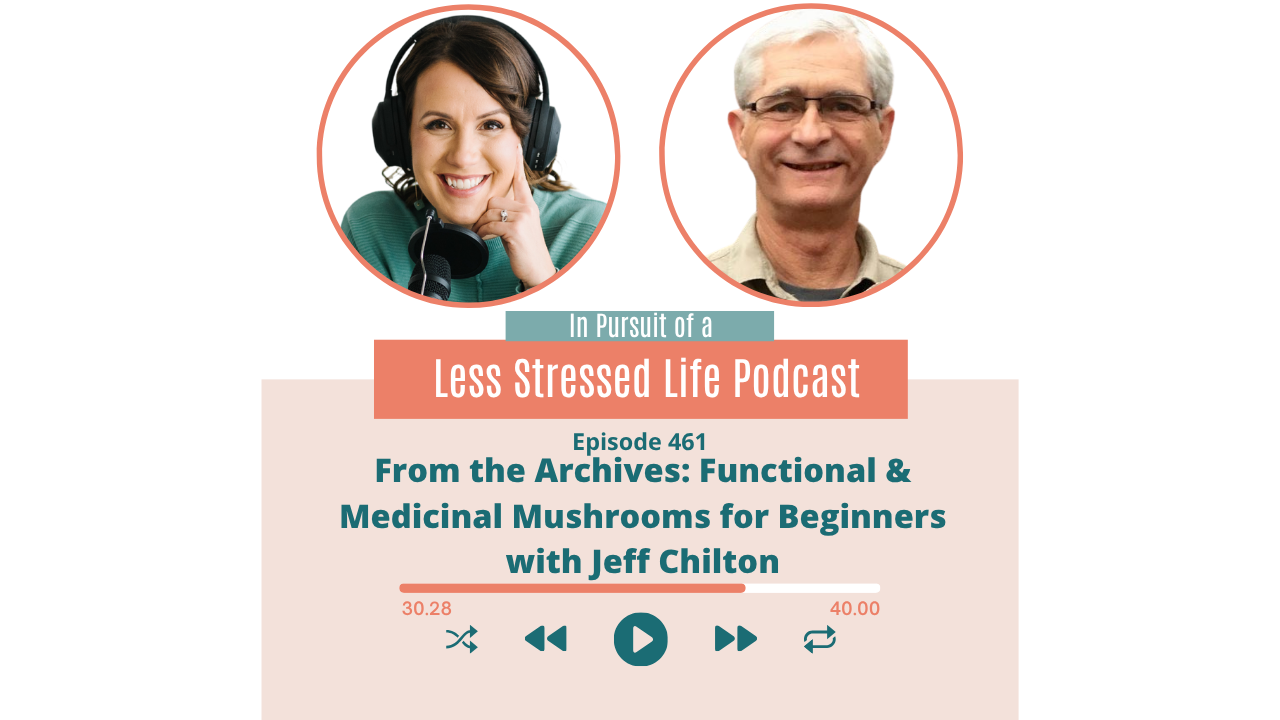
The Less Stressed Life celebrates 10 years next year🤯, and as I looked back through some of the early episodes, I realized there were a few conversations I wanted to bring back because they're just as relevant today as when they were first recorded. This week, we're revisiting Episode 39 from 2018 with Jeff Chilton, one of the world's leading experts on medicinal mushrooms and the founder of Nammex.
In this episode, we explore the science behind functional mushrooms, what makes mushrooms like lion's mane, reishi, cordyceps, chaga, and shiitake unique, and why not all mushroom supplements are created equal. We also discuss beta-glucans, immune and cognitive support, how to identify quality mushroom products, and simple ways to incorporate mushrooms into your daily routine.
KEY TAKEAWAYS:
- Functional mushrooms and their unique benefits
- Lion's mane, reishi, cordyceps, and chaga explained
- Beta-glucans and immune support
- How to choose a quality mushroom supplement
- Mushroom myths and common misconceptions
- Cooking with mushrooms for maximum flavor
- Simple ways to add mushrooms to your wellness routine
ABOUT GUEST:
Jeff Chilton is a mycologist, author, and founder of Nammex, one of the world's leading suppliers of certified organic functional mushroom extracts. With more than 50 years of experience in mushroom cultivation and research, Jeff has been a pioneer in bringing medicinal mushrooms to the North American natural health industry. He co-authored the bestselling book The Mushroom Cultivator and has spent decades working alongside leading mushroom researchers and growers throughout China to advance quality standards, education, and scientific research on functional mushrooms. Today, he continues to advocate for transparency, proper labeling, and evidence-based mushroom products.
WHERE TO FIND GUEST:
Website: https://www.nammex.com/
Website: https://realmushrooms.com/
Instagram: https://www.instagram.com/real_mushrooms/
Educational: https://www.nammex.com/mushroom-education/
Research White Paper: https://www.nammex.com/redefining-medicinal-mushrooms/
SPONSOR:
Thank you to Jigsaw Health for being such a great sponsor. 😎 Try their Electrolyte Supreme in the crowd-favorite Fruit Punch flavor this summer.🍓🍹Use code LESSSTRESSED10 on every order for 10% off!
NUTRITION PHILOSOPHY OF LESS STRESSED LIFE:
🍽️ Over restriction is dead
🥑 Whole food is soul food and fed is best
🔄 Sustainable, synergistic nutrition is in (the opposite of whack-a-mole supplementation & supplement graveyards)
🤝 You don’t have to figure it out alone
❤️ Do your best and leave the rest
WHERE TO FIND CHRISTA:
Website: https://www.christabiegler.com/
Instagram: @anti.inflammatory.nutritionist
Podcast Instagram: @lessstressedlife
YouTube: https://www.youtube.com/@lessstressedlife
More Links + Quizzes: https://www.christabiegler.com/links
Protocols: https://www.christabiegler.com/protocolshop
❓Questions for Christa? Submit them here: https://www.christabiegler.com/questions
TRANSCRIPT:
[00:00:00] Christa Biegler, RD: Welcome to the Less Stressed Life podcast. As I enter our ninth year of the podcast, we are bringing back a few episodes back from the very beginning, from the very first year, ones that I remember and I still think are super relevant today. So on today's show, we're bringing back an old episode from December of 2018, super nerdy episode, all about functional or medicinal mushrooms.
[00:00:22] Christa Biegler, RD: Now, the mushroom landscape has changed a lot since this episode was originally recorded. So this is about reishi and lion's mane and other beneficial mushrooms. And Jeff Chilton is our guest on this episode, and he talks all about the fruiting body of mushrooms, which there is a very large company that talks about how mycelium is better, and Jeff will talk all about why the fruiting body is better, which I think makes a lot of sense.
[00:00:44] Christa Biegler, RD: So I can't wait to hear what you think about this episode. The only negative to republishing some of these older episodes, even though the information is awesome, who knows what my interview style was nine years ago, but really there's no video to entertain you. So if you're listening on a regular podcast player, no problem.
[00:00:59] Christa Biegler, RD: But if you're watching on YouTube, then you're just gonna see a blank screen. But I hope you enjoy this episode, and I would love to hear what you think.
[00:01:08] Jeff Chilton: When you go to buy a mushroom product, what are you looking for? You're looking for an actual mushroom product. You're not looking for starch. You're not looking for this tempeh-like product. That's not what you're after, and it doesn't have the benefits that you're looking for.
[00:01:24] Christa Biegler, RD: I'm your host, Krista Biegler, and I'm going to guess we have at least one thing in common, that we're both in pursuit of a less stressed life. On this show, I'll be interviewing experts and sharing clinical pearls from my years of practice to support high-performing, health-savvy women in pursuit of abundance and a less stressed life.
[00:01:54] Christa Biegler, RD: One of my beliefs is that we always have options for getting the results we want, so let's see what's out there together
[00:02:17] Christa Biegler, RD: today on the Less Stressed Life, we have a really fun guy, and that is a total pun. We have Jeff Chilton, who was raised in the Pacific Northwest, but he's just a total mushroom head, basically. So he studied ethnomycology at the University of Washington in the late '60s. I mean, we're gonna get some history. Actually, let me just tell you something fun about Jeff.
[00:02:36] Christa Biegler, RD: So Jeff lives outside of he's British Columbia. He lives on Vancouver Island, and then he winters in Argentina for trout fishing. Don't you love him already? He's an incredible mushroom expert, basically. So he's worked all over in mushrooms. Basically it started in the '60s.
[00:02:52] Christa Biegler, RD: In the '70s he did a bunch of mushroom conferences, which was probably way ahead of his time, honestly. And then he had a book about mushrooms in the [00:03:00] '80s, and then he traveled a lot to China, looking at the supplement industry in the '90s, did a bunch of conferences. So it's pretty awesome, and through all this experience, he really culminated it to create his company, Nammex, I hope I am saying it right, which was the, really the first to offer a complete line of certified organic mushroom extracts to the nutrition supplement industry.
[00:03:19] Christa Biegler, RD: So I'm really curious about that. The way I see it is that probably, he's the mushroom extracts that you buy if you buy supplements, I'm guessing. So we'll talk about that. It's really fun. He is the man behind the thing that you see on the shelf. Welcome, Jeff.
[00:03:34] Jeff Chilton: Hi, Christa.
[00:03:34] Jeff Chilton: Thank you very much for having me.
[00:03:36] Christa Biegler, RD: Yeah. So let's stop, start top level. Let's help people understand why they care about mushrooms. First, mushrooms, if I was to say last year at this time, I would've said I feel like mushrooms are the emerging trend, but you're back here in the '70s doing crazy stuff.
[00:03:49] Christa Biegler, RD: So let's talk about overall, let's talk about mushrooms, how we wanna classify them. I think about them being adaptogens which are, help us deal with stress, and I put them in that herbal category. But [00:04:00] can you tell me how you view mushrooms and what as nutritional benefits?
[00:04:04] Christa Biegler, RD: What are some of the big things there?
[00:04:06] Jeff Chilton: You're absolutely right about mushrooms being adaptogens. I consider mushrooms actually one of the premier adaptogens. In fact, the way I look at them is food as medicine. Mushrooms are just a fabulous food. There's something, the first thing I tell people when they're talking about, "I wanna supplement with mushrooms," I just say, start out by eating some mushroom."
[00:04:26] Jeff Chilton: Mushrooms have a good level of protein, 20 to 40%. They are high in very good carbohydrates, mannitol being one of those, which is a very slow-acting sugar. And the other thing about the carbohydrate content of mushrooms is that it's primarily made up of beta-glucans. And beta-glucans, which we'll probably talk about more later, those are, make up 50% of the cell wall of a mushroom, and those are the compounds in a mushroom that give it its immunological activity.
[00:04:55] Jeff Chilton: And that immunological activity really, when you talk [00:05:00] about adaptogens are something that are working in the background. Adaptogens give you homeostasis. something that you can think of as a harmony herb. So they're out there. They're counteracting stress.
[00:05:12] Jeff Chilton: They're regulating some of our body processes. If we need a little bit more of let's say immune cells, it'll give you more. But it won't kick in until you really need it. So this is one of the things about mushrooms. They are gonna be there working in the background. You don't expect mushrooms to kick in and work overnight.
[00:05:31] Jeff Chilton: That's not how they work. Mushrooms are something that you need to be taking for a period of time, and then there in the background helping you over, let's just say, you're feeling down, you're feeling kind of lack of energy, or you're stressed out in some ways. Those mushrooms are gonna be there in the background helping you out.
[00:05:50] Jeff Chilton: So that's how I look at mushrooms.
[00:05:52] Christa Biegler, RD: I love it. I love what you said about cans. That's gonna be a really fun discussion. So let's talk about this is how I've seen mushrooms in the market so far, and I'd [00:06:00] like to hear your opinions about this. So first I started taking a mushroom supplement for exercise performance.
[00:06:06] Christa Biegler, RD: So I'm curious, and I don't remember. I think it, I gotta go, I should have pulled all my mushrooms out and looked at them. But I don't remember what that one is, but here's the ones of where I really see a difference. So we have reishi. I think it's relaxing. Chaga and lion's mane, now I could be getting this wrong, I'm pretty sure everything's mushroom.
[00:06:20] Christa Biegler, RD: Chaga and lion's mane, those actually do work for me. Like, I feel like I'm ultra focused if I put some of that in some kind of beverage or tea or whatever or just drink them plain. So I see reishi mushroom, or I'm seeing reishi, chaga, lion's mane. What are some other really common ones you feel are very mainstream in market, where maybe the listeners are saying, "Oh, I have seen that," or, "That's in a product I'm taking?"
[00:06:41] Christa Biegler, RD: Because this stuff is sneaking into products.
[00:06:45] Jeff Chilton: Yeah, it's funny because right now mushrooms of all are trending and they're like people are calling the next big super food. I started growing mushrooms commercially on a very big mushroom farm back in 1973. I worked on that [00:07:00] farm for 10 years.
[00:07:01] Jeff Chilton: I literally lived with mushrooms and knew this from that period. I knew the benefits of mushrooms from that far back. And I think the one in terms of you talk about three different mushrooms that are reishi for example, I would call that a premier adaptogen. The lion's mane now that's what a lot of people are taking because of its nootropic benefits.
[00:07:23] Jeff Chilton: So it actually stimulates the nerve growth factor, which stimulates the growth of neurites. So those are the things that we need, and we need those to keep being produced. That has a lot to do with our cognition and memory. And, who can't use something that'll help memory, correct? No doubt.
[00:07:41] Jeff Chilton: Especially as we get older. And also it's shown some effects on dementia. Dementia's now a huge issue out there. The one that I think some of the others that you haven't mentioned which people are familiar with would be cordyceps.
[00:07:51] Jeff Chilton: And cordyceps is a really cool fungus that historically has been wild crafted up at the Tibetan [00:08:00] Plateau.
[00:08:00] Jeff Chilton: And literally it's a caterpillar that overwinters in the earth. And so it goes in, it hibernates, and while it's hibernating, these spores of cordyceps actually take it over and consume it completely. And then in the summer, up pops this little blade-like fungus. So what they call cordyceps is caterpillar fungus, and people are out there on their hands and knees collecting these things.
[00:08:28] Jeff Chilton: In the last 20 years, cordyceps has gone from like in the early '90s I could buy a kilo of cordyceps for $1,000. Now they get up to $20,000 for a dried kilo of cordyceps, which just outrageous. Of course, nobody can actually afford to buy it. And one of the interesting things about it is when I tried to introduce cordyceps, that caterpillar fungus, companies in the early '90s looked at me like customers do not wanna eat insects, and also we have a lot of customers that are vegetarians.
[00:08:56] Jeff Chilton: They don't wanna eat caterpillar meat. Okay. That's fine. But [00:09:00] today, here's a really cool thing, is that, is- In the last 10 years and this is what I love about China, China is like the birthplace of mushroom cultivation. China right now produces 85% of the world's mushrooms. Now the world is full of, thousands of species of mushrooms, but there's only about maybe a dozen or two that can actually be cultivated.
[00:09:25] Jeff Chilton: Think about that. Of all this huge kingdom of fungi, and there's only two dozen of these that can be cultivated. Think of all the plants that we can grow. So just recently, scientists in China have figured out how to grow cordyceps, the actual little blade-like cordyceps not the caterpillar, the blade-like
[00:09:47] Jeff Chilton: So now in our company, we have cordyceps that we are selling, and at very reasonable price. And that to me is whenever a new mushroom comes [00:10:00] in Chris, whenever somebody learns how to grow a new mushroom, it's like a huge deal. Because like I'm saying, only a few dozen mushrooms actually can be cultivated.
[00:10:09] Jeff Chilton: Cordyceps is used primarily for people who had neurasthenia traditionally, and that means you're just coming out of illness. You're weak. You're fatigued. That's when they prescribe cordyceps. Now cordyceps is being used by a lot of people who are athletic.
[00:10:25] Jeff Chilton: They're maybe training some way. They are looking for something that'll help them out a little bit with their tiredness, their fatigue, and so on. So cordyceps has really penetrated the athletic market, so that's another one right now. The top four that out there really trending right now are lion's mane is number one.
[00:10:42] Jeff Chilton: Everybody wants lion's mane now. Reishi, cordyceps, and chaga.
[00:10:47] Christa Biegler, RD: So one thing I think you cut out just for a second is you were talking about how lion's mane is a nootropic, and it stimulates nerve growth, and?
[00:10:54] Jeff Chilton: that's the primary thing that lion's mane is used for now, is actually stimulating what's called nerve [00:11:00] growth factor.
[00:11:01] Jeff Chilton: And nerve growth factor is a protein that actually is responsible for promoting the growth of neurites, and those neurites are what are being destroyed and created all the time by us. But as we get older, the new growth of neurites starts to slow down, and that's one of the causes that they figure for loss of memory, and dementia, and maybe even Alzheimer's.
[00:11:26] Jeff Chilton: So the promotion of this nerve growth factor is very important, and if we have something that can actually do that... people now, they're always looking for an edge. So this is why we've got this whole category now out there called nootropics. And so everybody wants something that will somehow enhance their performance.
[00:11:44] Jeff Chilton: And so lion's mane has just taken off and everybody and his brother is looking for lion's mane.
[00:11:50] Christa Biegler, RD: Yeah. I've actually been looking for someone to talk about nootropics. Maybe you're the guy. But- ... let's talk a little bit about cordyceps here. So my first question is, if cordyceps is so expensive, do [00:12:00] you feel like the market for could be adulterated, right?
[00:12:03] Christa Biegler, RD: We don't really regulate supplements in food, so it's easy for someone to say, "This is cordyceps," but it's not really cordyceps. Is that possible?
[00:12:09] Jeff Chilton: here's the thing is that, I said that cordyceps was one of the most expensive herbs, and it was, it, actually that was the wild crafted cordyceps at $20,000 a kilogram.
[00:12:17] Jeff Chilton: The fact is now that we can cultivate cordyceps the wild crafted price and the wild crafted cordyceps is nobody could afford that. Now it's at a very reasonable price. Under $100 a kilogram, dried kilogram. So if you go and you can buy real cordyceps now. And then that's the, that's what's really interesting.
[00:12:33] Jeff Chilton: It's real. It's got no caterpillar on it at all, and the caterpillar fungus, the cordyceps, you would take that and you'd eat the caterpillar and the fungus. This is just the fungus. So it's quite reasonably priced now, so anybody can go out there and get cordyceps. But in terms of adulteration, look, man, don't get me started about adulteration.
[00:12:54] Jeff Chilton: The supplement market has got so many fast buck artists out there- ... they're just trying to make [00:13:00] money. And my category of mushrooms is full of products that are not really mushroom. Can you believe that? There's a lot of products that are being sold as mushrooms that are not really mushrooms.
[00:13:11] Jeff Chilton: And a great example of that is are you familiar with the food called tempeh?
[00:13:17] Christa Biegler, RD: I'm familiar with fu- tempeh, yes. Very much
[00:13:19] Jeff Chilton: okay. Tempeh is actually cooked soybeans with a fungus grown on it.
[00:13:25] Christa Biegler, RD: So- 'Cause it's fermented soybean.
[00:13:26] Jeff Chilton: Yeah. So the fungus is growing on it. Yeah, when you buy it, it's this, the soybeans, and you look at it and it's all white.
[00:13:31] Jeff Chilton: That white is mushroom mycelium. And just so your listeners understand this a mushroom is a plant part. Just like if we're, if you've got ginseng or something. Ginseng is sold, and it's the root. So every plant has got multiple what we would call plant parts, and each one of those parts has different benefits because the root of ginseng is certainly different than the leaves in what it contains.
[00:13:52] Jeff Chilton: And so that's why people are consume the root. Just like with a mushroom. A mushroom is one part of this fungal [00:14:00] organism, and it has three parts. It has spores, it has what's called mycelium, and then it has a mushroom. And so when that spore first germinates, it germinates into a very fine filament.
[00:14:11] Jeff Chilton: And when multiple of those fine filaments come together, they'll fuse together to form a network, and that network is called mycelium. And that mycelium is what we never see. It's out- ... there in the ground. It's decomposing everything. That's what it does. That's what fungi do. They decompose all the organic matter.
[00:14:28] Jeff Chilton: So it's out there, and it's amassing nutrients. And when conditions are right, then like for us up here in the Pacific Northwest when it comes fall, it gets cooler, it starts to rain, perfect conditions for a mushroom to come up. And so it produces a mushroom, and then that mushroom will mature and produce spores, and then we have basically closed this life cycle loop.
[00:14:52] Jeff Chilton: So we have a spore, we have a mycelium, we have mushroom. What some companies are doing now is they're actually growing that [00:15:00] mycelium in a laboratory on cooked grain. Much like the way that tempeh is manufactured, and they sell it as a mushroom
[00:15:09] Christa Biegler, RD: Yeah.
[00:15:10] Jeff Chilton: So if you go out to the marketplace and you're looking for a mushroom product chances are you may very well end up with one of these myceliated grain tempeh-like products, and it doesn't have anywhere near the benefits of the mushroom.
[00:15:25] Jeff Chilton: And the other part of that is that what you end up mostly getting is starch in these products. So the supplement market is like a minefield. Trying to figure out what's a good product, it's very difficult.
[00:15:37] Christa Biegler, RD: We definitely need to cover that here in a minute, right?
[00:15:39] Christa Biegler, RD: We need to cover where the best places are to get mushrooms. I know when we talk general supplement education, really knowing integrity of company, Yes ... feeling really good about that company integrity. What is their third-party testing for quality?
[00:15:50] Jeff Chilton: Yes.
[00:15:51] Christa Biegler, RD: Being, and really going- yes
[00:15:52] Christa Biegler, RD: with brand. Once brands, you feel comfortable with that brand, right? So you can trust that brand typically.
[00:15:55] Jeff Chilton: That's right. That's abso- Yeah ... it's just like going to a physician or a [00:16:00] naturopath or an herbalist. You talk to your friends, "Okay who is it out there- ... that's a good one?"
[00:16:05] Jeff Chilton: You know what I mean?
[00:16:06] Christa Biegler, RD: It's just like that. You're exactly right. I love that. Yeah. So I have a question about I work with people with food issues, but a lot of times other issues pop up, right? Bacterial overgrowths, fungal overgrowth. So let's dispel maybe a bit of a myth potentially. Yes. It's thought that if people if people present with fungal, quote, unquote, "fungal issues," let's just talk about it in layman's terms.
[00:16:28] Christa Biegler, RD: The CDC estimates that 75% of women have a history of vaginal yeast infection at least one time in their life, meaning that they're experiencing fungal or candida-type overgrowth. Yep. So let's talk about some people would say, people with fungal or candida overgrowth should avoid mushrooms and yeast and other things like that.
[00:16:45] Christa Biegler, RD: What do you have to say about that?
[00:16:47] Jeff Chilton: You know what? That is a very interesting mythology. It's like the doctrine of signatures, which is produces like.
[00:16:53] Jeff Chilton: Do you really think that eating a certain food will necessarily produce that same food in your system. And actually, [00:17:00] the thing is with mushrooms and a mushroom is very different from yeast. And a mushroom is not going to necessarily feed that yeast any more than any other food will feed that yeast. In fact, medicinal mushrooms are actually used to counteract candida.
[00:17:15] Jeff Chilton: So really to me, that's a myth. And if you go out there and if you search the internet and see if you can find any actual scientific paper that absolutely demonstrates that consuming mushrooms will produce or feed a yeast infection, you will not find it.
[00:17:36] Jeff Chilton: And again, like I say, that's just this, somewhere this idea came up of "Oh yeah, if you eat mushrooms, that's because they are a fungus and yeast is a fungus. If you eat mushrooms, then you're just gonna contribute to your yeast infection." Two absolutely different fungi and it's absolutely- untrue that there's any correlation between eating [00:18:00] mushrooms and contributing to your yeast infection.
[00:18:03] Christa Biegler, RD: Yeah, it's kinda hard to substantiate because you just said there's thousands of types of mushrooms, and in the same way, I don't know how many types of fungus there are, but they're not the same, right?
[00:18:12] Christa Biegler, RD: Each of the different yeasts.
[00:18:12] Jeff Chilton: No. No, not at all, and yeast is very different. It's a single-celled organism. Very different type of fungus than the mushroom. The mushroom's in its own family and you've got other fungi out there that don't even produce what we would call a fruiting body, which is the mushroom.
[00:18:27] Jeff Chilton: Don't even produce anything. All they are is just a mycelium, and those types of fungi we call molds. So you'll see molds out there. And what's interesting is a lot of these molds have produced- compounds that are very beneficial for us. Like penicillin- Yeah.
...
[00:18:43] Jeff Chilton: Actually has come from a mold.
[00:18:45] Jeff Chilton: That mold does not produce a mushroom. It's in a completely different category than what produces or the whole mushroom family. Totally different category. ... And again, it's producing a compound that is an [00:19:00] antibiotic.... It's very important for us.
[00:19:03] Christa Biegler, RD: Yeah. Medicine being based on herbs or inspired by nature, was the original source, right?
[00:19:08] Jeff Chilton: Yeah. Oh yeah, absolutely. Absolutely.
[00:19:10] Christa Biegler, RD: Yeah. It's funny that you talk about I wanna talk a little bit more about uses of medicinal mushrooms and things before we go into kind of like geography and where you find mushrooms and whatnot. Yep. But- Sure ... you were s- talking earlier about how China produces 85% of I think the world's mushrooms.
[00:19:25] Christa Biegler, RD: And so- Yep ... I always think that China I'm, one, curious about their weather and if that's part of it and their size.
[00:19:31] Christa Biegler, RD: I was just thinking that China, they kinda did, they've done a lot of things right.
[00:19:36] Christa Biegler, RD: Oh,
[00:19:37] Jeff Chilton: yeah ...
[00:19:37] Christa Biegler, RD: they have like- yeah ... they, it's the birthplace of some-
[00:19:39] Jeff Chilton: Yeah.
[00:19:39] Christa Biegler, RD: Oh, yeah ... pretty ancient medicine- Oh, yeah. Yeah ... that k- that kinda do things first. So it's kind
[00:19:42] Jeff Chilton: of- and think about Chinese philosophy in general. Daoism and those types of philosophies, they have been there for thousands of years.
[00:19:52] Jeff Chilton: Couple thousand years ago they had a very high culture going on already. Whereas geez, people in Europe were, we had Rome [00:20:00] and Greece and all of that. But man, the Chinese they produced a culture that and art and all of this that was just fantastic. And look, here's the thing about China, and I first went over there in 1989, and one of the reasons I went over there was because I went over to a conference, a mushroom conference.
[00:20:15] Jeff Chilton: China has got like literally hundreds of thousands of mushroom growers. Small farmers. They've been doing this for a long time. They started growing shiitake mushrooms in the 12th century. Now they're the world's largest supplier of shiitake. And again, they produce 85% of the world's mushrooms.
[00:20:32] Jeff Chilton: They have research institutes everywhere. They've got the farms, they've got factories conferences. So I was over there just soaking it all up, and also just learning more about how they use mushrooms. Because when I first got into this business and started my company in 1989, I literally was walking around natural food expos and things like that trying to convince companies to put mushrooms into their product line.
[00:20:58] Jeff Chilton: But because [00:21:00] nobody- Kristin, nobody in 1989 had a mushroom product. None of the ... They all had green herbs, 'cause that's what we know in the West. We know more about green herbs, so they all had green herb- nobody had a mushroom product. So I had to literally have articles written. I wrote articles produced books, all sorts of information during the '90s just to educate people to the benefits of mushrooms.
[00:21:24] Jeff Chilton: And it's just for example, in the United States up until recently, we've only had maybe one mushroom in the marketplace. That's the button mushroom, whereas in Asia, they're eating 12 to 15 different mushroom species over there, and they've had that in their diet for a long time.
[00:21:44] Jeff Chilton: So we're just now starting to turn on to this whole idea of mushrooms as food and ultimately mushrooms as medicine. And let me tell you something that's really, I thought was really fun, is that I reading up on the history of [00:22:00] mushroom growing and things like, in the 17th century in England They called mushrooms poor man's meat.
[00:22:09] Christa Biegler, RD: Yeah.
[00:22:10] Jeff Chilton: Poor man's meat. A- and sometimes mushrooms are big and very meaty and you can imagine they're out there, they're growing wild. You can go out there and harvest these things and put them into your diet. And for people in the countryside out there, people looking for food stuff, 17th century, poor man's meat, a big, solid, meaty mushroom.
[00:22:31] Christa Biegler, RD: Yeah. Actually, that's not different than what we would suggest now. It's funny how history repeats itself, right? Because a lot of people will get a burger on a portobello mushroom, and so that's not- ... substituting meat, the meat, but they're replacing a portobello with a bun.
[00:22:43] Christa Biegler, RD: Or a common recommendation is to make your meat go farther, put mushrooms in it and no one will know the difference. Absolutely. And so apparently they knew that in the 17th century too.
[00:22:51] Jeff Chilton: Yeah and that's interesting. You're totally into food, so you've been following this trend is like they're now, okay they've actually done studies where they've chopped up mushrooms and [00:23:00] they've blended it with ground beef at different concentrations, up to at least 50%.
[00:23:05] Jeff Chilton: And everybody who eats those says it's as good as the regular, if not better. And it makes sense. Whenever I'm eating ground beef literally I'm gonna chop up some onions, I'm gonna chop up some mushrooms, I'm gonna put it all together and barbecue it up. That's the way I would eat ground beef as a patty.
[00:23:24] Jeff Chilton: it's great. It's really good.
[00:23:27] Christa Biegler, RD: Yeah. Actually, I'm curious. There's so many directions to go here, but I'm curious since now we're talking about food-based options for mushrooms, I remember not liking... If you're listening to this episode and then going at least there's mushroom powder," I remember as a food-based thing, I didn't like mushrooms until college because someone prepared them right, which is really a story of every type of food, right?
[00:23:45] Christa Biegler, RD: And if it's not prepared right, you don't always love it. Oh. And it was prepared... It was sad, right? So I had portobellos in sauteed in leftover scampi butter, and they were like candy, and I just kept doing that again. And then, it's just downhill from there. But so I'm curious some of your favorite mushroom [00:24:00] preparations- Well-
[00:24:01] Christa Biegler, RD: Just how you like to eat ... a-
[00:24:02] Christa Biegler, RD: It is hot weather season, and there is probably no better time than now to make electrolytes part of your daily routine. Electrolytes help you make energy and help get hydration into the cells, so you aren't just peeing out what you put in. I've been drinking electrolytes for at least five years, and I'm always looking for a great-tasting, high-quality powder just to change up the flavors.
[00:24:24] Christa Biegler, RD: This summer, I'm doing a lot of Electrolyte Supreme from Jigsaw. It's got a great complementary vitamin and mineral profile beyond the classic electrolyte minerals of potassium, sodium, and magnesium without any sugar or artificial colors. It tastes great, and probably my go-to for my kids, especially the lemon lime flavor, as a hydrating lemonade for summer.
[00:24:45] Christa Biegler, RD: You can get 10% off every single order at jigsawhealth.com with the code LESSSTRESSED10. That's LESSSTRESSED10 to take 10% off of all of Jigsaw's incredible products from [00:25:00] Electrolyte Supreme to potassium and adrenal cocktails to cod liver oil and beyond. So go get yourself now and start hydrating.
[00:25:13] Jeff Chilton: absolutely. Let me give you my number one in terms of, okay, if I just wanna have mushrooms on their own as part of my meal, and this is so important, when you talk to people oftentimes they say, "Oh, God, mushrooms, it's like slimy, terrible." And I'm like no, I don't...
[00:25:29] Jeff Chilton: Where are you getting this?" I know where they're getting it because the key with mushrooms is you have to cook them in a hot pan on a high heat. I cook mine in butter. That's my oil of choice. And so you get a nice hot pan, get that butter nice and hot, you throw them in there. What happens is that when it's a hot pan, it will seal the moisture inside the mushroom.
[00:25:50] Jeff Chilton: If you cook it on too low a heat, what happens is all the water comes right out of them. They're 90% water. They're a vegetable. I mean, not a true vegetable, [00:26:00] but they're like a vegetable, so the water comes right out. Next thing you know these mushrooms are sitting in water, and they just become a soggy mess.
[00:26:08] Jeff Chilton: So high heat. What I like to do is The other thing is don't slice them too thin, maybe a eighth of an inch or something like that. I like to brown them, so I like to caramelize the outside of them. I'll even at times in my pan I'll flip them over by hand if I have to get the other side browned up.
[00:26:27] Jeff Chilton: So I wanna brown 'em up high heat. I, I like to cook 'em a little bit longer. I like 'em to be well-cooked. And then at that point I'll just sprinkle a little bit of salt, a little bit of pepper. Oh, man it's delicious. I can hardly get 'em out of the pan because I'm eating 'em as I'm cooking up.
[00:26:44] Jeff Chilton: They're really good. And, I'm talking about the agaricus right now. And look I was worked on a agaricus farm for 10 years. I lived with them. And I ate a lot of them then. I've never tired of them. I think ... I don't care what people say. Wild mushroom hunters are go, "Oh, yeah, agaricus, [00:27:00] it's bland.
[00:27:00] Jeff Chilton: It's this. It's that." Yeah, I do not think so. I beg to differ. I think it's very ... It's called the mushroom of Paris. That's where agaricus cultivation began in the 17th century over in France. And no I think it's a great mushroom. You know that a portobello is the same as the button mushroom?
[00:27:19] Jeff Chilton: These are the same mushrooms. The difference is the portobello has been able to mature But the button mushroom is harvested immature- Oh ... very young
[00:27:29] Christa Biegler, RD: It's just like green and red peppers. Just like green and red peppers.
[00:27:31] Jeff Chilton: - yeah, so it's an immature mushroom. And why they do that is because it's got a much longer shelf life.
[00:27:37] Christa Biegler, RD: Yeah. So- And you can grow it faster probably, obviously.
[00:27:40] Jeff Chilton: It actually takes more time to do the portobello, but it's like one of those ways that they can entice people into, "Okay, here's another mushroom that you can taste."
[00:27:49] Jeff Chilton: But back in the '70s when I was on this mushroom farm, we had a Japanese scientist there, and he was doing experiments with shiitake and enoki, and oyster [00:28:00] mushrooms. So I was exposed to that from a very early part time in my career, and I was just fascinated. So I was able to actually eat these mushrooms, which hardly anybody else in the whole country had access to because they weren't being sold in the markets.
[00:28:16] Jeff Chilton: And in 1978 at our company there, we introduced fresh shiitake mushrooms into our local market in the Seattle area. 1978, that was the very first- fresh shiitake mushrooms that were introduced in a major way in the United States. And here's what's interesting is that the whole thing flopped because the feedback at that time was, "Oh, this shiitake mushroom, it's too strong."
[00:28:45] Jeff Chilton: I'm like, "Too strong? It is wonderful." Shiitake mushroom, are you familiar with shiitake mushrooms? Do you- I
[00:28:51] Christa Biegler, RD: was just thinking about how embarrassed I am that we don't even have, where I live, I don't have a lot of mushroom options, right? So I can get button and portobello- Yeah ... in my [00:29:00] local grocery store.
[00:29:00] Christa Biegler, RD: Yeah. And if I go a couple hours away, I can find a couple bins of shiitake-
[00:29:04] Jeff Chilton: Oh my God ... or oyster. I know. And I bet sometimes when you get there and see them, they're like, they look like hell because they have-
[00:29:11] Christa Biegler, RD: I know ... treated properly I wonder if I can order them online. I was just, I'm pondering in my head, I'm like, "Could I grow some mushrooms under my front steps-
[00:29:17] Christa Biegler, RD: in the back in the dark where it's moist? I don't know. I was just pondering this.
[00:29:20] Christa Biegler, RD: Well,
[00:29:20] Jeff Chilton: You know what? If you are in the right place, like out on the West Coast we- we've got mushrooms everywhere in terms of in the markets, and- ... we can also get dried shiitake mushrooms, which if there's any mushroom dried that I would recommend, I would say dried shiitake.
[00:29:33] Jeff Chilton: It's good. However if you go in a normal supermarket and you look for the dried mushrooms that they have there, you might be paying $3 for maybe 15 grams. It's like outrageously expensive. Whereas I can buy in my markets here locally in British Columbia, I can buy a pound of dried shiitake for maybe 15 to $20.
[00:29:57] Jeff Chilton: A lot of dried shiitake. And dried shiitake, [00:30:00] they're good. They are really good.
[00:30:02] Christa Biegler, RD: Do you just put in soups and sauces to rehydrate? Is that how you're preparing dried shiitake? Absolutely. 'Cause I'm thinking- Yeah ... I'm like, "I'm gonna go find some now." Yes. I think I can go find dried shiitake.
[00:30:09] Jeff Chilton: That's right. Or you can just, warm water, put 'em in there, let them rehydrate. Don't leave them for too long or else they'll get waterlogged. But- ... in there long enough to soften up. And the dried shiitake actually has a very strong flavor because when you dry mushrooms down, that flavor will be concentrated so it'll be very flavorful.
[00:30:28] Jeff Chilton: In China, they call shiitake xiānggū, which means fragrant mushroom.
[00:30:35] Christa Biegler, RD: That's beautiful, I love it. You're talking to all my foodie qualities. You're just making me ex- excited about food right now. So let's talk about, let's get other people excited about some people are really Motivated by taste and some people are motivated by health.
[00:30:47] Christa Biegler, RD: So let's talk about the health benefits of mushrooms a little deeper. You did mention- Sure ... some key things. You talked about lion's mane being nootropic. You talked about cordyceps becoming more of a endurance-type thing. Yeah. But we didn't cover a lot, and you touched on [00:31:00] beta-glucans, but I think you can go a little deeper on some of the benefits- Oh,
[00:31:03] Jeff Chilton: sure
[00:31:03] Christa Biegler, RD: of of mushrooms. Yeah.
[00:31:04] Jeff Chilton: Absolutely. Here's what's really interesting about mushrooms is when I first was in the mushroom-growing business back in the '70s, classical Western nutritionists looked at mushrooms and they said, "This is actually a non-food, everybody.
[00:31:20] Jeff Chilton: It's got a great flavor but the fact is there's nothing to this. There's no real nutritional benefits." Wrong. What they were talking about at the time, believe it or not, mushrooms are low in calories, and to a classical nutritionist in the '70s, if a food did not have any calories, if it was low-calorie, it was a non-food.
[00:31:44] Jeff Chilton: Food has gotta have energy in it. It's gotta have a lot of calories. and it's no. And now, here we are now in an age where low cal is a good thing. Back then it was like, okay, this mushroom, it's just like a great garnish, but it's certainly not a food. Mushrooms have a great amino acid profile.
[00:31:59] Jeff Chilton: They've [00:32:00] got B vitamins B1, B2, and B3, niacin, riboflavin, and thiamine. They've got very high amounts of potassium and phosphorus, which is really good. They also getting back to the beta-glucans, in their cell walls they have beta-glucans, and all mushrooms have beta-glucans in their cell walls.
[00:32:18] Jeff Chilton: That's an important component on that. So you can say to some degree that all mushrooms are beneficial and have some immunological activity. One of the things about the mushroom cell walls and the mushrooms in general, they're also very high in fiber. So that's where they have these resistant carbohydrates and that fiber is going down and feeding our microbiome.
[00:32:41] Jeff Chilton: So the fact of the fiber in mushrooms is also a very positive thing. But the beta-glucans in certain mushrooms and this is, the key to why some mushrooms are medicinal and some are not, is the architecture of the beta-glucan changes from mushroom to mushroom. Changes just a little bit.
[00:32:58] Jeff Chilton: It's just like the [00:33:00] way it's put together is just each one is just a little bit different from the other. And that's the thing too that I wanna be clear about, is that we can't put all mushrooms into the same profile nutritionally. We can't do that. Each, they're different.
[00:33:17] Jeff Chilton: Just as an example, shiitake's got 20% protein. Agaricus the button mushroom, has 35% protein. So the actual nutrition of each mushroom is a little different, although on, in a general sense, I've considered them to be all very beneficial. But getting back to the beta-glucans is that, okay, we've got certain mushrooms that are high in beta-glucans.
[00:33:41] Jeff Chilton: Guess what? Those end up being the mushrooms that traditional Chinese medicine is telling us are the medicinal ones. And it's wow, okay. These medicinal mushrooms all share one thing in common, and that is this high level of [00:34:00] these active beta-glucans. So one of the things that my company does is we test all our products.
[00:34:05] Jeff Chilton: We test them. We don't just test them for the standard stuff that you need to know heavy metals or pesticides or microorganisms before we sell them. We've got to pass all those tests, which we do, but we also test them for the beta-glucans. And so we've got data going back three years now.
[00:34:23] Jeff Chilton: We test every single lot that we make when we make up our products. And so we've got beta-glucan information where we can say, okay, this is what this particular mushroom should show beta-glucan-wise. Shiitake has 30% beta-glucan. Reishi, interestingly enough, has got 50% beta-glucan. And that's the other thing that I thought was so interesting is as we started doing these tests and after we built up a body of data that tested maybe 20 different reishi th- that we had, reishi products that we had, or 20 different shiitake products, we could say, okay, this is what we expect to see.
[00:34:59] Jeff Chilton: This is the [00:35:00] mean of all that. Reishi, here it is, the reishi being the, what I consider the premier medicinal mushroom. It was one of the very highest in beta-glucans. And I thought there you go. That makes sense. But we're lucky because some of these really choice edible mushrooms are also high in beta-glucans.
[00:35:20] Jeff Chilton: Shiitake Maitake. Another one would be lion's mane. Lion's mane actually, boy, if you ever get a chance to pick up some fresh lion's mane, grab it right now. It is really delicious. It's got a really sweet flavor. The other one right now that, out there, which I highly recommend to anybody into food mushrooms is called, they call it the king trumpet.
[00:35:43] Jeff Chilton: And it's a type of oyster mushroom. Ah, it is delicious. Really good. A- and it also has medicinal benefits. Before I leave this one part, let me just tell you, one of the best mushrooms I've ever eaten [00:36:00] is a mushroom called Termitomyces. And Termitomyces refers to the fact that this mushroom is cultivated by termites.
[00:36:12] Christa Biegler, RD: Ooh, weird.
[00:36:13] Jeff Chilton: Yeah. So where they get it is if you find these termite mo- mounds, and down inside the mound, they're growing, the termites are actually growing this mycelium down there.
[00:36:28] Christa Biegler, RD: If you want some really healthy termites- ... they have to have their food. I feel like I'm on an episode of N- Planet Earth right now.
[00:36:34] Christa Biegler, RD: Imagining the termite mounds. I literally was just watching.
[00:36:36] Jeff Chilton: Yeah. And so these mushrooms come shooting out with a super long stem. It could be 12 to 20 inches long with this cap on it, shooting out of these termite mounds, and the mushroom is absolutely delicious.
[00:36:54] Christa Biegler, RD: that is an interesting image in my head, Jeff. Thanks for planting that- ... if I have dreams about termite mound mushrooms [00:37:00] tonight. When I think about beta-glucans, I really think about blood sugar benefits and heart health benefits and microbiome benefits. So what I heard you, basically the translation of what you just said there was, like, if you want the best benefits of beta-glucans, do some reishi 'cause it's the highest amount basically.
[00:37:16] Jeff Chilton: Yes. And then the other side of that of course is that, you can also be eating mushrooms, meaning shiitake or maitake or lion's mane, because they're all 30% to 40% beta-glucan. So you can also be eating mushrooms getting them into your diet as a wonderful food, plus getting the benefits as a beta-glucan.
[00:37:36] Jeff Chilton: Now I know what we do we don't sell mushrooms per se. What we do is we take our mushrooms and we will dry them. We will then turn them into a powdered extract. So we don't sell just a dried mushroom or a fresh mushroom or anything like that. We sell bulk powders. Because we're a raw material supplier to the supplement industry, and of course the supplement industry, what do they want?
[00:37:57] Jeff Chilton: They want to put something in a capsule.
[00:37:59] Jeff Chilton: [00:38:00] These days what's really cool, and I really love, is products that come in pouches. I don't know if you've turned on to that too much, but I love the idea of pouches. Now all of a sudden we've got something that's lightweight.
[00:38:11] Jeff Chilton: You're not shipping a lot of weight around. Oh. It's, it's- Yeah ... a cool way to store food and on the shelf or shipping or whatever. And it's so much less energy to produce a pouch than it is a glass jar and a metal lid and all the rest. I think about all of that and I just think pouch.
[00:38:30] Christa Biegler, RD: Yeah, packets. Yeah. I definitely have my mushrooms in packets, and that is one thing I wanna talk to you about as we talk about sourcing of mushrooms. But that is the big question as just a real-life everyday person, if I want the health benefits of mushrooms, how much do I know? What's a good dose of any of these beneficial mushrooms, cordyceps or chaga or lion's mane.
[00:38:50] Christa Biegler, RD: How much? Is it a teaspoon? Does it not matter because of, like herbs, synergetics, and so just some is good? Tell me what you think should be how much should you take to [00:39:00] see a benefit over how long of time?
[00:39:01] Jeff Chilton: If you're supplementing- Then I would say you're probably needing to take one to two dried grams.
[00:39:06] Jeff Chilton: And the key here is what it is that you're actually taking. And I told you earlier about these products out there that were tempeh-like myceliated grain. And the problem with growing a mycelium like they're doing is that they don't separate the grain out at the end of the product, so the product ends up being mostly grain.
[00:39:23] Jeff Chilton: And you're not buying that product because you're looking for grains. You're buying it because you want mushroom tissue, and there's very little mushroom tissue in those products. And they're not mushroom. It's the mycelial stage. So what you have to look for is you have to look at the label really closely because even those particular products, if you look at the front label, it will say reishi mushroom, and it'll have a great picture of a reishi mushroom.
[00:39:48] Jeff Chilton: It might even say made with 100% reishi mushrooms. That is what, how these products are sold. And then if you're lucky, not all companies will do this, but if you're lucky, when you turn it over, it will [00:40:00] say, in the supplements facts, it will say mycelium. Then you go, "Oh, okay, this is not actually mushroom.
[00:40:05] Jeff Chilton: It's mycelium." And then you look down in the other ingredients, and maybe if you're lucky, it will say myceliated rice- Okay ... or myceliated oats. Look for that because if you see that, you know right away that you're getting this grain-based mycelium, and you're not actually getting mushroom. And there's a reason for it, Kristen.
[00:40:30] Jeff Chilton: This is the worst part about it. There's a reason for this, is that growing mushrooms is actually expensive.
[00:40:35] Jeff Chilton: It's very expensive to grow mushrooms. And can you imagine, mushrooms are still harvested by hand. We don't have mechanical pickers for mushrooms. So if you ever go to a mushroom farm like on the mushroom farm that I worked, it's a huge warehouse.
[00:40:49] Jeff Chilton: It's the agaricus mushroom actually- Doesn't need any light, so it's actually dark in the garicus houses. Most mushrooms need light to grow. The button mushroom does not. So we [00:41:00] all were walking around with miner's lamps.
[00:41:03] Christa Biegler, RD: Yeah.
[00:41:04] Jeff Chilton: We, yeah, and we had a-
[00:41:04] Christa Biegler, RD: It's a little depressing.
[00:41:05] Jeff Chilton: Yeah so there it is on this farm.
[00:41:07] Jeff Chilton: But basically it's expensive to grow mushrooms and because I'm a mushroom grower by trade, and I know the economics of it I realized in the '90s that I cannot grow mushrooms and sell them as a supplement because the minute you dry out a mushroom, now you have to get 10 times more for it because a mushroom's 90% water.
[00:41:27] Jeff Chilton: Like most vegetables. So if you're getting $5 a pound for a fresh shiitake, you dry those out, now you have to get $50 a pound for those- Yeah ... that same pound of shiitake. The economics don't work, so if that product says made in the USA I hate to say this, but it's not mushroom.
[00:41:44] Jeff Chilton: It's actually this myceliated grain product. And the issue is those products are very low in beta-glucan. The beta-glucan level's down around maybe 5%, and then the starch level is as high as 60%, which is [00:42:00] just the opposite of a mushroom. A mushroom is 30 to 60% beta-glucan and less than 5% of starch.
[00:42:11] Jeff Chilton: In fact, a mushroom doesn't really contain starch. This is something that's really cool too, is that, you've probably heard the people talk about mushrooms and they go, "Yeah, mushrooms are much more like humans than a mushroom is like a plant." The reason is that mushrooms breathe like we do.
[00:42:28] Jeff Chilton: They breathe in oxygen and give off carbon dioxide, so do we, and mushrooms actually have a storage carbohydrate called glycogen, like we do. Our storage carbohydrate is glycogen. Plants have a storage carbohydrate of of starch. Mushrooms do not have starch. So we can measure that. We can measure that and this is what happens, is when we do the analysis of all of these different other products that are myceliated grain, it's it's mostly [00:43:00] grain because the starch level is really high.
[00:43:02] Jeff Chilton: When you go to buy a mushroom product, what are you looking for? You're looking for an actual mushroom product. You're not looking for starch. You're not looking for this tempeh-like product. That's not what you're after, and it doesn't have the benefits that you're looking for. So when you go out into the market, or if you're on the internet looking for products, be very clear about what you're looking for and look for these little tells.
[00:43:27] Jeff Chilton: When it talks about, when it says mycelium on there or if it says anything about grains- That's what you'll be buying. You'll be buying a lot of starch, and ultimately that's a waste of money.
[00:43:39] Christa Biegler, RD: Yeah. It would be a lot of transparency from that brand if they mention that, because it reminds me of, I think we have more than just mushroom products that are done this way, right?
[00:43:47] Christa Biegler, RD: We have vitamin K2 for example, is made with bacteria, and so therefore sometimes it's grown on different types of beans, and so it's commonly grown on soybeans. And so for some people that doesn't work. I had someone really sensitive to garbanzo beans once, and she [00:44:00] reacted to a K2 grown on a garbanzo bean.
[00:44:02] Christa Biegler, RD: But unless you knew the background of that, you wouldn't know. Yeah. So kind of along those same lines, it's just different.
[00:44:06] Jeff Chilton: Oh, absolutely. Every year I go to a conference called Paleo f. A lot of people out there that are paleo and they don't eat grains, and there are a lot of people that are sensitive to grains.
[00:44:16] Jeff Chilton: And when they come by and say, "Oh, mushrooms, I love mushrooms and I'm taking this great mushroom product." And I just say okay, tell me the brand." And they tell me the brand and I say I hate to say this, but that brand that you're taking is actually mostly grain." And they're just like, "Oh my God."
[00:44:31] Jeff Chilton: It's these are people who don't eat grains and they're shocked. Absolutely shocked. And like you say, the issue is truth in labeling. Don't put it out there and say it's a mushroom when it's not a mushroom. It's not a mushroom. This gets back to the whole idea of plant part, and also if you're actually growing this mycelium and you're growing it on grain and you're not separating the grain out from the end of the process tell us.
[00:44:58] Jeff Chilton: Let us know. Let us [00:45:00] make that choice. Don't put it out there and call it a mushroom and try to hide that. you imagine here's something that I find just amazing, is some of these companies, they're selling these powders to food companies. And you know what they say? They say, "You know what?
[00:45:13] Jeff Chilton: Our mushroom products are very bland and they'll go with anything." In fact, they'll say, "They don't even taste like a mushroom."
[00:45:21] Christa Biegler, RD: Yeah.
[00:45:21] Jeff Chilton: And I'm like is that a red-
[00:45:23] Christa Biegler, RD: Here's your sign.
[00:45:24] Jeff Chilton: Yeah. Krista, is that a red flag for somebody selling a mushroom product? It doesn't even taste like mushroom.
[00:45:31] Jeff Chilton: Why is that? Wouldn't you ask why doesn't it taste like a mushroom if it's a mushroom product?"
[00:45:35] Christa Biegler, RD: So I do wanna talk to you about the growth and that whole thing. So basically you had said if you see mycelium on the label or mycelized rice or whatnot this is a red flag, and so you're maybe gonna see this if they're US grown.
[00:45:48] Christa Biegler, RD: So you have a Chinese mushroom farm basically, right? So let's talk about how that started. Why did you go to China to start a mushroom farm? And then the second part is we hear about pollution in China and [00:46:00] things that grow there, so how do you view that as an issue, if at all?
[00:46:03] Jeff Chilton: Certainly. And you know what? I agree that, boy, you have to be careful and with all products. And Chinese products, there's certainly a lot of negative news out about different Chinese products. And, and let me just say a couple things is we have to do the same in the United States.
[00:46:21] Jeff Chilton: The amount of pesticides and chemicals put on our food in the United States is enormous. It's like also, I say to people, "Yeah, would you eat anything that's grown down on the Gulf Coast of the United States, down there in that whole area where they're processing all sorts of chemicals and stuff?"
[00:46:37] Jeff Chilton: Of course not. It's the same with anything grown in China. There are areas, industrialized areas, that are quite polluted. And they've got factories and things like that and the factories the smoke and stuff from those factories leach out in the water and the air and gets drilled down.
[00:46:54] Jeff Chilton: We grow our mushrooms... and it's not just one farm. We deal with multiple [00:47:00] growers. In 1997... and again, I traveled all throughout China in the '90s and I visited farms and institutes from north to south, east to west in China, and I ultimately discovered, and some people that I started to work with over there.
[00:47:17] Jeff Chilton: I've been working with my Chinese partners now for over 20 years and we in 1997 I went to China with OCIA, which is one of the top organic certifiers in the United States. I took OCIA to China with me. We had the very first organic certification workshop for mushrooms in China, 1997. I'm a total believer in organic certification.
[00:47:41] Jeff Chilton: A total believer. My company's been certified since 1992. So in 1997 we organized this workshop over there. We had... It's really interesting. We had 24- mushroom growers come to this workshop. Today there are tons and tons of organically certified mushrooms coming out of China, [00:48:00] and not from Chinese certifiers or anything like top-level German certifiers.
[00:48:05] Jeff Chilton: Before any of our products leave China, we test them for pesticides, heavy metals, everything before they even leave. When they get back over here, we test them again. But again for me I realized that was the only place that I was gonna be able to grow mushrooms at a cost that would allow mushrooms to be sold as supplements.
[00:48:28] Jeff Chilton: And for that reason, there are no supplements in the United States right now, no mushroom supplements where the actual mushroom is-- comes from a grower in the United States unless it's a very small little business that's wildcrafting and sells a little bit here, a little bit there. But no, no major companies, nothing like that.
[00:48:50] Jeff Chilton: It's just simply not economical. It would be great if it was but it is not. So we grow our mushrooms way back in the mountains. Back where we're growing the [00:49:00] mushrooms, you look around and it's just forests everywhere and some cases, some rice fields, but way back in the mountains.
[00:49:06] Jeff Chilton: I just got back from China, a trip to China in early September. We visited reishi farms. Oh my God, it is one of the most beautiful sights you've ever seen. These-- it's all grown outside in shade houses and the reishi mushrooms actually grow on wood that is put into the ground, covered with earth.
[00:49:24] Jeff Chilton: And so The reishi mushroom comes up. Oh my gosh. Yeah, the reishi mushroom comes up out of the ground, and in these houses, and I'll send you some photos 'cause it's amazing. In these houses, and you'll see it's nothing but a sea of reishi mushrooms, and they're literally cap to cap.
[00:49:41] Jeff Chilton: It's like wall to wall mushrooms. It is just an amazing sight. And we're over there in, in September because reishi loves hot temperatures. Oh, was it hot. Oh my God. It was like, in some of these houses it was like 85 degrees and, ... although it's under shade cloth, it is hot [00:50:00] and humid. But we were there early because that's when they harvest these, is in September.
[00:50:05] Jeff Chilton: A lot of the other mushrooms like cold temperatures, so when we go over in November where it cools off. China's a huge country, so they'll grow mushrooms all throughout the country, all different locations. But again, with these farms, most of them are grown back up away from all of these industrialized areas.
[00:50:28] Jeff Chilton: The water is clean. And look, it's interesting because in China, I've been up we've toured up to a mountain, and the top of the mountain and we, and you walk down and then they... It's cool. They have steps that go all the way down this creek that starts up there, and all these beautiful pools and waterfalls.
[00:50:46] Jeff Chilton: The water is absolutely clear and clean, but as it continues down and hits the first village and they start to put their wash water into it, then it keeps on going. [00:51:00] By the time it gets to the ocean, it is a toxic soup. And look- If you wanna see the same thing, go to Europe and go up to Switzerland and look at the water, the rivers that start in Switzerland.
[00:51:13] Jeff Chilton: They are pristine. By the time they get to Holland, it is ugly brown toxic soup. This is not just a Chinese phenomena. This is something that we all have to deal with everywhere, and that's why I'm so supportive of organic agriculture. And I urge your listeners to buy organic. We have to support organic growers.
[00:51:37] Jeff Chilton: That's the only way we're going to slowly bring back food that's not chemical-laden.
[00:51:43] Christa Biegler, RD: Yeah, I grew up on the northern tip of the Missouri River, so it's not any different in the United States either as far as how our rivers-
[00:51:49] Jeff Chilton: you... No, exactly. Yeah. It's can you imagine swimming in the Mississippi as it comes out around New Orleans?
[00:51:55] Christa Biegler, RD: Come- When I lived in St. Louis, they would say, "You go swimming in that river?" Jesus. I'm like, "It's [00:52:00] totally different when you're on the northern tip of it,"
[00:52:02] Jeff Chilton: yes, exactly. It's no different anywhere in the world and it's really unfortunate. And I just feel so sorry for, first of all, for the earth itself, what we've done to it.
[00:52:11] Jeff Chilton: But then for people that have to live nearby that. And, Krista, the thing that is so disturbing is that when generations grow up and that's all they know- And they do not know a time when there is pristine, clear water or clear skies. That becomes the norm.
[00:52:32] Christa Biegler, RD: Yeah. Jeff, you were really describing this quite in a picturesque way, and I got to thinking maybe we should take a food tour to China, and you can show us around to some mushroom farms.
[00:52:41] Christa Biegler, RD: I feel like that's your next calling just- ... the way you describe it. It's, you're very passionate. You like to educate. I think it's a great fit for you as just a little side thing. It's tax-deductible travel. Works, not that it isn't already. But anyway, just an idea. I will- I think we should go on a trip to China
[00:52:55] Jeff Chilton: I will keep you posted because I have customers that are asking me the same thing, and [00:53:00] we're actually going to plan on that at some point. The logistics of it is always difficult because everybody's got a different schedule, but we would give people a lot of time to think about and plan ahead.
[00:53:10] Jeff Chilton: But yeah, that's something that's on our radar because many of our customers would love to go over there and visit the mushroom farms, and it is quite spectacular. I'll send you some photos, Krista.
[00:53:20] Christa Biegler, RD: Absolutely, yeah. You need a small group too. The big question is, solve the problem for us.
[00:53:24] Christa Biegler, RD: Where do we get, where should we go buy our mushroom supplements? Because you're the wizard behind the curtain. You know where to buy them. What can you tell us about where we can go get mushrooms?
[00:53:35] Jeff Chilton: First let me just to say if your listeners would go to nammex.com that's our website, N-A-M-M-E-X.
[00:53:41] Jeff Chilton: I've got a lot of great information there. So people can go to my website, and they can be further educated by all the information I've got. That's why I highly recommend coming to our website. Nammex is a business-to-business. We're a wholesaler. We sell to other businesses. That's what we do. We do have a retail [00:54:00] outlet where we sell the products on the internet.
[00:54:01] Jeff Chilton: And the reason we do that is a lot of our customers like to take our products and blend them. And and we're always getting calls from consumers saying, "Oh, gee, where can I get your products?" And so we just decided, okay, we'll put out our products standalone mushroom powders.
[00:54:16] Jeff Chilton: They're not blended with anything else. And we sell them on the internet at a site called Real Mushrooms, R-E-A-L, realmushrooms.com, and that's where you can find our products at the retail level. And then, we've got a lot of customers out there that all I can say
[00:54:33] Jeff Chilton: A lot of them are like ... it's funny because we've got big companies, we've got small companies. These days we've got, we sell to companies that put our products in chocolates. They put them in teas, in coffees. It's like people now are getting so innovative with mushrooms and foods in general.
[00:54:52] Jeff Chilton: My goodness, you would know that. The food thing has just been .. It's just so interesting to see all the different food and beverages [00:55:00] out there now. And, even this, just this idea of people moving away from soda pop- Yeah ... going to beverages that are actually beneficial and can give us something positive.
[00:55:12] Jeff Chilton: It's just like I'm just so happy to see people of your generation who are as deeply committed to real food, to clean food, to good eating, a healthy lifestyle. That to me is just gratifying.
[00:55:30] Christa Biegler, RD: And I thank you for pioneering that really, because you were plowing some pretty tough sod there in the '70s especially, right?
[00:55:38] Christa Biegler, RD: Trying to do, trying to get the word out, and here is the fruits of your labors so many decades later really. It's actually pretty incredible. I think the mushrooms are keeping you looking very young. Thank you. So that's an excellent thing. Yeah. Yeah, I was just thinking so realmushrooms.com, I'll be visiting there.
[00:55:54] Christa Biegler, RD: Finally, before we go, I hope I'm not forgetting anything. Oh, I was gonna say yeah, I see these mushrooms popping up [00:56:00] a lot. I actually use them I use some herbal compounds that have mushrooms built in as some adrenal support and things. So yeah, you see them a little bit everywhere.
[00:56:09] Jeff Chilton: Yeah. Yeah. And you should send me maybe the brands that you're using, and I can, just give them a quick once-over and go, "Oh, okay, yeah. Good good. Not good." Or,
[00:56:16] Christa Biegler, RD: So- yeah. It's fun for you, too. I know it is. I can tell. Yeah. Excellent. So Jeff, if you had to leave our listeners with, a closing thought on if this is really something that's blowing their mind and they're like, "Okay, where do I start?"
[00:56:30] Christa Biegler, RD: What would you tell them?
[00:56:31] Jeff Chilton: The first thing I tell people is put mushrooms into your diet. So go out into your market, buy some mushrooms. Start out, with small amounts and cook them properly. See how well you like their taste. The cool thing about mushrooms is you can put them into anything.
[00:56:50] Jeff Chilton: Put them into stir-fries. I eat mushrooms with my meat. So if I'm cooking up a steak or something I can't eat it without mushrooms along with it. You can put mushrooms into so many different things. [00:57:00] They go with so many different other recipes.
[00:57:02] Jeff Chilton: So put mushrooms into your diet. If you're fortunate enough to be in a larger city or an area where you've got some small growers, go to the farmers market or something like that. Try out some of the other ones. Try shiitake. If you can find shiitake, definitely buy some shiitakes and, cook those up. Oyster mushroom is good, and then that king trumpet if you can find it. Lion's mane if you're lucky. On the West Coast, we have, so many mushroom growers, small mushroom growers that are putting these into the markets that it's not hard to find them. I know out in the Midwest it's qui- different- Yeah
[00:57:34] Jeff Chilton: in terms of that. And it was interesting that you just recently used a metaphor of plowing the sod or something. I thought, "Oh, yeah. I wonder if Krista was a farm girl."
[00:57:45] Christa Biegler, RD: Everything around me is a farm, so
[00:57:48] Jeff Chilton: yeah. Yeah. You said you're from the Dakotas, and I thought yeah. Okay, yeah.
[00:57:51] Jeff Chilton: That's definitely farm country, for sure."
[00:57:53] Christa Biegler, RD: Yeah. And you're definitely in mushroom company. I, Yeah. I look at photos from someone I know who's in Port Angeles, which isn't very far from you, I [00:58:00] think, and-
[00:58:00] Jeff Chilton: That's exactly right, yeah ...
[00:58:01] Christa Biegler, RD: yeah, and it looks like a fairy tale when- Oh ... she's out mushroom hunting, and I'm like- Oh
[00:58:07] Christa Biegler, RD: "Oh my gosh. I think I just need to go visit there." It's just
[00:58:09] Jeff Chilton: a- If you can get a chance- ... look at list ... Krista, go out and visit her because that Olympic National Park, which is, she's right on the edge of there, is one of the most beautiful spots in the world. And y- what's interesting is in the 1890s, in, in Seattle, they still hadn't figured out and people still hadn't gone all the way through there.
[00:58:32] Jeff Chilton: They actually thought that they might find Shangri-La in there.
[00:58:37] Jeff Chilton: And what, for me, it is Shangri-La. If you go back in there, and go during the summertime, they've got trails all the way through back there. There are beautiful valleys, rivers, lakes. It's a fantastically beautiful area, beautiful forests.
[00:58:50] Jeff Chilton: Yeah.
[00:58:51] Christa Biegler, RD: Yeah. Sounds great. I feel like I went on a trip today with you, Jeff. You really settled, you really helped my wanderlust today, and you really spoke to my foodie [00:59:00] senses. So I had such a good time talking mushrooms here. It's even hard to summarize. We talked about, basically mushrooms, they're growing, how to pick them out, beware of mycelium.
[00:59:08] Christa Biegler, RD: We talked about adaptogens or use them as, ... they're really food. It's really food as medicine, and that is speaking my language. When I work with people, I type in, food as medicine program, right? Oh, cool. To just set the stage. So I like how you mention that right off the bat.
[00:59:21] Christa Biegler, RD: Yeah. Okay. Yep. Totally. This is up-leveling stuff, right? This is how you continue to improve your life by looking for a beneficial kinda super foods, but also these are just things we've always had that we're taking notice of now,
[00:59:32] Jeff Chilton: yeah. And I appreciate you very much in having me on today.
[00:59:36] Jeff Chilton: It was great to talk to you. And I looked at your Facebook page this morning, and I went, "Wow, you are really doing a lot of cool stuff." So it was really, it's really wonderful to meet people like you out there, especially your generation. You're the same generation as my sons and, it's just I look at them, and they're so much into health and exercise and diet and food.
[00:59:54] Jeff Chilton: And I'm just like, it's just very gratifying. So thank you very much.
[00:59:58] Christa Biegler, RD: Yeah. Thank you, [01:00:00] again, for everything you do. It's been a blast.
[01:00:02] Jeff Chilton: Yes, absolutely. Thanks, Christa
Do you need a detox?
Getting "too old" to handle alcohol?
Sensitive to smells or metals?
Skin issues?
Detox isn't just juice cleanses & snake oils. It's a process that our body is trying to do all day long.
Take the quiz to find out if it's time for a detox.


