
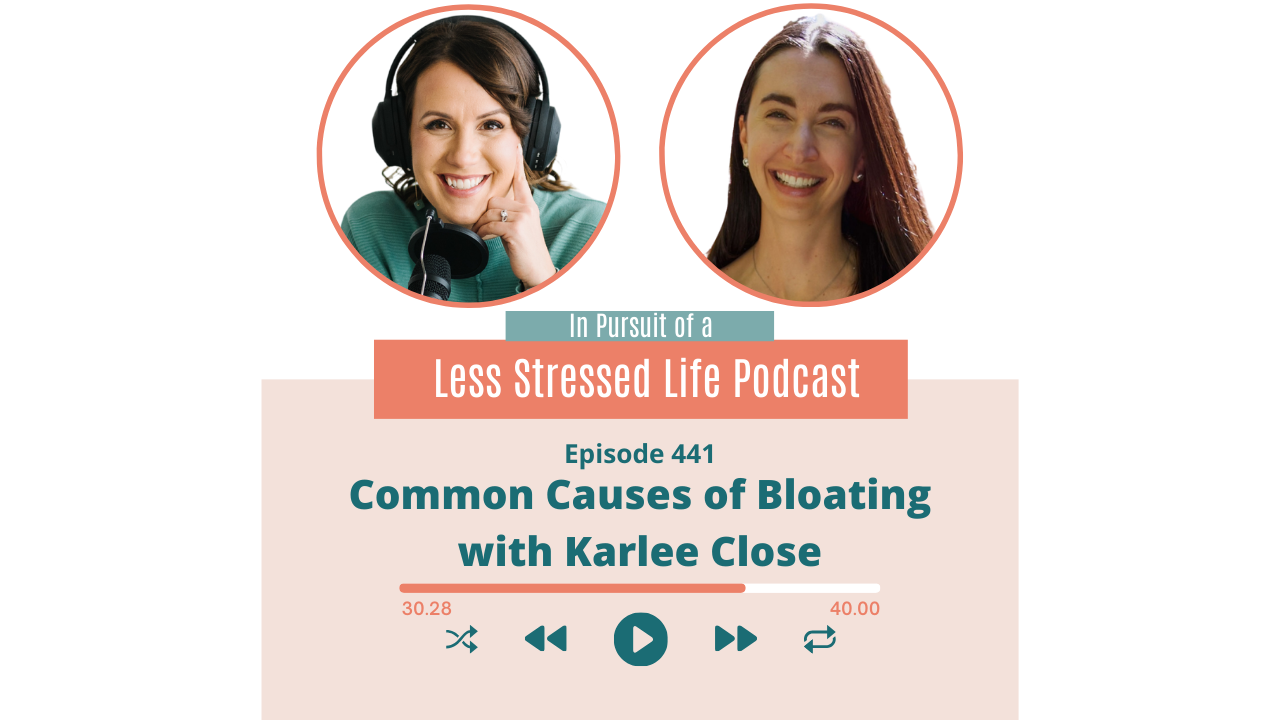
Common Causes of Bloating with Karlee Close
🚨🚨🚨Watch Christa's free training here: christabiegler.com/blueprint
This week, Karlee Close joins me to talk about why so many women stay stuck in chronic bloating despite eliminating foods, running tests, and trying supplement protocols. We unpack how stress physiology, under fueling, and blood sugar swings can quietly shut down digestion, even when you are eating “clean.”
Karlee shares her own story of cycling through restrictive diets, repeated food sensitivity testing, SIBO protocols, and candida cleanses before realizing that the missing piece was foundational habits. We dig into how skipping meals triggers cortisol and adrenaline, why digestion starts in the brain, and how eating in a constant fight or flight state can lead to gas, constipation, and that six months pregnant feeling by the end of the day.
We also cover the role of sleep, movement, and nervous system regulation in restoring motility and reducing fermentation in the gut. If you feel bloated no matter what you eat, this episode brings you back to the basics that actually move the needle.
What's Your Bloat Personality? Find out here: https://www.beyondbloated.com/bloat-personality-quiz
KEY TAKEAWAYS:
• Chronic bloating is often driven by stress physiology, not just food
• Skipping meals and under eating trigger cortisol and slow digestion
• Blood sugar crashes increase cravings and worsen gut symptoms
• Digestion starts in the brain and requires a rest and digest state
• Restrictive diets and repeated testing can keep you stuck
• Light movement after meals supports motility and reduces gas
• Consistent sleep rhythms help stabilize blood sugar and gut function
ABOUT GUEST:
Karlee Close is a Certified Gut Health Coach, host of The Beyond Bloated Podcast, and founder of Beyond Bloated, where she helps women reduce chronic bloating through simple, sustainable habits.
After developing severe digestive issues in her mid-20s, she spent years cycling through restrictive diets and supplements without lasting relief. Now, she teaches a balanced, non-restrictive approach focused on foundational habits so women can feel confident, energized, and comfortable in their bodies.
WHERE TO FIND:
Website: https://www.beyondbloated.com/
Instagram: https://www.instagram.com/beyond.bloated/
WHERE TO FIND CHRISTA:
Website: https://www.christabiegler.com/
Instagram: @anti.inflammatory.nutritionist
Podcast Instagram: @lessstressedlife
YouTube: https://www.youtube.com/@lessstressedlife
More Links + Quizzes: https://www.christabiegler.com/links
SPONSOR:
Thank you to Jigsaw Health for being such a great sponsor. 😎 Use code LESSSTRESSED10 anytime for 10% off!
I released a free training that shares the 4 steps I use to help clients reduce eczema, inflammation, and food-reaction symptoms by 50%+ in a few months — without restriction or overwhelm. The feedback has been incredible, and I answer every question inside the training. Watch here: christabiegler.com/blueprint
TRANSCRIPT:
[00:00:00] Karlee Close: when we don't have that fuel for a long period of time.
Blood sugar drops, and that is very concerning to the body because oh my God, our brains are going to die. That's what the body is thinking, right? Because we don't have glucose, it's extreme reaction, but what it does now is it's gonna release stress hormones, cortisol and adrenaline, to get those blood sugar levels back up to a safe wrench.
[00:00:25] Christa Biegler, RD: I'm your host Christa Biegler, and I'm going to guess we have at least one thing in common that we're both in pursuit of a less stressed life. On the show, I'll be interviewing experts and sharing clinical pearls from my years of practice to support high performing health savvy women in pursuit of abundance and a less stressed life.
One of my beliefs is that we always have options for getting the results we want. So let's see what's out there together.
Today on the Less Stress Life I have Karlee Close, who is a certified gut health coach, host of the Beyond Bloated Podcast and founder of Beyond Bloated, where she helps women eliminate chronic bloating and improve their digestion through simple, sustainable lifestyle habits. Her work is rooted in her own experience after developing severe digestive issues in her mid twenties.
After starting a stressful full-time job as a data analyst, she spent years cycling through restrictive diets, food figure, and thousands of dollars in supplements without relief. Now she teaches women how to support their gut through foundational habits, balanced meals, and a non restrictive approach so they can feel confident, energized, and bloat free in their daily lives.
Welcome to the show, Karlee.
[00:01:52] Karlee Close: Thank you so much, Christa. Excited to be here.
[00:01:54] Christa Biegler, RD: Alright, so big switch from Dana. , Kind of Right, there's still data to analyze very often with clients. So let's hear a little bit about your story and how things started. Like how did you go from feeling fine to suddenly having I think, debilitating stomach pain and bloating and food sensitivities and other things.
Tell us a little bit about how this all happened.
[00:02:16] Karlee Close: Yeah, for sure. And I'll start by saying fine in quotation marks because I was not fine. I just didn't realize that I wasn't fine for a long time, and it wasn't until the. Gut issues kicked in that it was no longer I could ignore it. But going back to the beginning, I lived a very unhealthy lifestyle as many of us do through high school, university, college years.
I did not know how to cook. Everything came out of a box. I did not move my body unless it was dancing at the bar. I drank excessively with my friends on the weekend. Et cetera. No sleep, all the things. And because of that, I was sick all the time and not just getting cold, but getting reoccurring UTIs.
So I was on antibiotics over and over again. I would get really nasty throat infections every single year. Canker sores. There was one period of time where I had five canker sores in my mouth at once, which is excruciatingly painful. If you have ever had a canker sore and just fatigue all these symptoms that I brushed off as my genes, I have bad luck.
I have a weak immune system. Sex to be me. But that's life. And then I started my first full-time job as a data analyst. So I went to school for math. I was like, yay, I'm gonna go be a real adult in the world and get this job. And I was miserable. I hated it. I hated going to the office eight 30 to five every day.
I was bored. I was not fulfilled by the work that I was doing. And it created a lot of anxiety for me. Like every morning I was so stressed, I didn't wanna get out of bed. I was like, I don't wanna go to this job. I hate it here. And that is when my gut issues started. About two months into that job, I remember having my lunch and getting severe stomach cramping, running to the bathroom.
Bathroom explosive diarrhea. I looked six months pregnant every single day, and this just kept repeating. And before that, even though I had symptoms, I didn't know they were symptoms at the time. I didn't have gut issues, and I had always been thin my whole life, even through my horrific lifestyle. I just don't gain weight easily.
So I didn't know I was unhealthy. And when I started looking six months pregnant every day, it was very noticeable to me and. In my early mid twenties, you wanna wear crop tops and look cute, and I was embarrassed by my body. And I was having stomach pain and I was having explosive diarrhea and I didn't know what to eat.
So that is when I started my gut health journey really. 'cause I was like, okay, I can't live like this. This is really disruptive in my life. It's embarrassing. So the first step I took was to go see a naturopath to get a food sensitivity test done. I wanted to figure out what foods were causing the problem so I could stop eating them to stop having the pain and the bloating.
This test lit up like a Christmas tree, and my naturopath said to me, this is the worst one I have ever seen. And as a girl in her mid twenties who doesn't know how to cook, I was in my vodka sunny D era. So you could imagine how traumatizing it was when I was told. Stop eating like literally a hundred foods.
And I had a mental breakdown. I was like, what am I gonna do? I'm gonna die. I'm gonna starve to death. There's no other way to eat than the way I'm eating right now. But I did. I started eliminating. Gluten and dairy first. My mom was already gluten and dairy free, so again, I thought I just inherited it from her and it's just a thing that was passed on and now it's my turn.
So I did feel slightly better. I was still having stomach pain and diarrhea, and I was still bloated, but it was less often. So that kind of started my journey because I eliminated gluten and dairy and I started to feel a little bit better. So my mindset was. Food must be the problem. I am now sensitive to food and I need to figure out the right combination of food to eliminate to feel better, and that is where the spiral started.
So I will. Pause there for you.
[00:06:28] Christa Biegler, RD: Yeah, I think that this is pretty common and so it's like always trying to figure out how to meet someone with the stereotype of, oh, it must be the food because that makes logical sense 'cause it's the digestive system, but there's a lot of other. Reasons for why the digestive system doesn't wanna do what it wants to do.
Actually, as you were telling your earlier story with all the symptoms that you didn't know were really like things that could all be symptoms that could actually be related. I was wondering if you had a mold exposure because having recurrent UTIs and some of the other the. Chronic fatigue and other things.
And then sore throats and then Ill, a lot like that. Sounds like you had a mold exposure at some point, which would make you look reactive to a lot of foods and make your test results light up like a Christmas tree. So I was curious if you ever found that in your history as well. And I'm also intrigued in your Canadian, so I'm intrigued 'cause sometimes it's interesting to think it's interesting to me because so often we go to the GI doctor first and then when we don't get what we want or need, and I think GI doctors are very good at.
Diagnostics with cameras and scoping and things like that. But usually people go to a GI provider before a naturopath, and it's also, depending on what province you're from in Canada, it's like more or less readily accessible to go to a naturopath. So it's interesting that you entered the naturopath first, especially in your twenties.
So those are the two things I thought was interesting. Will you share about those? I'm
[00:07:49] Karlee Close: curious. Absolutely. So the mold exposure, I did do a candida cleanse because once the spiral started, I started trying to dig in what, what's going on? I did read a book, the Bloated Belly Whisper, and that actually led me onto sibo, which is a side story.
I read another book and it was, I can't remember the title right now, but it was related to Candida and at the start of the book there was a quiz and it was like. If you have this many symptoms, you have a candida overgrowth. Pretty much. And I had all of the symptoms, so I did do a candida cleanse for about two months and there were pros and cons to it.
I will say it did eliminate my seasonal allergies, which was really cool. So I do think I had a canida overgrowth, but during that time period I was already obsessed with. What I was eating. And if you've ever done a candida cleanse, , it's awful. Insanely restrictive.
[00:08:48] Christa Biegler, RD: Yeah.
[00:08:49] Karlee Close: And I am a very type A personality, so I was like, this is what I'm doing and I am not straying from it.
And as I mentioned at the beginning, it is difficult for me to put on weight and I lost a lot of weight during that, and it was not a healthy amount of weight, and it took me. Over a year to put that back on. Once I, yeah. Got out of that mindset. So there were pros and cons to it. But yes, I do believe I had a candida overgrowth and part two, I never saw a GI specialist because they refused to see me.
But I did see my interesting standard doctor before the naturopath. I didn't mention that
[00:09:27] Christa Biegler, RD: because you had limita, you had limitations with the insurance where they wouldn't see you. Just curious.
[00:09:31] Karlee Close: No. So the way it works in Canada is we all have, for the most part, a family doctor. So I went to my family doctor, I explained, Hey, all of a sudden I am getting bloating.
Pain, diarrhea after I eat, what's the deal? And she told me. You have a lactose intolerance, you probably have celiac disease. Just stop eating those foods. She did give me a requisition to get blood work done. I have an extreme fear of needles, so I did not wanna do the work, and I just was like, okay, the solution would be stop eating gluten and dairy anyway.
She did not gimme a referral to a GI specialist. I tried to see her several times and she was just like, no. Just stop eating those foods. She gave me a prescription for gas medication to help with the bloating. And I knew about naturopaths because my mom was seeing one. So she put me onto it.
And naturopaths are not free in Canada, but. I was working full time, I had a benefits package so I could use my benefits to pay for the naturopath so it was not an out of pocket expense, if that makes sense.
[00:10:39] Christa Biegler, RD: Yeah. Okay. There's a couple things I wanted to just interject in that story overall because I just wanna clarify if someone had a older mycotoxin exposure than, like Karlee said, I don't think a candida cleanse is like a long, it is miserable, right?
As you said, it does. It is a very, it makes a lot of sense for that time period. It was very common to do for a very long time. I'm sure people still recommend it. But typically we're trying to eliminate this toxin out of the system. Otherwise it creates these aggressive fungal symptoms typically, but it can look, it also suppressed the immune system, et cetera.
When you're not exposed to it, it's not as. Horrific, but sometimes it can linger. So I just wanted to mention those little tidbits because it's something I feel like I talk or educate about a lot. But I wanted to, as we start to talk about bloating, and I'm curious, so one of my first questions is gonna be how long you circled around this stuff before you started looking at alternative things.
And so I will share, I was telling you this offline, that there was a time where one of our. Taglines or one of our advertising, like essentially billboards was like, we help people with like bloating and burnout and skin rashes. I don't know, there was like three Bs, but I can't remember the last one.
But it was bloating and, but what I saw was, it's very interesting for our stereotypes I, so when we use the word inflammation. There's a certain number of people that will come to you for joint pain 'cause that's like our stereotype of inflammation. But inflammation could be pretty much anything. And with bloating, there was a very subset of clients that would come to us and we would do the things that would support the physiology of the body, but they would have refractory bloating.
And I think this is where the rest of what we're gonna talk about comes in where stress is typically the self-limiting factor. And I remember having this one nurse one time and she was. She had a real hard personality, right? Like she had to go be strong for a lot of people.
I always feel like nurses have a really high tolerance for pain. 'Cause they see a lot of stuff. And at one time she identified that she was most bloated or she was pretty much bloated on the two to three days that she was on staff. That she was actually working. And so as it reminds me a little bit of your story because things really escalated as you got into this job, and it would be easy for you to miss that pattern, and I guess you did for a while, right?
Naturally, because you were there every day. Whereas this person was at some point able to identify it does actually seem to be worse when I go to this job. 'cause one of the challenges is, or something my heart kind of melts around is like, or it's a sorrow for me, is this concept of unrealized stress and how it can look all these different ways.
So there's some real physiological, like how we're eating that literally creates physiological changes in the body and creates what looks like food sensitivities or immune reactions in the body, not necessarily the food's fault. About how the food's being processed. So tell us a little bit about like how long did you circle around these things before you started to look at, because you are thinking that you getting a food sensitivity test is the alternative from the provider, right?
So we went back that step and it's oh, this is the basics that I got from this provider. Don't need do this, and this. Which is just interesting to hear what different people recommend. No comment. It's fine, whatever. And then you go to the naturopath and you do the food sensitivity test.
And for me, I used to do a lot of food sensitivity testing about 10 years ago. And it was great until it didn't. It wasn't enough. And then there must be like another phase. But what I find and the, I was just dealing with this morning with a client. She said she had come in and asked about reintroducing food.
She said I did this food sensitivity test a year and a half ago. And it's you were long past the reintroduction periods. Long, long past. So tell us how long you circled around this before you were like, maybe these alternatives I'm was trying aren't effective alternatives. 'Cause I'm, it sounds like it took some time, if you had time to read a couple books.
[00:14:27] Karlee Close: Oh yes. It was an embarrassing amount of time. I went through this cycle of restrict supplement test for probably five years, and I started with the food sensitivity test. I did a food sensitivity test. Three times I did for the first three years. I would retest about a year later because I knew food sensitivities would change.
At that point, I didn't fully understand what I was doing. I was very early on in my journey, but I just kept taking the test to see like, all right, what's the foods now that I have to avoid? And during that time, my naturopath would give me different. Supplements things. Kill this, kill that, whatever. I didn't know again what I was doing back then, so I would just take it, eliminate foods.
Obviously, it wasn't working because I kept trying and kept going back and kept doing things. I read books. I discovered sibo. I tested positive for methane dominant sibo. Again, I was told, kill this. Kill that. Nothing was ever taught to me about. Why do I have sibo? Why does it keep coming back? Candida.
Read a book about that discovered, oh, I probably have a candida overgrowth. Did the cleanse for two months. I did it again later because I was like, you know what? I must not have killed it all because I'm still bloated. So I did it again, and I just. Kept doing this. I did a liver cleanse. The liver cleanse was the most miserable thing I have ever done.
You could ask my boyfriend. I was sitting at my kitchen table in tears because it was a 10 day cleanse of eating essentially apples and fruits and vegetables, and there was no protein. And I'm a hungry girl. I was starving, but I was like, I have to do this liver cleanse because this is my problem. So I was very obsessed and all of these different methods and strategies and elimination diets were causing a lot of stress for me.
And looking back now, it is no wonder I was not feeling better because all of the solutions that were provided to me. Were so stressful to me and it was making everything worse, but I didn't know that, as you mentioned, like most people don't realize that stress is a massive factor as to why you have gut issues along with so many other habits that we can get into if you're feeling up to it.
But that was, yeah, a five plus year journey for me.
[00:16:57] Christa Biegler, RD: Yeah. The problem with stress is it's such a baseline for us. We don't really think we're stressed and, this isn't exactly your story. I pick out, or I use this story a little bit recently, especially a woman who has children, she's been in, generally, very often she's in a stress response because she's waking up and reacting and taking care of another human for so long where it becomes this literal baseline.
And it might look for someone without that. It's am I picking up and responding to lots of messages on my phone? It's a very reactive thing overall, which is where like nurses, they're taking care of, how many quote unquote. Kids, right? Like different patients, right? And they all need something all the time ringing their lights.
It's like kind of reactive. We're never really taught much about our nervous system, right? And what it might feel like to be activated. People will ask, things like, how do I just stay? How do I like remove stress? It's like you don't actually remove stress. You get better if fluctuating in and out of a stress response state.
But if you cannot identify what that looks like for you, which takes some radical self-awareness. Then probably you'll hit rock bottom first, like most of us before you Oh yeah. Before you realize it, it's none of this is working. And to your point, briefly like sibo. Something in the United States as well has become more readily accepted, and I always say we're a little more interesting than two bacteria overgrowth, right?
Like we have a little more going on. There's what's going on above and below. And so unfortunately, it's a very high percentage of people that have relapse of SIBO because it's not really taking care of coming in and just. Trying to kill a couple bacteria, which really kills a lot of bacteria, isn't really covering the ups and the downs and all the other pieces.
And so as you said, stress is the self-limiting factor, but it looks like different things. So what are some ways that we communicate stress? The digestive system that feel tangible, like using your own examples if you want. That might cause bloating.
[00:18:47] Karlee Close: Yeah, stress. The thing about stress too is that you can be mentally stressed and feel it.
You're like, oh my God, I'm nervous. I'm anxious for this thing. That is a stressor, but you can also be stressing your body out without. Realizing it. Yeah. By doing things like under fueling, that's very stressful on the body. Yeah. Sleeping five hours a night, that's very stressful on the body. So in my first half of the journey when I didn't realize I had issues, I was very carefree.
I was going out with my friends and partying, doing my thing, eating whatever I wanted. My body was very stressed out, but I was not mentally stressed. Then when I stepped into part two, the full-time job that I hated. I was still physically stressing my body, but now I'm also mentally stressing my body.
And it was the two angles coming in together, and that is the straw that broke the camel's back. And then my gut was like, all right, we're done with you. Like you need to change your ways. So I wanted to point out that there's two types of stressors. I love it. So getting both under control is gonna help with bloating because if you, like I said, aren't sleeping.
I recommend eight plus hours a night. Honestly, especially if you have gut issues, like you need that time to rest, recover, repair eating enough. I see it so often with the women that I work with, they don't eat enough in a day. Whether that be because they skip breakfast, they don't have time, they work through lunch.
They just are taught to avoid carbs because carbs are the devil. Like we've been taught a lot of misinformation. And so under fueling your body is gonna be a stressor. And then of course, there's the mental stress. So if you are jumping from working, writing emails, you're irritated at your boss, and then you're like, all right, I'm gonna go eat my lunch now in an angry state like your body.
Cannot digest that food. Even if it is the most nutrient dense meal on the planet, you will not be creating stomach acid or digestive enzymes to break down and digest that food because your body is in a state of fight or flight. So when we're in fight or flight. Our body does not care about breaking down that hamburger you just ate.
It's prepared to run or fight literally survival mode. So what I always do to get myself outta fight or flight before I eat is I make sure I sit at the table away from distractions. No phone, no computer, no tv. You may think scrolling on Instagram is not stressful. It is. So please do what you can when you can.
But sitting away from distractions is step one. Taking three to five deep breaths, just two signal to your body. You are safe. We are going to eat. Another thing that I do if I'm at home making a meal is I'll put on some music and I will hum along to it or sing along to it because that activates our vagus nerve.
It's also fun, so you know, sing, dance, hum along to your music while you make your meal. That also is gonna help put you into that rest and digest state. Take your time when you eat, put aside like 20 minutes. If you've got 10 minutes to devour a meal, it's not enough time. 20 minutes. That gives you some time to clean up after maybe chew really well.
I'm sure you've heard it before. Our stomachs do not have teeth. If you can really break down that food before it hits the stomach, that's just gonna make it so much easier for your gut to digest that food. And just enjoy it. Leslie don't make it feel like it's. A task to eat your meal in five minutes flat make mealtime enjoyable, a restful, relaxing space.
Sometimes I'll sit outside on my balcony 'cause outdoors is great. It's relaxing. But truly getting into that rest and digest mode is like step one. 'cause digestion actually starts in the brain. So we need our brains to signal to our guts. It's time to eat, so stomach acid and enzymes and all the gastric juices start flowing so you don't end up bloated after that meal.
[00:23:03] Christa Biegler, RD: Yeah, I think in general, in, at least in North America, I think it's becoming more pervasive worldwide. And I don't know that Canadians are much different than Americans, but we don't necessarily look forward to our meals when our days are full and busy. And even my kids at school get an absurdly short lunch break.
I remember when we had our Spanish exchange student and there was a French Exchange student. They were just so appalled at the very short lunchtime that they had overall. I was talking to someone yesterday about, you know how when you're a running track or a race or something, you'd wanna run against someone who's better than you if you were trying to improve it, so you actually could understand the pace.
This reminds me of. Eating with all my nutrition classmates in college and being done eating before all of them, and not really understanding why I was done eating. I didn't think I was eating that quickly, but if you don't have, and before that, I really just was eating with my family and I sat right next to my dad who was a.
Like in the military, and he probably ate his food so fast, right? And so that just became like the pace. And so until I saw a different pace, it's hard to realize you have to have this epiphany outside of yourself very often of sh because I can't just quit my job, right?
So how do I create some safety in that space? And so how do you take a break to actually eat that food? So you talked about how digestion starts in the brain. Which is lovely. So let's talk about what happens when we're skipping meals and not eating enough during the day. How people who aren't eating, I don't know, you've heard people say this or water makes me bloated.
So what would you say to those people? What's happening for them?
Over half of us are not getting enough magnesium, which is responsible for thousands of processes in the body. But how do you know if you'd benefit from magnesium? What visible signs could you see? Here are some cases where I'd want you to start thinking maybe I should try magnesium for that. Now, let's say you wanna get in some good deep sleep.
Try a high quality magnesium 30 to 60 minutes before bed. If you have any inkling of a headache or even just to relax, any of those premenstrual cramps or muscle tension, especially post-workout, magnesium would be a superstar for filling in those gaps. Now up to 600 milligrams for that headache. If you're finding your heart racing with caffeine or with stress, then for sure magnesium's calming effect could be helpful.
But if you're dealing with eye twitches or restless legs, you're past the point of as needed. These are major red flags that you're probably depleted in magnesium. The good news is you could absolutely fix it, but it might take a few years to really fully replete those magnesium stores. But here's the deal.
Don't stop when the symptoms stop. Just keep going to replete it even further in any of these cases. I love jigsaw's mag, SRT because it allows you to take a higher, more effective dose without any laxative effects because it's got an eight hour time release. That's what the SRT stands for. It stands for sustained release technology.
It's the only time release magnesium with a human trial on the market that we know of. This is helpful to get all the benefits of magnesium throughout the day or throughout the night depending on your need. You could take it at both times if you want. And it's Meg Sr T's 20th birthday this year. So you can celebrate by getting yourself some Meg, SRT with the discount code, less stressed, [email protected].
You can use less stress 10 to get a discount on anything you want, as many orders as you [email protected], including my favorite potassium cocktail and cod liver oil. So go check them out and we just appreciate them sponsoring the podcast so much. So when you support them, it supports us.
[00:26:46] Karlee Close: Yeah, and like I said, this is a massive one. I would say this is probably the thing. I see the most in my practice and the thing that I help my clients with, because we're just used to living that way. So for example, very common women skip breakfast.
They claim they're intermittent fasting. They've read about it, they believe it's beneficial. Okay. If you read about it, you think it's beneficial. I get it. I get why you're trying to do that. They're too busy to eat lunch. They skip it, they work through it, or they're shoveling it down while they're working. When we go too long without eating, or we're skipping meals, or we're under fueling, our blood sugar is all over the place. So when our blood sugar drops too low, say you've gone seven hours without food, your body needs food to exist. Your brain is fueled by glucose. So when we don't have that fuel for a long period of time.
Blood sugar drops, and that is very concerning to the body because oh my God, our brains are going to die. That's what the body is thinking, right? Because we don't have glucose, it's extreme reaction, but what it does now is it's gonna release stress hormones, cortisol and adrenaline, to get those blood sugar levels back up to a safe wrench.
That is slowing down digestion significantly because like we talked about earlier, when you are in fight or flight, when you have high cortisol, adrenaline, digestion is not a priority. So digestion slows stomach acid, enzymes not being produced, motility is slowing down, and you are going to experience gas, constipation, and therefore floating.
Not to mention when your blood sugar drops that low. Your body is searching for fast fuel. It wants a quick hit so we can get back up to safe levels. So that is when the cravings kick in at 3:00 PM and you're at your office and you see the candy jar and it's looking real appealing at that time of day because you skip lunch and it's not a willpower thing.
A lot of times people think I just can't say no to the candy or the muffins or whatever when they're around. But if you aren't eating enough, and not just eating enough, but eating balanced meals throughout the day, so you're including your protein, your healthy fats, your fiber, your complex carbs, again, your blood sugar is gonna be on this rollercoaster causing you to have these cravings and the quickest hit of.
Glucose to get your blood sugar back up is going to be the pastries, the chocolate, the candy, the sugary drinks. So it's not your fault if you are feeling these extreme cravings, but it is gonna cause you to have digestive upset. So I really strongly recommend if anything, have breakfast within one to two hours of waking.
If you're not used to eating breakfast. I hear it a lot. I'm not a breakfast person. I'm not hungry in the morning. If you are drinking coffee first thing in the morning, coffee isn't appetite suppressant. So it would make sense that you don't feel hungry if you haven't had breakfast for years. If your body is in a state of survival, it's not expecting food, you're not gonna feel hungry.
But if you can start just having something really small in the morning, like a little bit of a smoothie or maybe an egg, whatever it is, just to get that rhythm back, your metabolism will start ramping up. You will start feeling hungry again. I was just working with a client who never ate breakfast ever, and I was like, you know what?
Trust me, please, let's just do this. Try to have breakfast. So she did, and she let me know. I start I'm hungry in the morning. I wake up and I'm hungry. She's I've never had this feeling. She's lost weight. She's not bloated. Her food sensitivities are starting to reverse, everything is improving.
[00:30:40] Christa Biegler, RD: Safety.
[00:30:41] Karlee Close: Exactly.
[00:30:43] Christa Biegler, RD: Your body like starts to shut things down when it's I don't know when I'm gonna get fed again. And that's essentially like what happens. And even in your story, things were not good and then you started this job and then everything really fell apart and I see that. It's like you're getting by and then when you add on this additional stressor, things fall apart.
And I only smiled or smirked when you said women start intermittent fasting because I did that, I was working in a program where we were teaching intermittent fasting and I totally trashed my thyroid and adrenals and just emphasize, I always love stories, right? But what I've seen with.
Clients that don't eat breakfast or have this fasting history is it takes some time for this stuff to come online. And we have a little bit of a recalibration on there's no intuition around eating in, we falsely think intuitive eating means. Stop when I'm full. Eat when I'm hungry.
But when the fallacy is, like when you said I'm not hungry in the morning or if I, drink coffee, I suppress my appetite. I noticed if I drink coffee and I don't eat, like I am not an anxious person, but I'm like all scattered, right? And so that's how it looks for me. Because of those biochemical responses that you were describing.
Literally, it's oh, I didn't eat on time like I wanted to drink my, 'cause people get worried about doing a type A person, especially, right? We get worried about doing it right. 'cause they've heard, oh, you should eat before coffee. And I think it's okay if you understand the positive negatives of how your body is gonna respond.
Just eat your breakfast. And sometimes even me I am like, oh, an hour has gone by. It is time for me to eat. I must eat. And so anyway, I share that. I feel like it, for me, and I've noticed this with clients for sure, it takes some recalibration to get back to feeling like you can eat again. I'm just saying it doesn't happen in two days all the time.
I feel like it takes enough time and there is like a, almost like a confusion for the body, right? It's because everything is happening in the brain and so one, we've turned off a lot of things as we're undereating and under nourishing and then we just try to eat enough or a lot and we're like, I don't know if this isn't.
The right amount sometimes. And so I would say there's a rough patch in between there of figuring out where to land, where you may end up overeating 'cause you've been undereating for a while and not that should be stressful. It's like there's a part where you come back to the middle point if you just are patient with yourself as well.
So I just wanted to, I dunno if you've seen the same thing or not.
[00:33:01] Karlee Close: Yeah, it definitely takes time. And I know we're all impatient because when you have been feeling unwell for. Decades. In some scenarios you wanna feel better quickly, right? And there are definitely some quick wins involved. Like you often start to feel small changes quicker than like decades, but to get fully back to where you expect to be. It can take time because if you think about the damage you've done over the amount of years, it's like to expect that to be reversed in a week is unrealistic.
[00:33:33] Christa Biegler, RD: Yeah.
[00:33:33] Karlee Close: But
[00:33:34] Christa Biegler, RD: or even a month or two sometimes. It's pretty unrealistic. Sometimes we have to stop and remind ourselves of how far we've come, and I find like in general, something I'm thinking about building in that I was doing for people, it's like we actually need to remind ourselves of our own progress as we go as well.
Because as perfectionists, when we don't go zero to a hundred. Or a hundred to zero we're frustrated and it's that wasn't the goal. The goal is like incremental, decrease in improvement. Something measurable you can see. But our brain is constantly wanting to switch the field goal for us. So we have to fight that a little bit.
Not necessarily fight it, but we have to realize like that's a little bit of our stress response as well. Unfortunately, right? That we want this to be perfect or we, or I find another like mental emotional pattern I see with clients is just like fear in general of oh, today someone said I'm just afraid that in seven months I won't be better.
I'm like, why don't we just focus on right now this month? And I understand it's so normal. We're all trying to predict the future overall. Okay. I have a few more things I wanna talk about. Just the what's going on in the body. But before we talk about movement and its impact on the body, I wanna go back to something you said about sleep, because it can be when you have physiological gut issues, sometimes sleep is impacted because of serotonin being made in the gut.
But that said, there's a lot of sleep issues that are unfortunately created by our lifestyle as well. This. The episode's not about sleep, but I have to when there can be a caveat, I wanna stop and ask you about the caveats. What might you tell someone who is I cannot sleep or I'm sleeping poorly or whatnot related to gut issues when you're like, yeah, but you need to sleep.
And I know that's not a small question. I know it's actually a big question but what might you say overall, or would you just focus on what you can control and what are some of the inconsistent routines in people who are dealing with bloating around sleep, perhaps?
[00:35:20] Karlee Close: Yeah, definitely. Step one is like making the time for sleep. So if you're only allowing yourself five hours of sleep, no, you're not gonna be sleeping well. That's not enough. And it's also about having a consistent bedtime and wake up time, even on the weekends. This was huge for me. I hated my job, so I was staying up super late on the weekends.
It's like that fear of I want the weekend to last forever 'cause I don't wanna go back to work.
[00:35:48] Christa Biegler, RD: Yeah.
[00:35:48] Karlee Close: And then revenge bedtime come Sunday night. Yeah, exactly. So then come Sunday, I'm trying to go to bed at a reasonable hour because I have to get up for work the next day and I cannot sleep because I stayed up until 2:00 AM on Saturday and I slept until 11.
Getting a consistent bedtime within 30 ish minutes every night, even on the weekends, is gonna help get into that routine. Waking up around the same time every morning, getting morning sunlight. That helps reset your circadian rhythm. Most of us are inside, literally all the time, so if you can, if you have the ability to.
Sit outside with your breakfast, even if it's just for five minutes. If you can't sit near a bright window, open it. If you can, try to get some morning light that truly is very important for sleep. Having that melatonin production at night to make you feel sleepy screens is huge. If you are on your phone lying in bed, scrolling until the moment you close your eyes.
That blue light is messing your sleep up big time again, messing up your circadian rhythm. So try to put your phone away 30 minutes an hour if you can, before bed. I read before bed. It's a nice calming activity and it's not like a, I'm reading an educational book before bed. I'm not trying to get my brain all activated.
It's like a calming thing for me to have a tea, chamomile tea with it. Create a calming ritual for yourself that says. I'm going to bed and it doesn't have to be crazy. Like I literally have a tea. I get off my phone an hour before bed, I read a book I like, I go to bed at the same time and I wake up at the same time-ish every day.
If I can, I go outside. I'm not gonna say I'm perfect and I do it every morning. These things are. Quite important for our sleep. And there are things that I bet you 90% of people don't do. So if you're struggling to sleep, try some of them. You don't know until you try. Blood sugar is another thing that impacts our sleep.
Like I talked about, if you're not eating enough at night, your blood sugar could be crashing. Cortisol and adrenaline pumps out at 2:00 AM when you're trying to sleep. So if you're waking up around. One to three in the morning wide awake, and you're like, why am I awake? What the heck happened Could be blood sugar related.
That was happening to me actually. And it's not that I was undereating, it's that I have a really fast metabolism and I just need to eat more frequently than the average person. So I was stopping my dinner at six and not eating again until. Eight the next morning, and that was too long. So I started having a very small balanced snack before bed and I stopped waking up at two in the morning wired and wide awake.
So another thing to look at, but there are a lot of ways to improve sleep. So if you think you're someone who just can't sleep, I promise you there are things you can do to improve it to get that working for you.
[00:38:45] Christa Biegler, RD: Yeah, I think people are most shocked to hear that when I give them some numbers. I'm like, you might need to hit this amount of carbs.
They're like, what? And it is shocking. It's like it's communicating when you are eating and digesting carbs. The problem is when people are not digesting carbs because of some of the AFO mentioned things that we discussed because when we are not digesting food, you will have some gut imbalances typically.
That's the side effect of. Not digesting and digesting happens when we're eating fast or distracted or all the things that you already said. And so it's like all of the pieces that need to fit together. So undigested carbs are really the problem, but then that's why people are surprised because there's been such a conversation for so long about carb restriction and people see, less water retention and bloating.
'cause we have, I think generally we have a lot of issues overall and digesting and. Letting the body utilize carbs is so nourishing to the adrenals to supporting blood sugar, balance, et cetera. And so when not, exactly as you just said, it'll wake you up. And I think people are most shocked by that related to sleep, to be honest.
So super good, important reminders. And the other thing I wanted to underline that you said is hanging, I think sometimes our brain needs a place to like rest, right? It's oh, I've heard some of this before, but. What if you had a ritual? So as I think about, I feel like it's the end of the year and I'm journaling more and I'm thinking about intentionality and I love the concept of a ritual.
And a ritual doesn't have to be this like long drawn out thing, but it's like something you have reverence to. And so you brought up these couple things and it's like the ritual can be, the mealtime can be the ritual in the first place, and the bedtime routine can be, the ritual and perfection here is not needed.
I think our brain goes instantly to where we cannot do something all the time. And it's maybe it's not seven days a week. Maybe not always all the time, but what if it's the majority of the time to start with, right? What if we focus on everything we can do instead of the one day we can't do it because of the wedding we're going to or something.
So I just like to remind us of our brain is so sneaky and wants to play tricks on us sometimes. Or say oh, I think I'm stuck in that place. And I always think if someone feels like they cannot do something, then who am I to tell them the otherwise? We have to have this kind of that's.
That's having a wall around something overall. So another kind of pillar around bloating. We've talked a bit about food and skipping meals and snacking and not getting adequate amounts of macronutrients, making you hungry and causing blood sugar dysregulation, which will cause sleep issues.
So good, right? Like all these things. Super connected. Let's talk about how movement can impact bloating overall.
[00:41:24] Karlee Close: Yeah, and this is one, I don't know, people make the connection all the time because I feel like we're either on one spectrum, one side of the spectrum or the other. We're either the people who are like crazy active, we're going to hit seven days a week and we can't miss our workout and we love exercise, which is awesome.
But then there's the other side where we're just busy and we work desk jobs and we have kids and it's I can't get to the gym. I wish I could, I just can't, I rarely see the middle ground. But the middle ground would be a great place to be if you can. And I'll explain both sides and how they impact bloating.
So we've got the very stagnant person, the person who is working the office job sits a lot. That is going to slow down your digestion. One of my biggest recommendations for clients who experience bloating and gas after meals is to move their body after the meal. If you cannot go for a. 30 minute walk.
That doesn't matter. Even if you are at home and you can't get outside, let's do chores. Okay, I've got a load of laundry to do. I've got 10 minutes. Let's do it now. I gotta put the dishes away. Let's do it now. After this meal, it is gonna help stimulate digestion. So you've just eaten this meal now it's sitting there and you're just gonna go and sit.
And now everything is just sitting and it's very stagnant fermentation, bloating, gas, slow motility. It's all way more likely if you're just gonna be very still. Whereas if you get moving and you put the laundry away, you do a five minute walk outside, you put the dishes away, whatever it may be, you are helping digestion move along.
Things are moving quicker. It's gonna move faster through the digestive tract, and it's not just gonna sit there and ferment and cause the bloating in the gas. The other side is the person who is doing a lot of. Physical activity, they are loving, hit, they're runners. That is stressful on the body and I actually have proof of that.
I myself do enjoy spit in class. I do it once a week. I. It is a very high intensity workout like we are spitting. My heart rate is going up to one 70, like it's a lot. I'm sweating. It's a great workout. I wore a continuous glucose monitor for two weeks, just as a fun experiment for myself. And I went to spend class.
This was after I had eaten, so it wasn't food related. And just from the spin class alone, my blood sugar went. Just because of the stress that I was putting my body under. And that's not to say I should never do spin class 'cause it's terrible for me, but if that is your main form of exercise and you are doing that.
Five to seven days a week and you are having gut issues. As we talked about earlier in the episode, stress is one of the biggest reasons why you have gut issues. So if you are also adding unnecessary stress by doing the hit, the spin, the running over and over again. That's not necessarily the best form of exercise for you to be doing.
My favorite types of exercise for someone who has severe gut issues is walking, stretching, yoga, maybe some Pilates. Very relaxing, chill exercises. You're moving your body, you're stretching it out there. If you Google like floating stretches on the internet, you can find like stretches that are good for the abdomen, like getting gas moving.
'cause honestly, a lot of times bloating is caused by food. Sitting there fermenting gas buildup, slow motility, constipation. Not always, but a lot of the time. And if you can just help move those things along, that will at least reduce the amount of bloating that you're experiencing after meals.
[00:45:22] Christa Biegler, RD: Yeah. Yeah.
I don't know if I even finished talking about when people would come to us for bloating. There was a subset of them that, I don't know how to describe it, but it was like they literally hated themselves. Or hated their bodies. And I always am really interested in emotions stored in the bodies. And I don't know if you, it generally is coming into your work regardless.
'cause when we're having overall mindfulness or being intentional about these lifestyle things, which are actually the things that. Create our entire life, right? What we're doing every day throughout the day creates our life no matter what. I don't know if you've ever seen where there's some personality profiles sometimes around this, 'cause I think it's in Eastern Asian medicine, they talk about worry being stored in the stomach as well.
[00:46:08] Karlee Close: Yeah, I do. It's very sad, honestly, and I relate because I was that person, right? Like I was in my mid twenties and I did not like the way I looked. And it is, it takes a hit to your self-confidence. And I do have clients on like discovery calls crying because they're upset about the way they look like they do not feel good in their skin.
They do not feel good in their clothes. They feel very limited in what they can wear. And there's definitely a mindset piece around that. It's hard, right? Because
[00:46:41] Christa Biegler, RD: yeah,
[00:46:42] Karlee Close: it's hard to accept. We talk about body positivity and it's it's hard to accept your body when you know this is not. Normal.
Yeah. Like I knew that was not my body. It's like it is, but it isn't. So yeah, you're right. There's a lot of emotional. Aspects to it for sure.
[00:47:00] Christa Biegler, RD: I think. I think I was never prepared for all of the emotional, mental aspects in private practice when I started 10 ish years ago. That for sure because of the gut-brain connection, there's always gonna be, but because we're humans, there's gonna be an emotional aspect to no matter what we're doing.
And sometimes our physical symptoms just give us an opportunity to look at some other layers to unlayer, because I think. No matter what, whether we like it or not, healing does come in layers. Just because you reduce or resolve some symptoms at a certain level doesn't mean there's not going to be other things for us to unlayer as part of life.
The things to solve are inevitable. There will be many of them throughout time and throughout life. So if you could summarize a couple of things, if you could tell someone a few things that they can do today, and we've already covered this mostly, right? But we wanna end on this tool. And I wanna mention one thing before I go there.
, There is also another episode called, I think the title is just appropriate, where it's like you can love your body and still want to change it. And I think sometimes it can take time to get to that point. Most certainly. I think there's a lot of like potentially inner healing to different things around that.
You can not hate your body and still want to change it as well as is the point. But if someone was listening to this and they were delighted to hear all of these things that they can work on related to bloating, what would be if you were gonna tell someone who really needed to hear this episode?
Don't forget to do these few things every day to improve bloating. How would you wanna wrap that this up? Or how would you, what would you wanna tell people?
[00:48:37] Karlee Close: Yeah. I would start by saying, add food back in opposed to eliminating food. Don't just look at the food sensitivity test and take it as is. Listen to your body.
I eliminated so many foods, just 'cause a piece of paper told me to, and I didn't even react to them. So listen to your body more than a piece of paper. I also would highly recommend you start eating breakfast within one to two hours of waking up. If you're not used to breakfast, start with something small.
When you do eat, ideally you space your meals three to four hours apart. So maybe you have breakfast, lunch, a snack, dinner spaced, three to four hours apart. That's my regimen. Make sure all of those meals are balanced. So they include the protein, the healthy fat, the fiber, and the complex carb. I know carbs are scary for some people, but it can be like.
A piece of sweet potato, some rice, some quinoa, a piece of fruit like add in a little bit of carb if you're new to getting carbs back in your diet monitor. The other things that we talked about, even just looking, and taking a step back and being like, okay, what does my sleep routine currently look like?
What is my movement schedule? Am I moving or not? Stress, like, how am I eating my meals? Just observe how you are doing these things and pick one thing from each category that you can improve. Maybe you can put your phone away at mealtime. That's the mindful eating aspect taken care of. Maybe you can go for one five minute walk a day.
Amazing. And then maybe you start going to bed around the same time every night. That would be phenomenal place to start. Truly, if you could just pick one from each category, that is gonna be my wrapped with a bow advice.
[00:50:28] Christa Biegler, RD: I love it. This was fun. It's always fun to come back to these essential basics.
Honestly, this is the stuff that. We all need, but we don't always do. It's not as sexy to do the things that are free that really are so important. And I think stopping and being honest with ourselves is also hard to do. Like it's very easy to just skip over things and wanna jump straight to the fancy stuff.
And we need to include, we need to have this stuff as well. Karlee, where can people find you online?
[00:50:59] Karlee Close: I am beyond bloated on Instagram. That is my most active social media. I also have beyond bloated.com, my website. That is where you can learn more about working with me, and I do have a new free resource that I'm excited about.
It is the What's Your Bloat Personality quiz. Everyone loves a good quiz and yeah. Everything that we talked about today is put into this quiz. So basically you run through it. It's free. It's about two minutes long, and I will tell you what your bloat personality is based on your daily habits. I'll explain why your habits are keeping you bloated, and I will provide you with.
Three personalized tips on what you can start doing today to start to improve your bloat. And that's on my website. If you just go to beyond bloated.com, it's like right there on the home screen. What's your bloat personality quiz? So you can do that?
[00:51:55] Christa Biegler, RD: Yeah. When we get these types of things, like we love a good quiz or we love to identify because it starts to help us, it like does some of the work of telling us about ourselves in a way.
Or we can check it against ourselves. I think that's part of why we like it, right? It just like. It makes it easier on our brain. Thank you so much for coming on today.
[00:52:12] Karlee Close: Thank you so much. It was a pleasure.
Do you need a detox?
Getting "too old" to handle alcohol?
Sensitive to smells or metals?
Skin issues?
Detox isn't just juice cleanses & snake oils. It's a process that our body is trying to do all day long.
Take the quiz to find out if it's time for a detox.


