
Thriving with Autoimmunity with Michele Spring, CHC
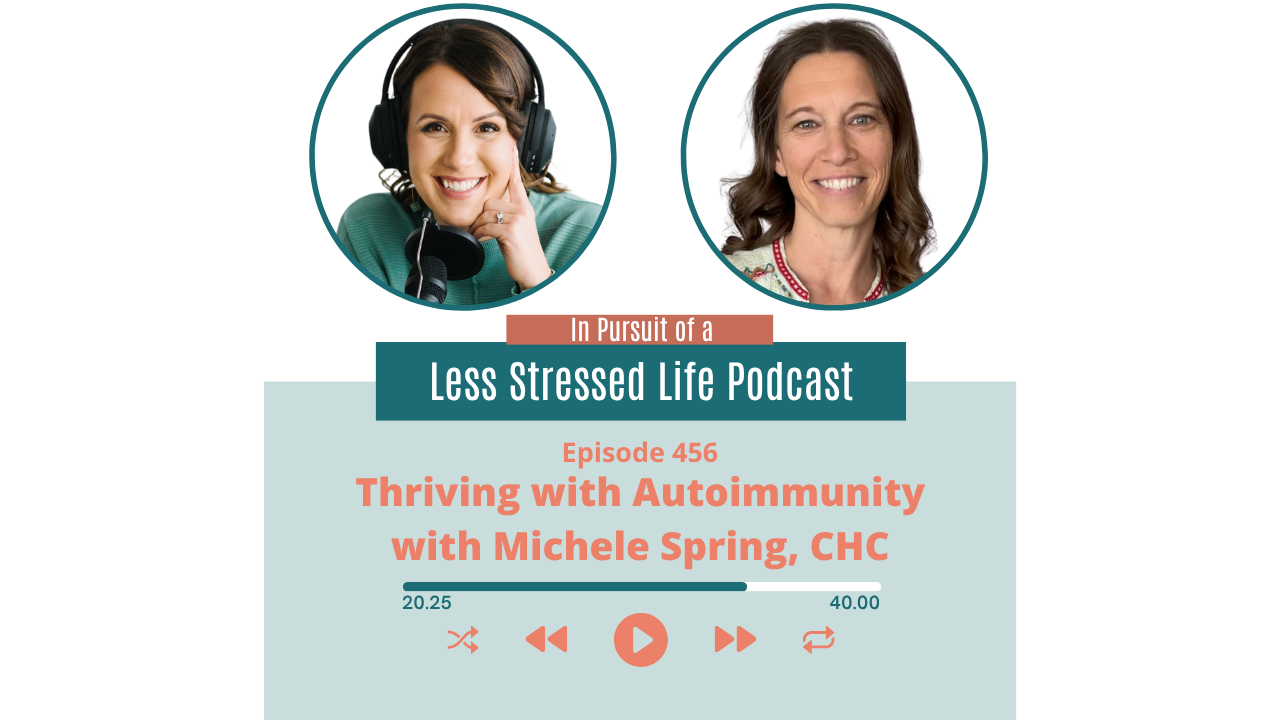
This week, I’m joined by Michele Spring for a conversation about Hashimoto’s, autoimmune healing, and the often-overlooked role stress plays in chronic illness. We talk about why food can be a powerful tool for uncovering inflammation, how restrictive diets are meant to be temporary, and what happens when symptoms return after you've already done the work to feel better. We also explore the connection between perfectionism, people-pleasing, overachievement, and autoimmune disease, along with why nervous system regulation became such an important piece of Michele’s healing journey.
KEY TAKEAWAYS:
• Hashimoto’s is about more than thyroid hormones
• Food can uncover hidden sources of inflammation
• Healing often requires more than dietary changes
• Overachievement and people-pleasing can fuel chronic stress
• Nervous system support is a missing piece for many people
ABOUT GUEST:
Michele Spring is an autoimmune health coach, founder of Thriving Autoimmune, and a Hashimoto’s and Celiac disease warrior. After struggling for years with fatigue, brain fog, weight gain, and other symptoms despite conventional treatment, she discovered a root-cause approach that transformed her health. Today, Michele helps women with Hashimoto’s and hypothyroidism reclaim their energy, clarity, and confidence through nutrition, gut health, nervous system support, and sustainable lifestyle changes. Through her coaching programs, educational resources, and personal experience, she has helped hundreds of women take control of their health and thrive.
WHERE TO FIND GUEST:
Website: https://thrivingautoimmune.com/
Instagram: https://www.instagram.com/thrivingautoimmune/
SPONSOR:
Thank you to Jigsaw Health for being such a great sponsor. 😎 Try their Electrolyte Supreme in the crowd-favorite Fruit Punch flavor this summer.🍓🍹Use code LESSSTRESSED10 on every order for 10% off!
NUTRITION PHILOSOPHY OF LESS STRESSED LIFE:
🍽️ Over restriction is dead
🥑 Whole food is soul food and fed is best
🔄 Sustainable, synergistic nutrition is in (the opposite of whack-a-mole supplementation & supplement graveyards)
🤝 You don’t have to figure it out alone
❤️ Do your best and leave the rest
WHERE TO FIND CHRISTA:
Website: https://www.christabiegler.com/
Instagram: @anti.inflammatory.nutritionist
Podcast Instagram: @lessstressedlife
YouTube: https://www.youtube.com/@lessstressedlife
More Links + Quizzes: https://www.christabiegler.com/links
Protocols: https://www.christabiegler.com/protocolshop
TRANSCRIPT:
[00:00:00] Michele Spring, CHC: so many people are gaslit and dismissed by their doctors and told, "Just take this medication. It's all in your head. There's nothing else you can do." And then maybe you've tried one or two things and it doesn't seem like it worked.
[00:00:11] Christa Biegler, RD: I'm your host, Christa Biegler, and I'm going to guess we have at least one thing in common, that we're both in pursuit of a less stressed life. On this show, I'll be interviewing experts and sharing clinical pearls from my years of practice to support high-performing, health-savvy women in pursuit of abundance and a less stressed life.
One of my beliefs is that we always have options for getting the results we want, so let's see what's out there together
All right, today on The Less Stressed Life I have Michele Spring. Michele is a health coach, AIP coach, a Qigong and yoga teacher, and the founder of Thriving Autoimmune. After being diagnosed with Hashimoto's and celiac disease while raising two young boys and working full time, Michelle found herself exhausted, foggy, inflamed, and frustrated by being told medication was the only solution.
Through healing her gut, and regulating her nervous system, she completely transformed her health and now helps women with Hashimoto's do the same. Welcome to the show, Michele.
[00:01:29] Michele Spring, CHC: Thank you so much for having me.
[00:01:30] Christa Biegler, RD: Yeah. I met Michele at a conference recently, and I guess I'd already
I was aware of her because she has a, I think a quite a large online presence around autoimmunity, et cetera. So here we are, talking about her story and how that has shifted and changed and evolved in the years. So I always like to start, Michelle, with the story, with a little bit of the origin story.
So you were diagnosed while raising two young boys and working full time. I'm sure that's in the bio on purpose. That reminds me of my own health story. It's oh, there was a few things happening at the same time, right? So tell us a little bit about what that diagnosis was like. How many practitioners did you have to see to get diagnosed with Hashimoto's and celiac disease?
And what was that process like in general? I'm also curious to know if these were separate diagnoses or if they happened together, and if anything else happened right before the celiac diagnosis, because sometimes I see people an infection or something, and then they secondarily, like it'll trigger the celiac.
So I'm a little curious about how this all started and when this was.
[00:02:26] Michele Spring, CHC: Yeah. We actually have to go back to 2006 because I used to be an Ironman triathlete.
Crazy, like doing s- like workouts all the time, twice a day. And after I had done my second Ironman, I just didn't seem to recover. And I just felt tired, and like a, there was a point I thought I had mono because there was nothing I could do to feel better. And so I went to my doctor and he diagnosed me with hypothyroidism.
And immediately put me on levothyroxine. And for a couple of years it worked and I felt okay.
But then it started to go downhill again. And then I had both my kids- ... and it just went off a cliff. I really started feeling so bone-deep exhausted every single day. I could barely move. I would go to work, 'cause I was working full time as a computer programmer, and I would get specs And I'd have to read through them at least three or four times before I even understood what I was supposed to do because I was so brain fogged.
And I would come home, pick the kids up from daycare, and just crash on the couch, and I wouldn't be able to move for the rest of the night. My husband would have to cook dinner. My kids kept coming to me like, "Mom, come play with us. Come play with us." They were just toddlers at the time, and I couldn't do it.
I was so tired. And I just kept thinking there's something wrong." And I would go to my doctor, the one who prescribed the thyroid medication and had diagnosed me with hypothyroidism, and he's "
[00:03:46] Christa Biegler, RD: Eh,
[00:03:46] Michele Spring, CHC: there's nothing else we can do. It's... your labs are coming back fine."
Y- there's nothing else.
And things... I just kept on getting more and more symptoms. Like, all of the typical thyroid things kept coming back. And I didn't have an infection that as far as I know, but I definitely... There was one time I pooped my pants ... which is not normal, right? And-
...
[00:04:05] Michele Spring, CHC: I would be like, we were looking at houses, and I'd have to go to the bathroom at the model home houses and stuff like that- 'cause I was just... my gut wasn't ... wasn't normal. But I didn't really think much of it. I just thought that was just how it was.
[00:04:17] Christa Biegler, RD: It's easier to ignore than some other things that are- Yeah, exactly ... you can... and it's not like you're telling anyone- Yeah ... "My gut hurts."
You know what I mean? Yeah.
[00:04:24] Michele Spring, CHC: E- exactly. It's, it's- Yeah ...
[00:04:25] Christa Biegler, RD: a lot of times
[00:04:26] Michele Spring, CHC: But it just got to a point where everything, all of these symptoms were so bad, I would spend the nights in my closet. I would close my closet door, and I would cry because I thought I was literally dying. I thought I had something like cancer or something wrong with me that was so bad that nobody was able to catch it, and that it was just the end of me, and I was not gonna grow up to see my kids grow up or anything like that.
Yeah. And finally, I just got so fed up that I started googling all of these different things, and I finally found a functional medicine practitioner near here. I'm in Boulder, Colorado area.
And he ran a whole battery of tests and discovered that I had celiac disease and told me, "Yeah, it's Hashimoto's."
And I was like, "Wait what is that?" And he said, "It's an autoimmune disease, and it's the cause of most people's it was all at the same time, but it explained so much to me at the time, too.
[00:05:19] Christa Biegler, RD: Yeah. That's really interesting overall. There's so much in that.
Did you ever get a colonoscopy for celiac or just a blood test?
[00:05:28] Michele Spring, CHC: Just the blood test. At that point, I was just like I'm done. Oh, totally. I'm just gonna... I'm not eating any more gluten.
[00:05:32] Christa Biegler, RD: You were so thrilled at that moment in time.
[00:05:34] Michele Spring, CHC: At that moment, yeah.
[00:05:35] Christa Biegler, RD: Yeah.
[00:05:36] Michele Spring, CHC: And I did a, the autoimmune protocol after that- because that's what my functional medicine practitioner said. And about six months or so after that, I did accidentally get gluten in soy sauce, 'cause I had no idea at the time that gluten was in soy sauce. And it was the worst night of my life. Like- Yeah ... I was never, ever... even tooth childbirth, nothing was as bad as that night.
So I have no questions in my mind whatsoever
[00:05:57] Christa Biegler, RD: that- Yeah ...
[00:05:58] Michele Spring, CHC: gluten
[00:05:58] Christa Biegler, RD: it makes me really curious if when that occurred or if it was always a problem, do you feel, if you look back at your overall health before the Hashimoto, or even before the hypothyroidism diagnosis by your regular doctor, can you see maybe some evidence of anything there or any issues gut related that would be...
'Cause sometimes a very common symptom of celiac is that the brain fog is horrific. We've, it's been a really long time since I did that episode, but there was a naturopath I interviewed where she didn't have any gut symptoms. Hers was total brain fog related to gluten. So I'm curious- Yeah
what you thought if you look back in time, if there was a lot of other potential things. Even with your triathlete training, so often exercise will trigger gut symptoms and things as well.
[00:06:42] Michele Spring, CHC: Oh, yeah. Even in my last triathlon, like the last Ironman I did, I was in the bathroom a lot all along the run course.
[00:06:48] Christa Biegler, RD: Yeah.
[00:06:48] Michele Spring, CHC: But yeah mine was definitely brain fog related. the blood test he did showed that I had the cerebellum- ... like the antibodies against my cerebellum. So I probably, if I had kept eating gluten, I would probably have had gotten gluten ataxia. Like which is the dizziness and inability to like, stand up as, as easily.
And then also I just felt like memory issues, which I know can come with Hashimoto's as well, but it was just things ... I used to have the best memory. I could recall anything. And I have ADHD, pattern recognition is like one of my specialties, right? And I, there was just this point- I feel this. So there was a point where I was just like,
the memory, and it was ... it went beyond walking into a room and being like- ... "Where was I? Why am I here?" It was- Yeah ... like I couldn't recall things that would've been easy for me. Yeah. And then ever since I've taken gluten out, and it's taken, it's been, what, 12 years now since I've done that.
It has slowly come back, but- ... it's still not where it used to be.
[00:07:46] Christa Biegler, RD: Yeah. I think a lot of sluggish thyroid falls between the cracks. I wanna talk a little bit about your story and how it makes so much sense for a moment, and then get into more of the pieces and how you evolved and whatnot.
But when I started to support my thyroid, I was like, "Who is this person whose brain is very focused and functional?" And my husband remembers lots of things, and I also thought, "Man, maybe there is something wrong with me for the amount of things I cannot remember." And I think there's a point of that, and then also just the stress of having small children and all the stress around that time of the things I don't remember.
Your hippocampus actually shrinks under stress, right? And you literally cannot remember certain things. It's like kind of a protective mechanism, right? And so I feel a lot of what you just said. So with this story, you went in and you had your thyroid labs drawn. I'm guessing they just probably drew like TSH and maybe T4 probably.
And I always think that usually things are a disaster if your thyroid labs show up off, and that was what you were describing too. You're like, it was a disaster. And then I felt better for a little while, and then I was not really good enough. And it wasn't probably only Hashimoto.
It's not like you got the Hashimoto's diagnosis and it was like, "Oh that explains life." It's now you get to fix, now you get to support your body with this new lens. Now you get to support your body with this new lens of celiac. But what I find a lot is because I feel like the thyroid is like balancing on a crappy Jenga stack underneath, right?
It's it's like a Jenga where all the pieces were removed underneath, and there's all these nutrient co-factors for the thyroid to function. I just can't imagine that this is not almost everyone's story. I see this all the time where people feel good. Maybe they never felt good on their thyroid medication, and there's a lot of optimizing there.
This has been a bummer in general, right? They never felt good. Maybe they felt good for a while, but then they didn't anymore, We could apply that to different medications. It's happening with this other really popular class of medications. But if we don't have nutrient co-factors, what's your body supposed to do, right?
It's it's not like you're just putting in the hormone replacement or even the inactive hormone replacement, which is what levothyroxine is, right? It's T4, and your body still has to convert it to T3, right? If it doesn't have the resources to do that, or if it doesn't have the other resources that happen or that machine essentially needs, it's like it's gonna break down in a different place, right?
It's like- Yeah ... only a piece of it. So that just makes sense. And I think I love Hashimoto's because it unpacks or it allows you more... I think that lens allows more opportunity than straight thyroid or hypothyroidism because once we assign Hashimoto's as a label, which means you have these elevated antibodies it's usually there's an immune system interaction as well.
And even though that was probably there before, it's oh, I gotta support all these systems is what it tells us. And so it's, it gives you opportunity to see things you didn't see or didn't know, et cetera. And you must have felt so much, you must have felt so much better when that provider found those things and was like, "Oh, you've got more options to feel better."
[00:10:46] Michele Spring, CHC: Oh, totally. And I say this all the time, and I'm so glad it actually happened.
Not glad at the time, obviously.
[00:10:53] Christa Biegler, RD: Yeah, of course not.
[00:10:53] Michele Spring, CHC: But, it's like all of the disease mechanisms that were probably going on in my body at the time- ... that I have been able to really overcome.
And it's just like when you think you have all those symptoms, it's your body crying out for help. It's saying, like-
[00:11:08] Christa Biegler, RD: Absolutely ...
[00:11:09] Michele Spring, CHC: there is something wrong here.
[00:11:10] Christa Biegler, RD: And it gets louder. It gets
[00:11:12] Michele Spring, CHC: louder. And it gets louder and louder. Yeah. And so by addressing all of this, I was able to take care of all kind of symptoms that I had no idea were even remotely related.
[00:11:21] Christa Biegler, RD: Like what?
[00:11:21] Michele Spring, CHC: So yeah, like it might not be, quote-unquote, Hashimoto's or even celiac disease, as it could have been just like the general inflammation in my body-
...
[00:11:28] Michele Spring, CHC: Or just generally, like, all these other things that were going on. So yeah, it's 100%.
[00:11:33] Christa Biegler, RD: What were a few of those that you didn't even realize were abnormal?
'Cause that's the thing, it's like we're not always conscious of something without a label. We're like, "Oh, I didn't know everyone didn't have this."
[00:11:42] Michele Spring, CHC: Yeah. One of the ones that I love is my teeth hurt.
Which my dentist said is actually inflammation of a lot of- The gums ... the nerves and stuff in the gums and everything.
But yeah, my teeth hurt. I had ridiculously heavy periods at the time. Yeah, like dry hands and I know that's more of a- ... still a thyroid thing, but like I had no idea. No matter how much moisturizer I would put on or anything, and especially when I moved to Colorado, it just was
I had dinosaur hands. They were terrible. And now I don't even need moisturizer. It's like it's great.
So there's a lot of these just little-
...
[00:12:12] Michele Spring, CHC: Little tiny things that they're not things that you're going to go to the doctor about and whine and say "My life's over because my hands are dry."
But it's just all these little things that just kinda just went away as part of doing everything else.
[00:12:24] Christa Biegler, RD: Yeah. I have so many thoughts about that. And actually, I like subtype skin issues by- ... how, like what the patterns are. Talking about pattern recognition. And just literally having dry hands or hand eczema or rashes on the hands is usually characteristic of I call it stress mediated.
Anyway, there's a lot there. But with thyroid issues- Part of it ... you can be more predisposed to dry skin and dry hair is what part probably Michelle is somewhat referring to as well. Yeah. Okay. So your doctor prescribed a special diet, and the thing about Hashimoto's is that once you get the Hashimoto's diagnosis, which by the way is a little bit
Sometimes it's hard to get a provider to draw the labs needed to diagnose the Hashimoto's, and it can vary. The labs can look different on a different day. But it's unfortunate because it's like, to me it's like $10, like I know someone can go draw those labs for $10, and I've seen people's ... I had a client once who had her doctor draw them, and her insurance was charged $2,000.
And so that's part of the issue with doctors drawing them is like what does insurance cover? And it's like mind-boggling. I only share that anecdote to let people know "Oh, this stuff is accessible to you at any point." So anyway, once you get into the autoimmune territory, then diet changes become, can be quite profound.
They can really make a bigger difference. There is more shifts in autoimmune physiology I feel where diet changes and alterations become ... This is the population where it's like most important in my opinion. And of course, when you have celiac, someone emailed me recently and she was asking, 'cause I help people with food sensitivity.
She's like, "Well, can you get over, can you overcome celiac disease?" And I was like, "Celiac disease is not a food sensitivity. It's an autoimmune condition, and no one can guarantee resolution of an autoimmune condition once it's occurred, so it's just- Yeah. Sometimes our understanding of things is a little skewed, but I share that on purpose.
So tell us what happened as you changed your diet and what happened, and then tell us how things evolved from there.
[00:14:17] Michele Spring, CHC: Yeah. So- my functional medicine practitioner prescribed doing the autoimmune protocol, which is pretty restrictive. You remove things like nuts and seeds and eggs and grains and dairy.
There's a lot. But I was so done at this point that- ... I was just like, "Just tell me what to do, I will do it," right? And-
[00:14:34] Christa Biegler, RD: Totally ...
[00:14:34] Michele Spring, CHC: within three weeks of being on that, I had felt better than I had in over 15 years. It was that profound.
And over like, six weeks into it the inflammation just seemed magically went away.
I just felt so incredible. I was on the... It's an elimination and reintroduction protocol, so I was on the elimination portion for three months, and then I started slowly reintroducing foods.
And through that I discovered at first that eggs didn't agree with me. But after a couple of more months of healing, I was able to successfully reintroduce those.
But like, things like paprika, I- ... nightshades are a very common thing I have found with- ... autoimmune patients that- for sure ... they can't tolerate. But I was fine with red pepper and all these other things, but I in- reintroduced paprika and I had depression for 24 to 48 hours afterwards.
It was crazy. I went to a concert where I love... I was surrounded by all these really happy people dancing, and I just stood there just depressed the whole time. And- ... every time I tried to reintroduce paprika- Freaking
[00:15:28] Christa Biegler, RD: paprika.
[00:15:29] Michele Spring, CHC: I know, right? But that happened for almost a year.
But like, as I kept on healing and just going through all of this, I eventually was able to reintroduce it, and I had no problem whatsoever. So it was very interesting just to see the different- Oh, boy ... things and, like, how different things can actually affect you. I still to this day don't do very well with corn.
Almost every time I have corn, unless I'm on vacation, I tend to get very inflamed. I would... sometimes I'll get back pain. But I c- ... just notice my body doesn't feel right.
[00:15:58] Christa Biegler, RD: Yeah.
[00:15:58] Michele Spring, CHC: Dairy, I get gas and bloating, and if I continue to have it a lot, I won't continue... i'll start to feel inflamed as well.
And then I just automatically just keep gluten out. But so that's my diet really now is just- Gluten-free all the time- makes sense ... and then corn and dairy when I'm out. So that ... I'm like, I'm ... 'Cause it's harder to find those things, like-
[00:16:18] Christa Biegler, RD: Which is- Yeah ... which by the way
It's quite free for the most part. Oh, yeah. Which is really good. Yeah. I really appreciate this story. I worked with really specific food sensitivities and food sensitivity testing for a number of years before I evolved over time, and we saw all kinds of things, like what you described with the paprika.
Thank God it was paprika and not something that's, just in everything. Paprika- ... is in a lot of things, but at least it wasn't salt or pepper. It would've been very hard to pinpoint. Yeah. Whereas paprika is slightly more interesting and slightly more unique and may have been a little bit easier to pinpo-
And again, it's a nightshade, right?
[00:16:49] Michele Spring, CHC: Yeah ...
[00:16:49] Christa Biegler, RD: so it's a little bit different. It was already on the high-alert list. Okay, so there's a couple things I wanna highlight from your story. Yeah. After three weeks you felt better than you did in 15 years. I always find three weeks is a magic number.
So after 10 to 14 days there are certain white blood cells that turn over, and those have the cellular memory of those food sensitivities. But some have longer, like one-plus month overall. And so that is often why, especially if there's pain-mediated stuff, where you'll sometimes restrict longer.
But still autoimmune paleo isn't just, 20 foods or whatnot, and there's a lot of creativity that is there. Did you have any issue with reintroductions? This is where people get stuck quite often, is they restrict and then they're going to reintroduce and they have issues. And did you have any of that?
[00:17:30] Michele Spring, CHC: Issues as in mentally doing them or just-
[00:17:32] Christa Biegler, RD: Oh, no, like when you were reintroducing foods and you were like, "Oh my gosh, I can't reintroduce anything." Did you ever have that or was that- The- yeah, the only
[00:17:39] Michele Spring, CHC: things that were just the eggs and the paprika. Those were the only two that I actually had- Yeah
any sort of initial issues with, but nothing that- Cool ... over time, other than the corn and the dairy- ... were the only ones that, yeah.
[00:17:49] Christa Biegler, RD: And the really positive thing about your story is that you weren't restricting for an extremely prolonged amount of time that was extra restrictive.
Now we do see that sometimes where people have been restricting for three, four, six plus months, a very limited diet, as they start to reintroduce, and what's happening in that case, I think, is like we're not restoring function to the other systems, and so they tend to struggle reintroducing. Or sometimes they'll feel worse with restriction because they're so depleted- and undernourished. Did you ever feel ... Was there ever a time ... It doesn't sound like it because yours sounds like it went well in general and you followed, like you didn't over-restrict for too long. Was there ever a time you felt worse with restriction? Probably
[00:18:27] Michele Spring, CHC: not. Not, I have not, but I have definitely seen that with some of my clients.
Especially people that have, like they've been afraid to get off of AIP- Yeah ... because they're like, "Oh, I feel so great."
Yeah. I'm so afraid to reintroduce 'cause I w- I won't feel that way anymore.
[00:18:39] Christa Biegler, RD: Yes,
[00:18:40] Michele Spring, CHC: so that- I have definitely seen that, yeah.
[00:18:41] Christa Biegler, RD: Yeah, that was the thing that started the transition for me of oh, this is actually
sometime, right? And it's oh, this mental piece is creating more harm than good in this scenario where someone is afraid. And I wanna talk quite a bit about that because even in your practice you, and this happens to, I think, all of us as we're trying to find answers, like you continue to layer in things.
You're like, oh, this isn't a one and done thing. Like even though I felt better than I did in 15 years, there were other things that helped me maintain and im- continue to improve. Before we get there, I wanna ask a little bit more about something you said before we hit record and then it came up in your story, and something you helped people with a lot is finding exercise that works for them because exercise will send you into a flare.
So tell me a little bit about ... I know you had your triathlete years, but tell me about how that relationship was for you finding the right exercise and how you sometimes, I would assume you've experienced this firsthand first where exercise sent you into a flare. So tell me a little bit more about that.
[00:19:39] Michele Spring, CHC: Yeah,
[00:19:39] Christa Biegler, RD: It is hot weather season, and there is probably no better time than now to make electrolytes part of your daily routine. Electrolytes help you make energy and help get hydration into the cells, so you aren't just peeing out what you put in. I've been drinking electrolytes for at least five years, and I'm always looking for a great-tasting, high-quality powder just to change up the flavors.
This summer, I'm doing a lot of Electrolyte Supreme from Jigsaw. It's got a great complementary vitamin and mineral profile beyond the classic electrolyte minerals of potassium, sodium, and magnesium without any sugar or artificial colors. It tastes great, and probably my go-to for my kids, especially the lemon lime flavor, as a hydrating lemonade for summer.
You can get 10% off every single order at jigsawhealth.com with the code LESSSTRESSED10. That's LESSSTRESSED10 to take 10% off of all of Jigsaw's incredible products from Electrolyte Supreme to potassium and adrenal cocktails to cod liver oil and beyond. So go get yourself now and start hydrating.
[00:20:46] Michele Spring, CHC: when I first in that like, 2014 area when I w- got diagnosed with Hashimoto's, that's when I could barely even walk around the block without it just... I felt like the next day I was pushing against a brick wall. And I'm like, "This is something wrong," because I used to do Ironman triathlons.
It used to never be a problem for me to go out for a 20-mile bike ride or a 12-mile run, and I'd be fine. Why can I not even walk around the block?
And I was doing things like yoga and things like that, like shorter. And I remember going to my doctor, this was a different doctor, and saying they asked, "Hey, do you do exercise?"
And I was like not really." And they're like it you don't walk or you don't do yoga?" I'm like yeah." And he says, "That's exercise." And to me, in my brain, coming from a iron man- Unless
[00:21:32] Christa Biegler, RD: I was killing myself-
[00:21:33] Michele Spring, CHC: Yeah, exactly ... it wasn't exercise. Exact- no pain, no gain, right? And so it was such a- I
[00:21:37] Christa Biegler, RD: wonder how this all happened.
[00:21:41] Michele Spring, CHC: It was definitely a mental, I don't know, struggle, like some grief there.
[00:21:46] Christa Biegler, RD: 100. Grief is the best word, right?
[00:21:48] Michele Spring, CHC: Yeah. 'Cause like my whole life I had identified as an athlete. Yeah. I'd always been in a sport. Yeah, all through like school years, all of that kind of stuff. And so to not be able to even do anything other than, quote-unquote, "walking," which is what I do now, and I love walking.
But at the time, I just, society really does say "No pain, no gain. You have to really work so hard. You have to do all of these like workouts every week or else you're not really getting any benefits." Or, and like you have to be killing yourself. And- ... so I bought into that. So getting to a point where it was so bad and then like I finally was able to start adding on to my workouts and stuff, but then I would notice if I would try to go too hard or go for too long, or like the intensity, like any of that kind of stuff, then I would definitely have that feeling again of pushing against a brick wall.
So it's been a it's been a journey over the last- ... I don't know, like 12, 14 years or whatever to really dial in the right amount of exercises for me. But I definitely do a lot of walking, I do yoga, I do qigong. Qigong is like my favorite thing ever because it's like moving meditation.
So it's, helping to calm my mind, my body, my nervous system, as well as getting movement and toning. So it's amazing. But I, I just do and strength training and things like that, so that way I'm still moving my body, but not so much that I'm taxing it. And I definitely have an interplay, like if I am too stressed or if I've eaten a lot of more like maybe inflammatory foods, I've been out a couple of nights things like the corn and the dairy-
Then I won't push as hard in a workout.
Makes sense. But then other times when e- everything else is going well, then I'll go hike nine miles in the mountains here in Colorado.
So it's not like I don't do anything. I just have to be very careful about it now.
[00:23:29] Christa Biegler, RD: Yeah, that makes so much sense.
If we go back to that Jenga example in the head, right? It's if you are depleted, then your workout recovery would not be very good, and that's one of those quiet improvements that you see after people start to heal is like- ... oh, their workout recovery improves. And you're like, it's like this thing you couldn't even put your finger on before it was happening.
You were just grieving it, but you didn't even know it how to say or "I wish this was better," right? Exactly- ... the same way. Or maybe you didn't even think it would be better. But one, the workout recovery, Much better. And then the other thing that you said was If I've been getting into inflammation in a different place, I might avoid exercise.
Because exercise, a lot of exercise, not all, not Qi Gong, not really yoga or some of these mobility things, but if we're strength training, we're introduc- and it's incredibly valuable, we are often introducing inflammation on purpose because we're breaking down muscle fibers and rebuilding. And so there's inflammation happening already.
And so we don't wanna stack up inflammation on inflammation, because then we can have, in an autoimmune case, it's oh, I only have so much tolerance for so much inflammation, right- ... in general. And so that makes tons of sense. Okay. So I hear this in the story, I hear this in the way you identified as an athlete, et cetera.
It's like you were a high achiever. And so there was grief in even shifting that. I wanted to ask you about Qi Gong. One moment. Going back to Qi Gong, when did you get in- introduced to that?
[00:24:53] Michele Spring, CHC: That was actually I wanna say six or so years ago. I had actually was on a coaching call for business of all things- and somebody was on there talking about how they were a qigong practitioner, and it was like a perfect thing for autoimmune disease. So I was like, "Huh." So I went to
[00:25:08] Christa Biegler, RD: go- Maybe I should look at that.
[00:25:09] Michele Spring, CHC: I know. And so I went n- online and I found some workouts from it, and I was like, wow, this is pretty cool.
And I couldn't believe how energized I felt just from doing- That's so cool ... like a 10-minute workout. I c- it's hard to say. It's like a session workout. I don't know what you call it 'cause you don't get breathing hard. But you're just, you're moving your body. And I was like, "I am sold." I signed up for a qigong teacher certification that same day.
[00:25:32] Christa Biegler, RD: Oh, fun. So on point with being like the achiever. And I- Oh,
[00:25:36] Michele Spring, CHC: God ...
[00:25:36] Christa Biegler, RD: and we'll get there at the end of wow, you do all these things to help the client. And I think this is just a testament to oh, I just wanna help. I just wanna help, right? These are all the things that I do. But back to being a high achiever and this mindset piece, et cetera, when did this start to become more o- I know there's different things that you support your clients with around nervous system, and
We didn't really talk about, we were using more your story to help guide this conversation, but there was some point where you decided to maybe not be a computer programmer and to start helping people with autoimmune issues. When was that, in the
[00:26:02] Michele Spring, CHC: journey? Yeah, that was about a year after my Hashimoto's diagnosis, after I had seen how much of improvement in my whole entire life, like the ripple effect even with my- family. My kids had their mom back and all of this kind of stuff. And people started asking me how did I do it, and not that my computer programming job was bad by any means, but I was like saving the accounting department five hours a week, things like that. And I didn't feel fulfilled.
Sure. So I was like, I want to do this as my job. And so I started it off as like a side hustle at first, but then I quit my job eventually so that I could do this full time- ... and really help as many women as I possibly could.
[00:26:40] Christa Biegler, RD: Yeah. Cool. So after you got going with practice, I'm sure you started somewhere.
I see we have similarities, and so I'm sure you started with something, and then you were like, "Oh, it seems like we need this, and it seems like we need this as well," as you even progressed in your own journey. So at what point did you start to use different nervous system practices or start to realize that was making a really big difference in your health first?
[00:27:03] Michele Spring, CHC: Yeah. When about 2018, I actually had to go back and do AIP again-
...
[00:27:09] Michele Spring, CHC: Because in between 2014 and 2018, I kinda just slid back into my old lifestyle. Yeah. Back into my old overachieving, trying to... I was, like, quit my job at this point, but I was working more hours.
[00:27:22] Christa Biegler, RD: And- Shocker. Can't relate.
Just joking. I know totally know what you mean. Are we talking about... Who we talking about here? You- ... or all the rest of us?
[00:27:30] Michele Spring, CHC: And taking care of two kids and all of this. And ironically it was business, like going to business coaching and really trying to understand why I wasn't where I wanted to be yet- led me down this rabbit hole of oh, really... There's a lot of things that I have to discover about myself. Oh, maybe this overachieving thing isn't the best thing for my health. And just seeing how much I would give to other people, and not even necessarily in my business, but just in general.
Like, how many times I would say yes to people when I really wanted to say no. And just how many times I would resort to emotional eating over- ... eating the things that I knew I would feel better by eating- ... but I was so stressed or so I just didn't care- Oh, no ... or whatever. And just watching myself almost as an observer, like a 30,000 kind of foot view, being like- why are you making these decisions? Why are you doing these things that are not leading to what you know is how you're gonna live and feel better? so all of that together really just kinda led me down that path. And so when I did t- AIP in 2018, I was able to maintain the remission that I went into and how I've been feeling ever since because I've been...
it's a constant back and forth, right? I was like- ... oh, okay, now you're doing that. Now you're emotionally eating this, or like, all these, the different kind of patterns that I was discovering about myself and then trying to release them and all of that. But, as you probably know, personal development and all of that is not an overnight kinda thing.
It's like peeling an onion. Yeah. But through all of that it's been, like, a radical transformation. Yeah. That I feel so much calmer all the time, all of that. And so by doing that and realizing that if I can get over some of these things, I can just stay healthy, and I have to bring that to these women that I help as well.
And so that's one of the reasons I wanted to do qigong is because it's nervous system regulation and feeling calm and feeling energetic. And then just all these other- pieces that- ... have just been so transformational.
[00:29:33] Christa Biegler, RD: I hear a lot of really valuable things there.
I underlined something and bolded it, and I'm gonna ask you about it in a moment. But as you realized things were backsliding and you needed to reset to an extent, do you think you were frustrated about it initially?
[00:29:47] Michele Spring, CHC: Yeah. Yeah, 'cause I was like, yeah, I had healed.
[00:29:50] Christa Biegler, RD: I know.
[00:29:51] Michele Spring, CHC: Healed. Like-
[00:29:51] Christa Biegler, RD: Yeah
[00:29:51] Michele Spring, CHC: use that word.
[00:29:52] Christa Biegler, RD: So I think it's very common. I only ask you that because I think it's very common. I've been talking about this more over the last year or two. It's this phenomenon we all have where we all want to fix something and then slam the book shut, and then-
Yeah ... never reopen that.
[00:30:06] Michele Spring, CHC: Especially overachievers.
[00:30:07] Christa Biegler, RD: Yes, exactly. But the reality is what happened once could happen again, especially- ... as we have these patterns of who we are. And so relapse prevention is this thing we don't necessarily talk a lot about in functional medicine, but it's ... And actually, what is crazy that I'm, like, healed from at this point was I wanted that for my clients.
I wanted them to get better and to not need me anymore. And so if someone came back and needed me for anything I did not intentionally mean this, but it was happening subconsciously. I saw that as failure for me. And like, because I was so wrapped up in the results of my clients, which made me a very valuable practitioner, but also was very detrimental to my own health.
We have to unpack these things. So you said something that was really important. You said, "As I was watching myself as an observer from a 30,000-foot view," and I thought that was really profound, 'cause you were talking about how much I would say yes instead of a no, et cetera. But at some point you realized this was happening, right?
You weren't ... 'Cause you started with, by saying, "I figured out by getting business coaching," which I thought was not related to my health, 'cause I was looking to figure out, like, why I wasn't where I wanted to be. But then you said, "I watched myself as an observer from this 30,000-foot view." And I think this is extremely important, because one of the hardest things, I think the thing that blocks us the most is unconscious stress, or the stress we don't realize we have.
And it's very hard to realize what's going on if we're just spinning around in a bottle, right? We're just doing, and we can't stop to look 'cause the overachiever doesn't wanna stop and look. So often our body will force us to stop and look. So I'm wondering, do you remember a point or a number of points where you were
There was facilitation or you were allowed, or how did you stop to watch yourself as an observer? Because I think this is the point. If we only did this, we would learn so much about ourselves. So when ... was there a point you can remember where this happened, where you were able to stop and watch yourself as an observer, AKA become aware of these patterns you were having that were causing stress for you?
[00:32:07] Michele Spring, CHC: I'd say there's many points, but one of them in specific was we have a shared business coach
...
[00:32:14] Michele Spring, CHC: I was at a retreat with him, and I thought I was the only person there who didn't feel good enough and who wasn't where I wanted to be. Like- Then
[00:32:23] Christa Biegler, RD: you found out it was all of us.
[00:32:25] Michele Spring, CHC: The, but then I found out it was literally- Everyone
every single person there. It didn't matter if they were making millions of dollars or if they had been in this business for even longer than me and making $1,000. I was actually honestly shocked because I literally thought I was the only person. And that was so profound to me that I was like, "Wait, what else am I doing that I thought I was the only person?"
And really starting to take that step back. And so I think that was one of the most pivotal moments of my entire life, honestly. Just be able to see that, And then it was just like a series of little moments just... I think it was more becoming aware at first that I was doing things and becoming curious-
And saying-
[00:33:07] Christa Biegler, RD: Those are my favorite words ...
[00:33:08] Michele Spring, CHC: interesting. Like why did I do that again? Why, huh. And is there something else like a... i'm a computer programmer, right? For 16 years. Is there a system I can build around that so that I don't do that again?
[00:33:22] Christa Biegler, RD: I love it so much. I totally resonate with this.
I think no one can really put their finger on the unworthiness that is a point of pain for all of us as a human race- ... but it is there. If there is one thing that I have learned from walking next to humans and working with them, it is oh, there is unworthiness underneath all of this other crap, all of these other things that we present in general.
But like you said, you came into probably that room looking for, "I'm not where I want to be. I must just need to have this strategy or this thing," and our business coach is really good at he's always talking about this topic. It has a a name, but it's like very hard to Google, but it's essentially that becoming detached, like this matters, but also like none of this matters 'cause it's all just human.
It's all just human, and so it's like getting to this point of detachment, 'cause we become so attached and our stressors are so there. There's all kinds of stuff wrapped up in this- ... but this unworthiness is such a profoundly common thread that runs through us, and the faster we get to unpacking that, the faster our world becomes a better place.
But yeah I also was in a different business coaching room, and I went on a different retreat. I'll just share this because sometimes I mention it. It's funny how you go to a thing and then you get what you didn't realize. Like you came there, and I was doing this to my clients for the last few years too.
It's like they came in to help fix their food sensitivities or eczema or whatever, and it's like, "Okay, and we're gonna do some breathwork and some other coaching now." And so I went to this business coaching retreat a number of years ago. It was probably like 2021, and we were there, and there was this breathwork person that had come.
And again, and by the way, like you can have different experiences. So like I've had breathwork experiences that were unsavory as well. But the one I had was really wonderful, and I was like, what is this, right? Where it's like I felt different. It's a somatic practice, right? So it can kinda get you out of your head and into your body, right?
Qi gong or chi gong. I don't say it i'm sorry. It's chi gong. It's fine,
[00:35:20] Michele Spring, CHC: whatever.
[00:35:21] Christa Biegler, RD: Energy. That's chi, right? I don't know if I'm saying that anyway, so I think this is really profound and really beautiful. So then what happened? After you kinda had this realization, is that when you started to bring in some things into your practice?
And what were the common things you were seeing? As you work with these people with autoimmunity or Hashimoto's especially, as you started to integrate things, what were some of the patterns you saw as well?
[00:35:44] Michele Spring, CHC: Yeah. The women I work with, I've polled them many times, and just from my own observations most of them were overachievers.
Most of them were perfectionists. Most of them like to control things. And most of them were people pleasers. And so by seeing all of these, these are the kind of ... I think the awareness piece is really the huge part, because there's so many different modalities you can use, and it really depends on the person- and what they respond to. And it could be years sometimes of them trying different things to find what else wor- what works for them. But it's really the awareness that they are doing these things in the first place, and like you mentioned, these unconscious behaviors and all of that, becoming aware of all these behaviors and then just giving them several different ways of addressing it. A lot of these women they just have come to me and said "Wow," "I just didn't even..."
I, yeah, it's just really that awareness piece I think that is the huge part. and becoming aware that there are things that they can do about it is also another huge part. Huge ... so many of them have pain and things like that, and they had never heard of somatic release or even just the psychosomatic thing, ways of, like, how our brain can actually cause pain in our body, all of these different kind of things, and giving them certain techniques so that they can actually become in touch with their body again.
So many people are, you said living in their heads. And so- ... it's just there's all of these different kind of ways that there's not even a a right or a wrong way a lot of times. It's just-
[00:37:13] Christa Biegler, RD: Totally.
[00:37:13] Michele Spring, CHC: Yeah.
[00:37:14] Christa Biegler, RD: I say this a lot, and there's a lot of ways to get to where you want to go, and you can look at that as overwhelming or you can look at that as "Oh my gosh, that's amazing."
Yeah. "I've never tried everything." Yeah. And, 'cause people, I think something I'm talking about right now online, et cetera, is people have, get, they hung up on I've tried a lot of things. It's that can either you can fall into hopelessness and despair, or you can use that as data and say "Oh, I tried this thing, but I didn't really like that thing, so I'm just finding a different one that I like better," right?
'Cause you said it- Yeah ... in a different way. You said, "There's lots of different ways to get to this. There's lots of modalities we could do this." And like you, I spent a couple of years testing different nervous system practices and m- trying to figure out the thing that would help my clients the fastest, right?
I was trying to find that thing, and then I realized oh, my clients are a lot like me, so what if I share the things that just helped me, right? And I quit looking for some magic bullet, 'cause there's not one magic bullet. It's just the thing that resonates most, and I love these couple of things, so this is what I will help my clients with.
And I don't have to do everything. Yeah. As
[00:38:15] Michele Spring, CHC: well. It's like in my membership I actually have this thing I call the Lifestyle Lab- ... because I want people to try I have check marks it says for relaxation, for headaches- ... for all of these different things. Yeah, I love it. And then I give them a time limit.
I only have five minutes, I have 10 minutes or whatever, and then I have all these different modalities so they can try- ... and see what works for them. And maybe what works for one thing doesn't work for another thing and all of that 'cause I really do believe you need to experiment and figure it out, because one thing doesn't always work for me for all situations.
I wish it did. Yeah. It would be really easy.
[00:38:45] Christa Biegler, RD: Yeah. And we have options. We have options. Yeah. There was a couple things you said. I don't know if I highlighted these words, underlined them enough yet, but you said, "I became really curious and I became aware." And I'm like, oh, are we- Like kindred spirits, those are some of my favorite words.
Those have to come first. And when we position- first of all, awareness is the first step to everything, awareness and assessment. And the second thing is curiosity allows us to naturally shift our nervous system into a more open state. So if there's nothing else, like curiosity and awareness are really valuable.
So just wanted to highlight that from your story. So there's so much we could talk about here, and I know things have evolved a lot over time. And so I would love to ask you, If you were talking today, you did such a good job of sharing your story, and I felt it was so resonant. There was such a visceral emotion there, so hyper-specific.
If someone was listening to this and they felt so touched "Wow, this woman gets me," like I feel that same way, what would you wanna tell people in your position? What thing would you wanna leave them with today? What encouragement would you wanna leave anyone who has been in your shoes?
[00:39:53] Michele Spring, CHC: I think I would tell them to not give up hope and to know that they actually have the power to make changes in their lives.
'Cause I think so many people are gaslit and dismissed by their doctors and told, "Just take this medication. It's all in your head. There's nothing else you can do." And then maybe you've tried one or two things and it doesn't seem like it worked. But again, experiment. The, bound to be something out there for you.
The, yeah, it just, you just need to be able to find it, which may take a little bit of work, but like just know don't lose hope. Know that there is a way to feel better and to heal.
[00:40:25] Christa Biegler, RD: Yeah, I love it. Michelle, where can people find you online?
[00:40:29] Michele Spring, CHC: You can find me on Instagram @thrivingautoimmune and YouTube, it's Michelle with one L Spring.
You can also search Thriving Autoimmune. I should come up, and those are the best two places.
[00:40:40] Christa Biegler, RD: Perfect. Thank you so much for coming on today.
[00:40:43] Michele Spring, CHC: Thank you so much for having me.
Do you need a detox?
Getting "too old" to handle alcohol?
Sensitive to smells or metals?
Skin issues?
Detox isn't just juice cleanses & snake oils. It's a process that our body is trying to do all day long.
Take the quiz to find out if it's time for a detox.


