
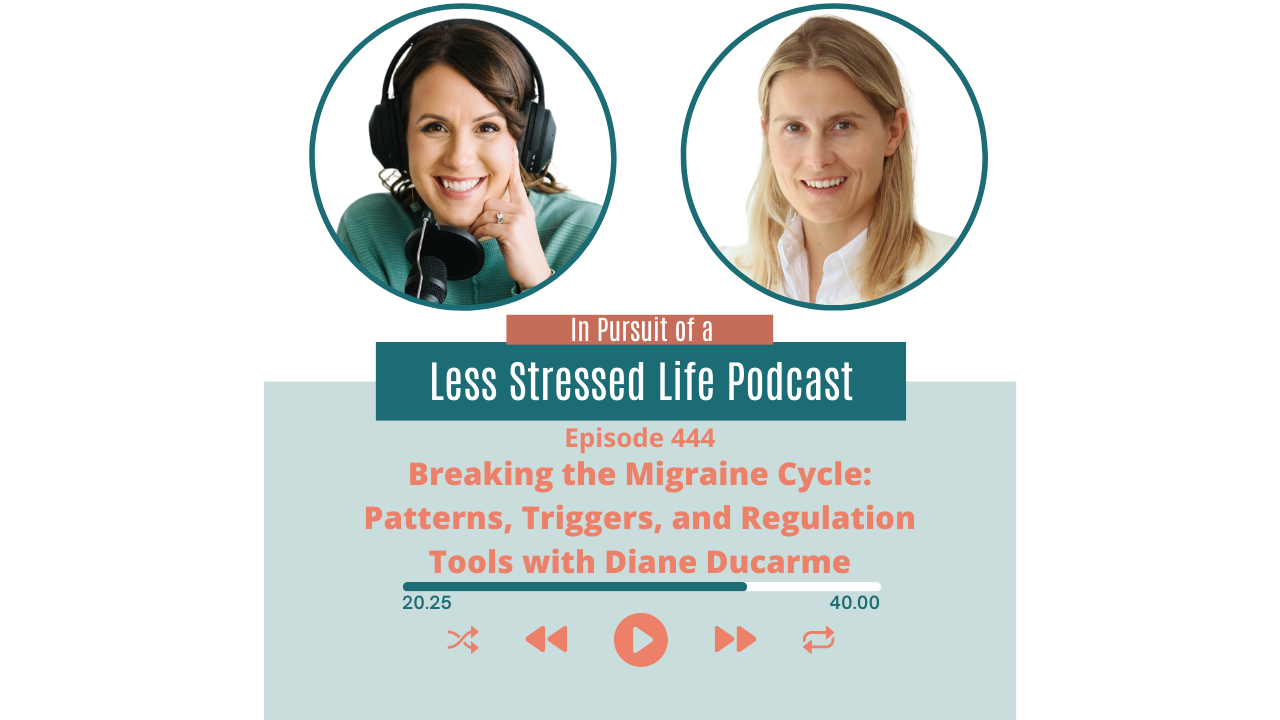
Breaking the Migraine Cycle: Patterns, Triggers, and Regulation Tools with Diane Ducarme
☘️☘️☘️Enter the March GIVEAWAY: https://www.christabiegler.com/giveaway
🚨Watch Christa's free training here: christabiegler.com/blueprint
This week, Diane Ducarme joins me to talk about migraines through a root cause lens. Instead of focusing only on pain relief, we explore why the brain goes into pain in the first place and what the body may be trying to signal when migraines show up.
We discuss how different migraine patterns can have very different drivers. Diane explains how trauma, perfectionism, nervous system overload, hormone shifts, and digestion issues can all contribute to migraine symptoms, even when life outwardly seems calm or stable.
We also talk about why many people do not recognize their own stress levels, how the nervous system can become hypersensitive over time, and why migraines are often delayed signals from the body rather than immediate reactions. Learning your personal patterns can be one of the most powerful steps toward long term relief.
Diane’s free Migraine Heroes app: https://migraineheroes.com/download/
KEY TAKEAWAYS:
• Migraines often reflect deeper system imbalances
• Stress patterns can exist even when life feels “normal”
• Trauma and perfectionism can keep the body in stress mode
• Digestive dysfunction can amplify migraine triggers
• Hormones and cycle changes often influence migraine timing
• Learning your patterns is key to long term relief
ABOUT GUEST:
Diane Ducarme is the host of the Migraine Heroes Podcast and Founder of the Migraine Heroes app. She studied Business and Neuroscience with Harvard Business School and HarvardX, and trained in Traditional Chinese Medicine in Shanghai and at the Academy of Healing Nutrition. Diane blends Eastern medicine, engineering thinking, and modern science to uncover the real roots of migraine. Through her podcast, Migraine Heroes, she shares breakthrough insights, practical tools, and empowering strategies to help people reclaim control of their lives.
WHERE TO FIND:
Website: https://migraineheroes.com/
Instagram: https://www.instagram.com/migraineheroes/
WHERE TO FIND CHRISTA:
Website: https://www.christabiegler.com/
Instagram: @anti.inflammatory.nutritionist
Podcast Instagram: @lessstressedlife
YouTube: https://www.youtube.com/@lessstressedlife
More Links + Quizzes: https://www.christabiegler.com/links
SPONSOR:
Thank you to Jigsaw Health for being such a great sponsor. 😎 Use code LESSSTRESSED10 anytime for 10% off!
TRANSCRIPT:
[00:00:00] Diane Ducarme: Now there's a third type of stress, which I've observed, which is an internal induced stress is when your body is stressed, but your environment isn't.
So there's nothing wrong with the family. There's nothing wrong with the work. There's nothing wrong with the thoughts, but your body's trying to deal with something that really stresses it.
[00:00:19] Christa Biegler, RD: I'm your host Christa Biegler, and I'm going to guess we have at least one thing in common that we're both in pursuit of a less stressed life. On the show, I'll be interviewing experts and sharing clinical pearls from my years of practice to support high performing health savvy women in pursuit of abundance and a less stressed life.
One of my beliefs is that we always have options for getting the results we want. So let's see what's out there together.
It is March and it is the month of my favorite holiday. So we are going to celebrate here at the Less Stress Life in partnership with Jigsaw Health. We created the first giveaway I've done in years, and we made it really solid. So there's four winners you can enter throughout the month of March. Just go to christabiegler.com/giveaway.
That will also be in the show notes. We're giving away four prizes, two mega bundles from Jigsaw Health with prizes worth more than $200 of all of our favorite products like Mag soThe Mag, SRT, potassium Cocktail. Other electrolytes from Jigsaw and also a 30 minute one-on-one with me, which you cannot normally get.
And then also a mineral test with review. So if you're interested in any of those one prize per person to try to share the love a little bit throughout the entire month of March, you can enter, just go to christabiegler.com/giveaway. We've got a really cool software that makes it really easy. You just click some button, subscribe to the podcast.
You can end, have more entries. Really simple. And then you'll be set to go. We'll announce the winners after April 1st after the giveaway closes throughout the month of March. And happy month of St. Patrick's Day, my very favorite holiday. So go get entered, christabiegler.com/giveaway.
Today On the Less Stressed Life, I am joined by Diane Durcarme, who is the host of the Migraine Heroes Podcast and founder of the Migraine Heroes app. She studied business and neuroscience with Harvard Business School and HarvardX, and trained in traditional Chinese medicine in Shanghai, and at the Academy of Healing Nutrition.
She blends Eastern medicine, engineer thinking and modern science to uncover the real roots of migraine. Through her podcast, migraine Heroes, she shares breakthrough insights, practical tools, and empowering strategies to help. People reclaim control of their lives. Welcome to the show, Diane.
[00:02:57] Diane Ducarme: Thank you so much, Christa, for having me.
[00:03:00] Christa Biegler, RD: Yeah. All right. I cannot wait to hear a little bit about how you got into this topic, how this became your life's work with this background of business and neuroscience. So tell us a little bit of the story of how you ended up here doing so much around migraine or I don't know if you do more than migraine, any other pain mediated things, but tell us a little bit of this origin story and how you arrived here please.
[00:03:23] Diane Ducarme: I arrived here in the most unconventional way. It was when I was 17, I had a skiing accident. I broke my femur, I lost half of my blood and I shrunk a kidney. And it took me 12 years to find a solution. And because I was working for business in different places, I worked in Oliver Europe in South Africa.
And then in China. And in China, I wanted to just try traditional Chinese medicine. I just thought I'd like to make my mind over it. I was studying it on weekends 'cause I was just curious, but I wasn't quite convinced. I thought some of the concepts were a bit esoteric. And my doctor, Dr. Jang, who I love, she's 70 plus, she's retired.
We still work together. She fixed me within three weeks and I was not even trying to get fixed. I was just so unwell, but completely passed. When you've limped for 12, 12 years and you just accept that this is now you, this is the new version of yourself, except she put me back in place to where I was when I was 17 and later in 2015, a couple of years later my uncle died of a brain tumor.
My sister took me apart, one of my sisters, and she said, look, I'm very concerned. I have these migraines for the last three years. I've done a couple of MRIs. And I don't dare say anything to mom, but I think I might have the same. And I told her, look I don't doubt that you're in massive pain. But, maybe it's not that, maybe it's something else.
And especially if they haven't seen anything with EMRI, but she's I don't know what it is. So I said to her, I know someone. And together, we did a really long call with Dr. Jang and after three to four months she no longer had migraines. Dr. Tan was just adding foods and I loved that model and I thought, wow, this is quite cool.
And so this was 11 years ago and, and and I didn't think much of it except four years later, another friend of mine says the same, and she says, I have migraines. I've had them for seven years. I suffer every month. And I say to her, I'm so sorry, I didn't know. And she says, I'm not trying to advertise that at all.
I try to hide it actually. And my father recommended I have a lifetime of injections in the brain. And I told her what injections in the brain that sounds, no, that sounds unreasonable. Why? Why would he recommend that? And she said actually, he's a neurologist based in New York. And I thought, oh, okay.
But still, 50 years of injections. I understand you feel devastated. Let me try to ask you a couple of questions and figure out if we can find why your brain is in pain. And three to four months later, she also no longer had migraines. And I really thought, why, her father's clearly very smart, clearly very educated, and clearly a loving father.
Why would he not tell her what to do? So some of the foods I must have recommended her must be very close to medications. So on my weekends, because that's how you know I'm very nerdy on my weekends, hard to search for all of the medications that he was recommending. And on with foods that she had been consuming, imagining that they would converge and have the same chemical compounds.
And what I discovered was absolutely insane. I discovered that she was taking, she was gonna take painkillers, so thing to silence the pain. And I thought, oh, what I wanted to give her was things to address why the body was in pain. A bit like if you hurt your knee and you go to your doctor and you say, my knee hurts.
I broke it. And he was suggesting a lifetime of pain killers. But you might say, Hey, this is your knee. Maybe we put a bandaid over it. Maybe you stop walking for a while. Maybe we swell it and maybe you get operated if you need to. Yeah. And and that's what happened for her. And it was so life changing that I started to look it up a little and I saw it was 18% of women in that scientific paper.
And I thought, what one in five women? It means one in five, my friends, and start to recollect all of these conversations. And then I saw walls and walls of pain and. I really thought, wow, this really doesn't make sense. All of these people are in pain and they're taking more and more medication and being more and more in pain.
And I fell into a very compassionate love of these people, completely suffering, being bed rested. And I called a couple of my friends and said, I remember you mentioning you had migraines. You still have that mandate more than ever. I don't know what to do about it. And so that's how I unnaturally got into it.
[00:07:34] Christa Biegler, RD: Yeah. I am so curious, which is how this show really thrives is, I just have lots of questions about this. So I think that the provider that you were seeing, and you were in China, it was Dr. Jang you said, right? So was she a traditional Chinese medicine practitioner?
[00:07:51] Diane Ducarme: Yes. For a couple of generations.
She had written eight books. And as a teacher, I was like, okay, ah, on me. I thought, oh my God, I'm like back 12 years, ago. And I don't know what you did. I don't know how you did it, but this feels Yeah. Incredible.
[00:08:05] Christa Biegler, RD: So I'm curious about this because very often when we think of traditional Chinese medicine anytime we hear certain words, we all have stereotypes on what that means.
So one stereotype or piece of information that I've had from other people trained in traditional Chinese medicine on the show is that a lot of. The modalities and treatments that are being used are from ancient research, right? So all these different healers would collect all this data and bring it together, and they would say, here's the patterns we see with this condition overall.
The other stereotype might be that there is a lot of different herbal remedies put together often, et cetera. And I'm curious if there was other modalities. 'cause even the way you describe it, you say, oh, a very long call with my sister and Dr. Jang helped her a few months later. So would you say that there was multiple modalities at play with traditional Chinese medicine?
So I'm describing how I've heard some of it integrated into people's lives. But can you share some of the different types of modalities that are at play? Because you mentioned adding foods or adding specific compounds. So can you talk to us about generally the different modalities that you were working with for traditional Chinese medicine?
And then we'll get into some of this pattern things. Because when I look at some of the questions that you brought today and some of the questions I have, I think we have something in common that we like to look at, patterns that we see. And I hear it even with your own curiosity of doing your own.
Essentially anecdotal research with friends. So will you tell us a little bit about how this sort of played out with the traditional Chinese medicine model?
[00:09:34] Diane Ducarme: Absolutely. So usually in traditional Chinese medicine, you have acupuncture, which is a big part of it. You have herbs and then you have food, and food and arguably movement with date, et cetera.
Food is something that is a bit led to the side. For reasons, a bit like in the West. I don't know, it's just been led to the side. But what happened is that in the case of with Dr. Jang, I told her, I don't know. I can, I think I can trust you, but I can't trust all of the herbs of China. So I would like to go with foods and she said food is a bit slower, but it's really deep acting if you're disciplined.
And so when you talk about validities, indeed there is. A truckload of possibilities as to why the brain is complaining In Western languages, when we see a migraine, we designate the brain linked to every single organ and part of your body in a complaint mode. Trying to say something now. When someone says they have a migraine, they might see something very different than someone else.
Let's take some examples. We might have someone who's gone through a traumatic childhood an abusive parent, et cetera. And from there I started to have occasional headaches that over time in puberty transformed into migraines. And they have more and more. Here we're gonna have a certain domino effect and we're gonna have a certain types of migraine.
We might have let down weakened migraine completely related initially to the nervous system that then tripled and trickled into more complicated forms of imbalances. But we might also meet someone who. Had occasional headaches in their life, just occasional. And then perimenopause start to have more and more migraines and then terrible in full menopause.
And so they have constant dizziness, vertigo, aura inability fog, inability to focus. And so these, we both be called migraine, but they will correspond to a complete different root cause, complete different modality. It needs to be addressed completely differently and hammering these two people with the same treatment would not be acknowledging the difference that makes their makeup.
[00:11:44] Christa Biegler, RD: I'm smiling because it's very funny. I love, I think that we should all be looking for patterns and common denominators. And when you talk about, I'm gonna talk to you about types of migraines here in a moment, I'll you classify them, but similarly I have the same thing with skin issues is that we tend to treat.
Everything the same, and it's like it can be presenting differently. And so when we give it a type and we give the body what it needs in that unique way, we're much more successful, much faster. And so it's like the skin is complaining, or you're talking about the brain is complaining here as well. Yeah.
And I'll just mention one other thing before we get into these types of migraines a bit. I like to think about every condition or symptom. Through the lens of this health triad. And so I imagine a triangle and there's like a nutritional chemical component. And so I think of that being the food and the herbs of traditional Chinese medicine.
And then there is a structural, environmental, or physical component. And I like to think about the acupuncture there. And then there's often an emotional energetic component. And you didn't. Mentioned that too much yet related to migraines, but I think it's probably, what I have learned in time is that it tends to be a big driver of pain mediated conditions in general.
So we'll get into that in a bit, but I hear those similar, those correlations or those similarities between these different conditions?
[00:13:02] Diane Ducarme: Absolutely. And your listeners will listen to that and think immediately. When I think of food, I can have so many triggers like wine, cheese, chocolate, histamine.
When I think of environment my house is a bit damp or when the climate change, when the barometric pressure changes, I have more migraine. Or I think when the summer hits, I think when it's really a bit hot to have more migraines. I'm not sure. And then emotional. Each time I'm stressed during that stress period or after that stress period I have more migraines and if I manage to work less or feel happier at work, then somehow I can reduce that intensity and frequency.
And so they will completely not articulate it as beautifully as it just did. And I love your framework, that triangle framework. I think it's superb. It's just exactly that. It's is that emotions like stress, but not just stress. There's. Other emotions we talk about that can also lead to more migraines.
[00:13:55] Christa Biegler, RD: Yeah. And you just brought something up as you talked about that in a very resonant way. Something that had frustrated me for many years working with people with pain mediated symptoms is that they can be delayed, like you said. So I have this stressor whenever, and then a little bit later I have the onset of this.
Migraine or headache or whatever. Absolutely.
[00:14:16] Diane Ducarme: Absolutely. Can I give you one example
[00:14:17] Christa Biegler, RD: Please.
[00:14:18] Diane Ducarme: Do sometimes women will put a mi IUD Let's imagine someone who's bleeding and lost, retired and puts a mi IUD and ha no more bleeding and feeling good. Yeah, and that's great because the brain is 400 miles or 565 kilometers of blood vessels.
And so if there's not enough blood, we can be in pain as well. We're definitely very fatigued. Let's imagine that woman, she's so happy, she now has her migraine IUD, except that when she menstruate it also a time when her toxins evacuate her body. And over time, as she has migraines, she also medicate for them.
She's going to build up toxins inside of her liver, and so over time, the migraine IUD will cause a difference in environment in her body that will cause migraines, except that just as you said, because there's a delay. She's gonna feel it's the cause, but the doctor might say it's not the cause, and so she's gonna still trust her intuition and insist to remove it, except when she removes it because there's a trip trickle down effect.
She still will have migraine, at least for a certain amount of time, so she no longer feels she can trust her. My, do I just mention doctors? Doctors are incredibly important to diagnose migraines and and always, follow the treatment with your doctor. That being said the intuition of the person is paramount because it's like your dashboard is saying something really loud and it needs proper listening.
[00:15:45] Christa Biegler, RD: Yeah. I appreciate this. I think we're pretty aligned because that's my entire shtick these days is that all symptoms are signals from your body, so it's a matter of figuring out what the signal is. Fortunately, for anyone listening, there are typically patterns that we see with these signals, and they're not all the same for everyone.
There's always options for everyone, but there tends to be patterns. So I'd love for you to share with us. You mentioned a type of migraine type. A few moments ago, so I wouldn't mind if you would share some types of migraines, but also wanna invite you to talk about patterns that you see. And you've done a nice job of bringing those in so far.
So for example, in the work that you do, you support many people with migraines. And the beautiful thing about supporting people with the same set of symptoms as you start to see patterns. And so it sounds like you have seen some patterns. That aren't what you would find on Google, that don't always show up in the clinical setting. So while you're telling us a little bit about types of migraines, maybe there's some room to talk about some of the patterns that you see with migraines in general, in your clientele or in your work so far.
[00:16:56] Diane Ducarme: Yeah, absolutely. And indeed you're right.
I've been doing this since 2019, every single day. Maybe you've captured that by now. I'm a very serious nerd. I also speak a few languages and I find that migraine is also a form of language. So it's really about the pattern recognition, what is the brain trying to see? And I find people are incredibly good at really describing their pain, even though oftentimes it's not validated.
Let's talk about different patterns and different trajectories of patterns as well. Let's start given more on the less Stressed Life podcast. Let's start with stress. And in particular, I want to go slightly deeper than stress. We're gonna talk about stress and about trauma.
If we have a person who suffers trauma in childhood there will be two things essentially happening. The first one is that. They're gonna have their kidney system really depleting very fast. So when you're born you are born with a kidney bucket and in your kidney bucket the whole goal of life is to keep it full.
Some people receive a large kidney bucket, some people receive a small kidney bucket, but essentially your kidney system. So if I see she in Mandarin, I'm not designated just the two pieces of flesh at the bottom of your back. I'm designating your kidney. I'm designating your. Bladder your adrenals, therefore your resilience to stress.
I'm designating your sense of smell, your sense of hearing. I'm designating your ovulation, your hair those different aspects. Your neck. Yeah. Your, those different aspects of the body. Why? Because in traditional Chinese medicine, they. An organ is a bit like a football team player. He can't and pass and score and defend.
It's the team that does the job. If I take the ends two kidneys and I put them to the side, they don't do any magic. The magic comes from the operation. And so the, working together. And so if I go through trauma in my life, basically I have two modes with my vagus nerve, a nerve of rest and digest, which should be my default mode and a mode of fright.
Flight fight. Yeah. And my kidney system and my nervous system is gonna go in that fight flight mode more, and I'm gonna start to deplete my bucket. Okay? Now I have another way to refill the bucket by eating certain foods, but at that stage, because I'm in an extreme state of trauma, which I'm a victim of in that moment as a child, my kidney bucket is gonna start to deplete faster than is being replenished.
And the more. I am stressed, or the more my kidney system is depleted, the more I'm gonna be stressed and vice versa. So in the West, we've understood quite well. Now the gut brain axis and the bidirectionality of the gut brain axis. The emotion to gut axis is also bidirectional, meaning the more I'm stressed, the more I deplete my stress reserves.
The more I deplete them, the more I'm prone to stress. And I start to enter a vicious cycle. Now that's gonna start to tense up my body. So I'm gonna start to have, think of the migraines that are more neck related, shoulder related more sensitivity to smell when I have a migraine sensitivity to noise when I have a migraine.
More, more this kind like jaw tension teeth grinding these forms of migraines. Now there's something else happening, which is absolutely fundamental, is that meanwhile I'm stressed. I start to learn to be in that stress mode more and more. I no longer rest and I no longer digest.
Very big deal because if I don't digest. Of course I still eat. It means that the food entering my gut starts to be unprocessed. So even if it's beautiful food, it's really well curated food, and I'm a saint with what I eat. How it is transformed by my body is intoxicating. I'm gonna start to have a weaker stomach spin, weaker gastric juices, di digestive enzymes.
I'm gonna start to create a biome of a much less noble matter than I should, and that biome is gonna start to give a birth for sibo, candida mast cells, et. Essentially a bed where histamine can lodge the self. Yeah. Which is a big migraine trigger. And then I have set a ground that is incredibly hard for me to come back from.
And if I add medication on top of that to try to manage the pain or manage the anxiety. Manage the sadness. Let's face it, these lives are incredibly hard to lead, right? And people and listeners, they're always doing their best they can to power through the day, to love their loved ones, to show up at work to push through to try to show that they're fine when they're not, because showing their weakness.
Doesn't serve them well necessarily or quite terribly in society because society doesn't recognize that invisible disability. And so as they medicate, they will intoxicate their liver, which is gonna have ramification again on the kidney system and make it weaker.
[00:22:00] Christa Biegler, RD: Yeah.
We're pretty aligned here in general. 'cause you're talking about supporting the physiology of systems and I find that. Has been of best service is to walk through it. It totally makes sense that this kind of toxicity builds up in general. But I wanna zoom in on something you said. I've never said it quite like this, so I appreciated this.
So while stressed, I learned to be in stress mode and I know longer rest and I no longer digest. I always joke that you can put on my. Tombstone no one was digesting. And even the best food isn't really supporting us in that state. So what I wanna focus on is while stress, I learned to be in stress mode.
So the challenge I see very often, so there's a physiological downstream effect under stress. We deplete all kinds of nutrients and we no longer digest and absorb nutrients. And essentially lots of things break down or you add more burden in general with. Life, medication, whatever it is. But I wanna talk about this when I learned to be in stress mode, and I'm gonna ask you a question that kind of has had.
Plagued me in general for years about people not really resonating with the word stress or not really feeling like they're stressed. And I think when you said, I learned to be in stress mode, it becomes this normal. All the time. And so what would you say about someone that is dealing with unrealized stress or someone who doesn't feel like they're stressed?
'cause maybe they're high performing and which is a lot of humans, right? You just keep going under stress. And so what would you say about helping people identify their stress patterns or become more open to those so you can change them?
Over half of us are not getting enough magnesium, which is responsible for thousands of processes in the body. But how do you know if you'd benefit from magnesium? What visible signs could you see? Here are some cases where I'd want you to start thinking maybe I should try magnesium for that. Now, let's say you wanna get in some good deep sleep.
Try a high quality magnesium 30 to 60 minutes before bed. If you have any inkling of a headache or even just to relax, any of those premenstrual cramps or muscle tension, especially post-workout, magnesium would be a superstar for filling in those gaps. Now up to 600 milligrams for that headache. If you're finding your heart racing with caffeine or with stress, then for sure magnesium's calming effect could be helpful.
But if you're dealing with eye twitches or restless legs, you're past the point of as needed. These are major red flags that you're probably depleted in magnesium. The good news is you could absolutely fix it, but it might take a few years to really fully replete those magnesium stores. But here's the deal.
Don't stop when the symptoms stop. Just keep going to replete it even further in any of these cases. I love jigsaw's mag, SRT because it allows you to take a higher, more effective dose without any laxative effects because it's got an eight hour time release. That's what the SRT stands for. It stands for sustained release technology.
It's the only time release magnesium with a human trial on the market that we know of. This is helpful to get all the benefits of magnesium throughout the day or throughout the night depending on your need. You could take it at both times if you want. And it's Meg Sr T's 20th birthday this year. So you can celebrate by getting yourself some Meg, SRT with the discount code, less stressed, [email protected].
You can use less stress 10 to get a discount on anything you want, as many orders as you [email protected], including my favorite potassium cocktail and cod liver oil. So go check them out and we just appreciate them sponsoring the podcast so much. So when you support them, it supports us.
[00:25:43] Diane Ducarme: Yeah. So indeed, if you've grown up that way, you will not know that you can live a different way. You only know your pattern. And indeed it can come from trauma, which would is one way, but it can also come from an angle, another angle of stress that you've mentioned, which is perfection. If I have grown up with very demanding parents, I have a tendency to try to be more perfect.
Now, there's three types of perfection, externally induced, but can be also internally induced. I'm trying to just comply with what society is trying to give me, or can't remember the third one now, but there's different types of, perfection and so you try to mold a certain way, and so you put your state.
Of being in a constant under constant pressure, which is less aggressive, but is more pernicious because it's a 24 7 pressure that you put on. Now, when you do that, you will put the system in strain, and so externally speaking, you're gonna look extremely efficient, always on the go, requiring very little sleep.
In fact, you are actually from A TCM perspective, you're restless.
[00:26:59] Christa Biegler, RD: You
[00:27:00] Diane Ducarme: are not always on. You are unable to switch off. It's a very different notion, but they're equally draining. Now, ultimately, you will collapse. I sound dramatic when I say that. Ultimately in one way
[00:27:12] Christa Biegler, RD: or another you'll have some symptoms.
[00:27:15] Diane Ducarme: Ultimately your system is gonna say, okay, now we're out. You've burned everything we have, there's nothing left in the tank. But it can be a different way. Now there's a third type of stress, which I've observed, which is an internal induced stress is when your body is stressed, but your environment isn't.
So there's nothing wrong with the family. There's nothing wrong with the work. There's nothing wrong with the thoughts, but your body's trying to deal with something that really stresses it. So there's all sorts of migraines also related to cycle. Some people have their migraines at time of revelation.
Some people before the menstruation, some people during the menstruation, some people after the menstruation. For some people, it's whether related, not one type. Is when during your menstruation, that usually for us indicates there's blood clots, fibroid, or unwanted tissue in the body. And I remember vividly this woman who had expelled I suspect that she had a few things in her uterus.
And so that uterus to brain relationship, we always talk about the gut brain access. There's also a uterus to brain access. That uterus to brain access was signaling a problem there. And she expelled a block clot the size of a baseball. I had to fool what a base ball because I thought I must have the wrong ball in mind, that it must be my French mind.
But no a really large ball. And she said, you know what? Of course my migraine stopped, during my menstruation, of course it stopped overnight. I really felt like I dodged the bullet. But the other really interesting observ. As I am much less stressed. She says, I had quit my job. I had done so many things, and yet I was still stressed, and I don't think it was her being stressed, it was her body.
So it can come from trauma, it can come from external pressure that is temporary, in which case you'd recognize it. It can come from being type A, in which case you might not recognize it because this dates back also from childhood and it can also come from inside the body where the body's thinking every single day.
How. Am I going to get rid of this problem? And when you have a blood clot that size, it's not something that you can see with an ultrasound. It's something that your brain will indicate is happening, and that by addressing you expel very naturally. But you need power and you need your uterus to have what it takes to do such a huge job.
[00:29:28] Christa Biegler, RD: Yeah. I wanna underline a few things that you said that. We don't always recognize stress, but if we resonate with this tendency to want things to be. we never feel like something is good enough, right? That might be a version of perfectionism or type A or this constant narrative of how will I get rid of this problem?
It's so understandable. It becomes this loop, of course, In the entire brain. It fuels the entire migraine cycle. I'm curious about the woman who expelled the large blood clot. You described it a little bit, but was there something that happened right before?
Was there some kind of modality that supported her in. Expressing that. 'cause I'm a curious person and I am like, yeah, good grief. How did that
[00:30:09] Diane Ducarme: even Yeah, good grief happen. Exactly. In the Migraine Heroes up we have a tracker and there's a number of things we track and we look at, namely, how is this cycle in comparison with the migraine?
And one of the patterns is for these women who have migraines during menstruation. Usually it's a sign. There's either a fibroid, a clot, an unwanted tissue. It doesn't have to be really large. We've had some people have it very large some people very small. But the brain will equally complain that when it contracts to expel the menstruation a.
It is struggling to expel everything it wants to expel. And so that's gonna induce more pain, more contractions more blood loss that is required. You could have someone who's very depleted, very pale, very iron deficient, yet it's gonna have really heavy menstruation and kind of not understanding why her body is quote unquote so illogical.
Her body's completely logical. You remove these blood clots and usually, the next menstruation is just slightly less. Then as her blood builds back up then she goes back on her feet. A woman will lose 23 to 28 liters of menstruation in her lifetime. That is a lot of physical matter that she needs to reproduce.
So it can be very exhausting if you lose on top of it double the amount because your uterus is quite
[00:31:27] Christa Biegler, RD: right
[00:31:28] Diane Ducarme: trying to clean itself.
[00:31:29] Christa Biegler, RD: Yeah. Okay. I wanna ask a little bit, you say that vagal tone can explain why everything becomes a trigger. So remind us about vagal tone and why the state of your nervous system can make anything a trigger.
[00:31:48] Diane Ducarme: So I like to think of the vagus nerve as this massive tree inside of your body. I like this analogy a lot, where that tree's gonna plant its roots around your heart, around your lungs, around your smaller intestine, around your uterus. And these roots and ramifications will form larger roots along your spine, and then a bit of a trunk in the neck.
And then they're gonna plug into your brain just electric car, and they plug into your brain via the trigeminal nerve. Comes a big mystery. So in the west we have a lot of ego. Very male dominant culture and we don't like to see when we don't know. So if you look and anything about the biggest nerve is gonna describe what it does neck and below because neck and be below, I can see it.
The biggest nerve was discovered 200 years ago because if you dissect a body, you will find the vagus nerve. However, the way it plugs into the brain still has a lot of mysteries. So beautiful years of neurology in front of us. And so the biggest nerve still plugs in all of these cables, but we're not sure how, and this is where working with east and West, you can start to use what do we know from a Western perspective, and then what we have as hypothesis from the Eastern perspective?
And so that vagus nerve, if it's constantly activated, it's constantly constantly overworking then becomes hypersensitive. And you can indeed have people who've been so stressed with such a weak therefore stomach's been overthinking that this starts to be. Sensitive to all sorts of emotions of other people.
So they can be at a restaurant and they hear a couple fight next to them and they can feel. All of the fighting if someone makes a nod or a funny comment, they can feel what the person's not saying. So it's this sort of hyper EQ that penetrates them and they can't shelter themselves from.
That's also when , that to some extent that vagus nerve has done damage beyond its control. Yeah.
[00:33:43] Christa Biegler, RD: I think that's probably gonna help someone listening feel so seen, right? When they can be, I always called it, and there's probably different ways to describe this and different levels, it's almost like this empath energy, right?
Where you absorb other people's energy. And I can resonate with that to an extent. I was pretty unprepared for the amount of emotional work, and I think I will say that about most physical practitioners. When we go into the medical field, there is not a lot, not enough. There's certainly more now about nervous system work and trauma work, et cetera, and I, what I will mention here is that it's a real gift when you can find someone to support and to help you when there's an integration of the entire health triad that we were describing.
Because very often you're going to need to assemble someone in each corner quite. Most of the time, right? Because we're just not, we work a little bit in silos in medicine typically. At least in the western, cultures. And so it's very common that these would be separate silos and quite honestly, they're very connected.
And I think the longer, if you really. Or someone like you or someone like me who really loves patterns, you can't stop seeing that there's more that there's these other patterns as well. So I'm curious about, you haven't mentioned too much, you've done a beautiful job talking about different, types of perfection and some different.
Types of stress and how we can Yeah. Realize this, but how do you start to, generally handle trauma, nervous system opportunities, et cetera, in your work with migraine clients?
[00:35:24] Diane Ducarme: Yeah. It's a very good question and it's a very complex one. I love when you ask and or you talk about, in Western science you see these different professionals.
My experience is that when you do that, you may have experienced that. I do one professional and I fix sort of one thing, and then I go to the next one. I start to fix something else, but then something else. Pops up or the previous one is done again, and I have to almost start again. When you repair a system you repair systems they're interdependent.
So you have to go and boost each one and turn, but then come back to them. You can't say, I'm gonna take my kidney system and go from zero to a hundred. That would create so much damage. And if you feel very depleted and if you feel you, you've had a nervous breakdown, replenishing your kidney system head on might really create a ripple effect that causes other problems and potentially more problems and more migraines is how you would know.
And so you have to really take all of these sim systems one by one or two by two and boost them until they all become better version of themselves. It's a bit like you're the CEO of a new company and the company is underperforming and has a really low culture. And everyone's a bit down and not excited about their work.
You can't come in and say, okay, I'm gonna fire everyone and I'm gonna hire everyone. 'cause that's gonna break down the entire system. You have to say, okay, who are the toxic people that don't really have a job and really annoy everyone? Okay, let's get rid of them, those first. Then who are the key positions that should be replaced?
Okay, let's fire those, but immediately replace them with someone else. Okay, now we have a better culture. Let's train everyone. Let's give more budget more. Trainings. And then okay, let's go to the second layer, et cetera, et cetera, until you find you have a really successful and thriving company.
And with the body it's very similar. And so you're gonna go systems by systems or two systems at a time and nudge them or repair them. And there are certain things you can't do before you do others. That adds complexity. Also with foods, I think people don't understand that some foods, while they repair something, they can damage something else.
So for example, if you've had a lot of surgeries and you have left side migraines and maybe you have occasional blood clots, turmeric might be a good idea. But if you have dizziness and you're impairment post turmeric would actually. Increase the dizziness, increase the aura, et cetera, because it also comes with a second life force that actually would not benefit you.
And so another food should be selected instead. And I think this is what leads unfortunately to a lot of confusion and therefore to a disbelief that nature doesn't really have what it takes to help us. I'm here to say it's not true. It still has everything. It's still as glamorous as ever and we're still really old species that require very simple ways to
[00:38:19] Christa Biegler, RD: yeah.
[00:38:20] Diane Ducarme: Solve our physical beings.
[00:38:23] Christa Biegler, RD: Yeah. I have one another question that just comes from curiosity. As I think about, we talked about the pieces of traditional Chinese medicine, which I think informs some of your work. I think based on the experience Absolutely. Of stories that you told.
[00:38:36] Diane Ducarme: Yeah. maybe I want to emphasis on that.
Basically, at Migraine Heroes, I'm not, dogmatic or anything. Just whatever. It'll bring you from A to B.
[00:38:44] Christa Biegler, RD: Yeah.
[00:38:44] Diane Ducarme: Regardless of beliefs. And yes, I find that traditional chain missing is bringing a lot to the table. And when you augment it with proper Western diagnosis, then it's a complete gem.
[00:38:54] Christa Biegler, RD: Yeah. Fun. So I wanna hear a little bit about this topic that came up in my brain and there was something you said at the beginning. That sort of prompts you in this, when you went to Dr. Jang, you said, she fixed me in this amount of time, and very often we go to someone to fix us. When ultimately your body is healing itself by you getting the tools that it needs.
One of the tools that you talked about was acupuncture and in your work right there, I can understand where you. Bring in some of the tri traditional Chinese medicine pieces. Now, something interesting about acupuncture is it's, I think it play as many things do. It plays into a couple parts of that angle of the health triad.
It's we consider it to be this physical intervention. But it does largely impact the emotional energetic quite a lot. I'm curious. Because I would assume in your work you are not doing physical acupuncture with people. And so how do you plug in some of that? Or how do you get some of those benefits?
Or does that part just not used in some of the ways you support people? And this again, just my brain being curious. Because we often think like absolutely someone we're gonna have to go to someone to be able to get the same benefits. I'm curious if you're bringing some of those benefits from acupuncture in a different way in your work.
[00:40:12] Diane Ducarme: Absolutely. That's a terrific question because I get that quite a little bit. When people come and if you think of a woman versus a man, a woman in her lifetime is gonna lose. We talked about this, 23 to 25 liters of blood, and she's also going to produce 1, 2, 3, 4, 5 children. And so it means that by the time she hits her forties, she's produced about half of her weight in physical matter.
A man doesn't go through as much. Yeah. And so for a woman, she is a lot of physical matter. If you've produced, I dunno, a solid 30, 35 kilograms of human matter, you really need to reiterate yourself. And I find that. Women have so three to four times more migraines than men that a lot of the migraines have to do with physical matter.
A lot so I would say than movement. Now with food, you can also create movement. So if, for example, let me give you an example that is really concrete. Let's imagine a woman who's bled a lot. Yeah. She had just had heavy menstruation for a long time. Her brain is just gonna crave for blood volume.
She might be diagnosed as iron deficient or having too low ferritin or being borderline, but from a traditional transmitted scene perspective. Even though that's very precise, it's still not completely accurate. They would talk about having a full blood volume deficiency and replenishing the blood, and by having more blood, you can end, think and digest.
If you don't, your body has to arbitrage, and this is when it can start to complain. So if you have that wine, cheese, chocolate, then the blood goes straight into your liver for digestion. And then your brain doesn't have enough power to function. Yeah, and it's gonna start to complain. So if you take a triptan, which is a type of medication it's gonna constrict your blood vessel and force them back into your brain and give an impression of enough.
But the problem is very chemical as you can feel. If I do acupuncture on a body like that, I can momentarily redistribute the blood equally. But I can't really restore or regenerate the blood itself. And there's a lot of patterns like that for women, a lot. And so I find them a lot more chemical than their physical usually.
And even then. You can act with certain foods in certain meridians and certain parts of the body. Now that being said in the Migraine Hero app, we have this migraine now button. So over the course of the years we realized not only could we prevent migraine attacks, we could also teach people to stop them in their tracks.
And I've learned that from the people I was working with who would call me. Initially it was still on WhatsApp saying, oh, I was starting to have a migraine attack. I started to feed Tinging sensations. And lys in my right arm. I closed my curtains. I called my husband, cancel all of my appointments for the next three days.
I had one of your last infusions before going to bed because God knows when I was gonna eat next. And by the time I reached my bed, I was like, what? I swear I had one. Where is it? I have no pain. And then over doubts that this saves three days of their life, they start to text me. And so it happens quite a lot.
We've created the Migraine Now button, and that button is the fourth generation now is really to aim to teach you how to stop a migraine which is incredibly difficult because it's incredibly personal, so we have to dig into account weather and your situation and emotions, et cetera. But it's quite good.
And so one of the things I want to add is acupressure, because acupressure can also be self-administered and can help. In a certain moment of relief. So for example, if you touch the back of your skull, you have these two little balls at the top of your neck. They're called gallbladder 20 millions or wind pools.
And for some people just massaging those can be, can bring a really massive relief. So in that regard, yes, through the app we can still access it, but I do find that acupuncture is usually more useful after us, not necessarily before. If you have, for example, too many toxins,
[00:44:19] Christa Biegler, RD: yeah,
[00:44:19] Diane Ducarme: that your liver is completely behind,
[00:44:21] Christa Biegler, RD: right?
[00:44:21] Diane Ducarme: Yes, you can stimulate the liver, but chemically you can do so much like you can make it so efficient, especially when you have that power from your home to actually do that to yourself, understanding intellectually what you're doing, and so having that power, it means that when you're on holidays, when you're at work, when you are just having dinner and suddenly need hits.
Knowing what to do in that moment gives you control. And that's what we're about, is like the control and the joy to teach you your patterns. Like I can see Crystal like you're so smart and you can see a zillion of patterns in a single human. Here we're trying to say, Hey, you don't need to know the zillion, but we teach you yours.
So that in that moment you can feel empowered and you can feel. Free. You can live again, you can choose, do I stay or do I go. I don't have to not go to this party or stop being at this party because I'm in pain. I can actually stop my pain, reset and continue.
[00:45:16] Christa Biegler, RD: Yeah. Something I wanna highlight that you just said was that acupuncture works better after people, I will say recalibrate with some of the other work.
Because so often. We are driven to get help and especially we have been maybe dealing with something for a long time and sometimes we maybe even given up hope, but we'll try another thing. 'cause that's what happens when we have symptoms. And so very commonly, there's a lot of imbalance in the entire.
Biology of the human right. And so when we bring back or restore function to that biology of the human through different modalities, then something like a one-off thing, a simple thing like acupuncture pressure may be more supportive, right? Otherwise it's just a piece of the entire puzzle, I would say.
And so that makes a lot of sense to me. If you can get back to a much more mild place, it's gonna be easier to course correct. Typically. So I love that. I think you know, our job as clinicians if someone's listening to this as a clinician, our job is shifting to be able to help people be more empowered instead of, I find that if we create a system where they rely on us forever, that's a very disempowered state, and that was very unenjoyable for me.
I saw that a lot of times when I was working. In more heavily in one-on-one for many years is like people thought I had all of the patterns. Only I could, tell them what was wrong. It's like you have the control over your body, right? Like you have autonomy and you can regain autonomy and control over your body.
So it sounds like we're also very aligned there as well. Whenever we're in a podcast, we wanna make sure we have some tangible things someone can start to do today. And so what would you leave people with? If someone's struggling with a migraine or a pain mediated condition, or someone who just wants to break this stress pain loop, like what would you say to that person for something that they can do today?
What are some of the first steps that they can do today?
[00:47:05] Diane Ducarme: Yeah, so one of my favorites is like to make an infusion in the evening which is a kaile and GOGI bears infusion, and here's why. The Kaile is gonna do two jobs for us. It's gonna stimulate my liver and it's gonna detox it. So I love it. It's also very inexpensive and it's very, you can find it pretty much everywhere, anytime.
Now the Kaile also does something, a little note here. It's gonna cool down my digestive tract. I don't quite like that because it means if I was having too much, unless I overheat all the time, I would start to have a weaker, large intestine and start to have a bit more loose tools and ultimately diarrhea.
So I would've solved something, but then I would've created myself another problem. Now, if I add goy berries to it, goy berries are an adaptogen. It really. Beautiful sweet little berry that is elongated. Think of it like a raspberry means a strawberry in a very small format. And and that beautiful go Berry is gonna be able to do six jobs for me.
It's gonna stimulate my liver and detox it just like the ERs, but in addition to that, it's gonna feed my kidney system. It's gonna increase my yin. We haven't talked about. It's gonna increase my blood, it's gonna remove inflammation, so it has that power to address excesses in deficiencies. Plus it's neutral to slightly warming in temperature, so it's gonna come to balance the temperature of the kamile, and together they're gonna address a lot of different root causes that can come from migraines.
And so you can have that in the evening beautifully as you sip it Now. It's not because it's food and it's natural that it can be harmful. Do not have this beverage when, first of all, you're menstruate. When you're menstruate, your body needs to detox and there's no point in stimulating the liver. Nobody knows exactly how much it wants to bleed.
And if you were to have it, you would notice that you would bleed more. You don't need to bleed more. Yeah. So when you have your menstruation don't have it. Number two, if you are having an IBS like proper full blown irritable bowel syndrome and you were put on a FODMAP diet, know that kaile and goji berries contain fructan, and fructan is one of the FODMAPs.
And so you would immediately notice that when you sip it. You would feel bloated if you would feel bloated. Your body's just politely declining the invitation. Don't push it. Okay. We damaging something. There's no point. And also, last but not least if you're pregnant it's probably not the best time to have such a powerful tonic on the liver, like a powerful detoxification Nutanix.
So just refrain from having something so potent even though it seems very inoffensive when you're pregnant.
[00:49:52] Christa Biegler, RD: Yeah, that was fun. Thank you so much for sharing that. It's always fun to hear something different or new. Diane, where can people find you online or learn more about the things that you offer?
[00:50:03] Diane Ducarme: So Migraine Heroes is a podcast, migraine Heroes is an app and Migraine Heroes website.
[00:50:09] Christa Biegler, RD: Yeah. Thank you so much for coming on today. I really enjoyed our conversation and our alignment. I think there's this beauty when you see similar patterns in the world or you find that other people are gravitating towards some similar things or themes or patterns in general.
So it's just very fun to talk about this through a different lens with you.
[00:50:27] Diane Ducarme: Absolutely. Christa, I'm sure we continue after this call since we share so much interest. Thank you so much for the work that you do, for the light that you bring. In a, sometimes a very cloudy world.
[00:50:38] Christa Biegler, RD: Yeah, for sure. Thank you.
[00:50:40] Diane Ducarme: Thank you.
Do you need a detox?
Getting "too old" to handle alcohol?
Sensitive to smells or metals?
Skin issues?
Detox isn't just juice cleanses & snake oils. It's a process that our body is trying to do all day long.
Take the quiz to find out if it's time for a detox.


